It’s a-l-i-v-e!

GP comes to live! by Kai Staats

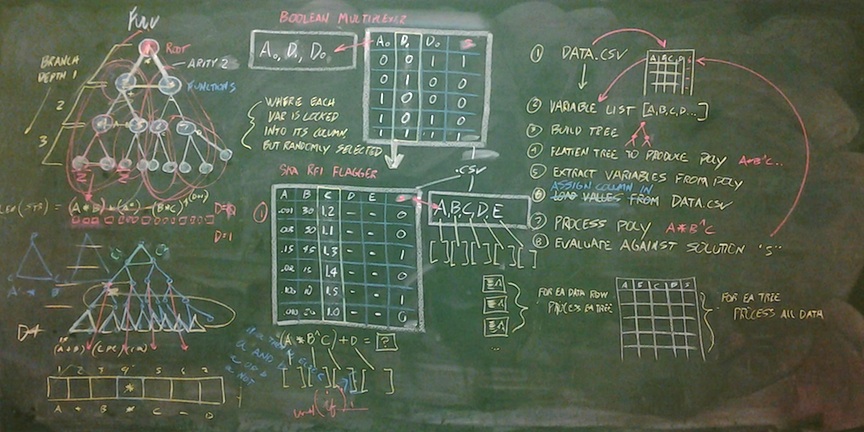
At roughly 1:45 am, my code came to life for the very first time. My genetic program found a solution not through a one-time, randomly generated polynomial expression, but through an evolutionary process which arrived to the desired solution.

I pushed back from the end of the SALT control room desk, threw my hands into the air, and at a respectable volume, “It’s alive!”

Given an equation with 2 terminals (variables) and 1 function (operand):

goal: a^b = c
data: 4,2,16
operands: +,-,*,/

Zero solutions found in the first 3 generations, but by the 5th, it produced 7 correct solutions out of 10 trees. This is with a very basic “either you get it or you don’t kernel”. No parsimony (reduction to the simplest solution). No crossover. Just simple point mutation. I also tried up to 100 trees in fewer generations or fewer trees in 100 generations. Each converges at a different rate.

I am very, very excited … and totally exhausted.

By |2017-11-25T00:00:48-04:00May 22nd, 2015|Ramblings of a Researcher|Comments Off on It’s a-l-i-v-e!

Salsa & SALT

SALT, Sutherland, South Africa by Kai Staats

I was again mugged last week, just three train stops down from Muizenberg. My fellow researcher was knocked to the ground and repeatedly hit upside his head. I tried to defend, but one of the four guys displayed a gun tucked into the front of his trousers when I charged them. I backed off while one of them forced his hands into my friend’s pockets. Oddly, they did not discover his cell phone nor wallet. Following much yelling and insisting we had nothing for them to take other than the car battery we were carrying, they took the battery and ran.

We were lucky, we learned, as a man has been shot in that same spot a few weeks prior. Not the best part of town to walk through, it seems.

I was very much on edge for the following days. When I found a man who had been harassing another of the homeless population pressed up against a wall, the folds of his jacket in the clutches of my hands, I knew I had to get away for a while.

The South African Astronomical Observatory site at Sutherland is my retreat of choice.

Feels so good to be away from trains, sirens, car alarms, people shouting, and the constant awareness of potential crime. Planning a long hike across two or three ridges to a distant set of peaks I have wanted to visit since my first visit here two years ago.

Tonight I am working from the control room of SALT, one of the world’s largest telescopes. Listening to salsa, chatting with astronomers, and working on my Genetic Programming suite.

Every few hours I step out onto the wind-strewn plateau to enjoy the dark, southern sky.

By |2017-11-25T00:03:45-04:00May 20th, 2015|Ramblings of a Researcher|Comments Off on Salsa & SALT

GP update 2015 05/11

(email to my fellow researchers)

Been coding 4-8 hrs every day for two weeks (since the GPU workshop). I feel I am making a snails-pace of progress, but at the same time learning a lot, step-by-step, piece-by-piece.

In the past 72 hrs I have migrated all functions into a Class (library), the foundation of proper Object Oriented Programming. Thuso stopped by yesterday and got me over a hurdle. Robert gave me some pointers as well. Mostly motivation. All coding remains at the tips of own fingers.

My code is clean, modular, and scalable. All functions are now ‘gp.[method]’ enabled. Once I get the internal message passing working properly, building a GP will be as simple as passing a few variables from one method to the next. In essence, I am creating a GP platform.

This may seem a bit overboard, but it sets the foundation for much simpler movement into the next steps: mutation, cross-over, and reproduction. I have merged what were two scripts into a single base which enables both Classify and Symbolic regression functionality, auto-selecting the associated dataset from the files/ directory.

The Tournament selection is done and tested. It randomly picks n Trees from the total population, selects the one with the highest fitness, and stores that in a list. Once for reproduction and mutation. Twice for cross-over.

Mutation is drafted. Need to call the methods in the right order.

Back to work …

kai

By |2017-11-25T00:03:38-04:00May 11th, 2015|Ramblings of a Researcher|Comments Off on GP update 2015 05/11

GP update 2015 04/14

(email to fellow researchers)

The GP Evaluation section of my code is complete.

I don’t want to admit to how simple this was, but after a few sleepless nights I woke this morning with a solution to synchronise the variables created by the SymPy eval function with the columns in the original data.csv

My code now draws the variables from the first row of data.csv (instead of a sep file) and auto-walks through every row for each tree, comparing the output of the randomly generated polynomial against the desired solution.

For my very simple test, I built a .csv whose solution for every row is the sum of all the numbers, as follows:

   a,b,c,s
   1,2,3,6
   4,5,6,15
   7,8,9,24

And by random luck, my third run of a single tree came up with the solution. However, it has not happened again, since :)

I can, as of now, draw from *any* .csv file, including the SKA data set. While it would not produce a valuable answer, it feels good to be real-world capable.

Now I am adding a flag for each tree that succeeds. Next, I will add support for Boolean operators and then build the Tournament.

Exciting!

kai

By |2017-11-25T00:03:22-04:00April 14th, 2015|Ramblings of a Researcher|Comments Off on GP update 2015 04/14

Learning recursion

Yesterday presented a real mental struggle.

I entered my office at AIMS with good friend Adriaan who had spent the night at my flat. I walked him through my work in Genetic Programming, sharing the challenges and success to date. The next step was to flatten the GP tree into a live polynomial in order to push real-world data through and learn how each tree performs.

I had devised a bottom-up approach, analysing the GP tree structure using the 2D array which holds each node and all of its associated values. A series of nested for-next loops would build the formula, starting at the bottom and working to the top. A bit mechanical, but something I knew how to do.

Adriaan suggested a top-down recursive method. I understood the concept of recursion, but had never programmed one properly. He drew an example on the black board and I was lost. He drew another, and I remained lost. I need physical examples for my brain to grasp a concept, and recursion is fairly ambiguous by nature. I grew frustrated. And Adriaan had to leave for Town.

I worked on two other updates to my code. Now my operands and coefficients reside in external .csv files which are imported at run-time.

Arun arrived an hour later and suggested I write a basic recursion script to calculate factorials. Of course. That made sense. And it worked!

I then returned to my script and in about two hours more had it working. The challenge was fine-tuning the code to present 3 different levels of recursion depending on the ‘arity’ (number of child nodes) for each parent node. In the end, the number of lines of code was similar to my original approach, but recursion is more elegant … and I learned something new.

Thank you Adriaan and Arun!

Now, my GP code generates randomly generated mathematical polynomials which will soon be tested in a tournament to determine which ones will move into four types of mutation and reproduction to build the subsequent generation.

Progress!

By |2017-11-25T00:03:13-04:00April 7th, 2015|Ramblings of a Researcher|Comments Off on Learning recursion

My first GP polynomials!

First GP Tree by Kai Staats Having wanted to replace the grey matter in my head with something more valuable, eg: whipped cream, the recursive loop now generates polynomial strings!

In order to convert the resulting string to an executable polynomials, Arun suggested the library Sympy. Sympy even evaluates the algo, producing a simplified version and/or returning ‘0’ if it is not functional. If this works, I will not need to write an evaluator.

New to this version, the code now calls external .csv files for available functions and terminals. At the very bottom of the run, it auto-generates the polynomial.

Fun!

By |2017-11-25T00:03:03-04:00April 6th, 2015|Ramblings of a Researcher|Comments Off on My first GP polynomials!

My first GP trees!

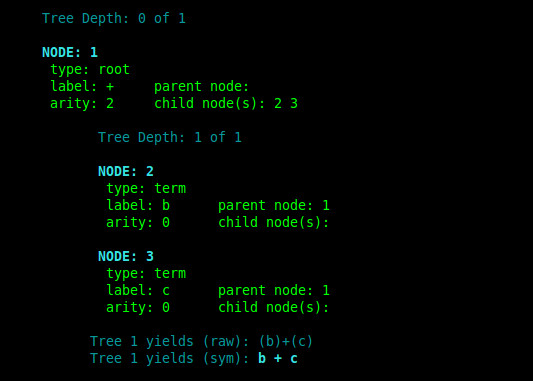
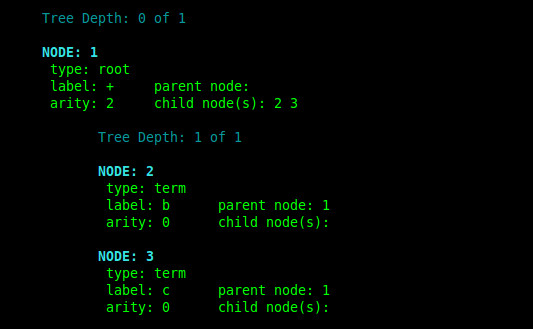
First GP Tree by Kai Staats After 10 days coding, I have completed a GP tree generator!

Tested are Full and Grow trees through depth 5. Both parents and children are properly recorded. I can run ‘trees’ from the command line to view the Numpy array which holds the tree.

The Python code is coming along nicely. Clean, commented, and modular such that I will be able to extract all internal functions as external methods. A few more changes, such as making the section that builds the root a function, but it’s getting there.

It will be relatively simple to draw upon external data sets for the FUNCTIONS (operands) and TERMINALS (features) as the entire code base is designed to scale.

Yeah!

By |2017-11-25T00:02:54-04:00March 30th, 2015|Ramblings of a Researcher|Comments Off on My first GP trees!

Zen & the Art of Research

Our professor Bruce took us on a 5 days, zen meditation retreat. Yes, a meditation research retreat. How cool / weird / awesome is that?!

We spent 8 hours each day not talking, and then talked about not talking over dinner. Wasn’t all that different from normal research, in my experience. The venue was stunning. A gorgeous, isolated guest farm about two hours South and East of Cape Town.

Thank you Nadeem, Arun, Gilad, Eli, and Martin for a great week … of not talking.

On departure we learned the next group to come through the guest farm is an orgasm retreat. I think I signed up for the wrong week.

By |2017-11-25T00:02:47-04:00March 6th, 2015|Ramblings of a Researcher|Comments Off on Zen & the Art of Research

Concretely Andrew Ng

Today I completed the Andrew Ng open course on Machine Learning

Every morning for the past two months I have awaken (woke? waked? woke up?) at 6 am, on the beach by 6:30, then run, surfed, practised yoga or a combination for an hour. Back to my flat for breakfast and 1-2 Andrew Ng videos until 10 am. Down to AIMS for tea and into the office (where I am distracted by the view of the waves and beach).

Had to watch some of the lectures more than once, to absorb all that was presented. I paused at every formula in order to copy it into my small, spiral notebook. Over 50 pages in all. The first two chapters were hard to get through, but then I gained a kind of momentum–I even looked forward to the videos.

If you desire a crash course to Machine Learning, this is the way to go.

However, I hope to never hear the word “concretely” again.

By |2017-11-25T00:02:40-04:00March 1st, 2015|Ramblings of a Researcher|Comments Off on Concretely Andrew Ng
Go to Top