It will unfold.
What form this takes, I do not know.
Words move through vessels and veins, circulating.
Fingers motivate keys to release the pressure inside.
Wanting to say more, knowing I must hold back.
Time. Give it time. Wait. It will unfold.
What form this takes, I do not know.
Words move through vessels and veins, circulating.
Fingers motivate keys to release the pressure inside.
Wanting to say more, knowing I must hold back.
Time. Give it time. Wait. It will unfold.
I am the starting gun, the witness to your bang.
I am the ripple that repeats again and again.
I am the emotion, the motion, the channel for your fear.
I am the reason you resonate, the connection you share.
I am the one who knows the beginning and the end, but
I cannot see from the middle when my work is done.
I am the pot, the frog, and boiling water.
I am the steam, the fire, and the frothing layer.
I am the protagonist, the force behind your unraveling.
I am the reason you came apart, in order to be rewound.
I am the function, the parameter, the broken rule.
I am the law without limit, expansion without form.
I am the Catalyst, the motivator of the reaction and the heat.
I am the cause for change, for lessons repeat.
Though I return to the beginning without you, I will not recant.
When the embers glow, you remain unique.
The combustion is done and I am consumed.
I am love received, shared, and lost again.
Shot in January of 2009, this 48 minute autobiographical film tells the story of Luciano Mendez, a man who has been without a home for many years, often living on the streets of Austin, Texas.
His story is familiar–a childhood fraught with the pain of a broken home, violence, alcohol abuse, and self destructive behavior. He lost his mother and father to cancer; his daughter grew up without him. He has never held a job for long, forever challenged by alcohol and drugs.
Luciano also speaks of forgiveness at the side of his mother’s deathbed, acceptance of his brother, and love through the pain. Luciano shares moments of powerful insight to his own behavior as he moves to change over time.
Northern Colorado Business Report
“A Supercomputing Future”
by Kai Staats
December 2011
Today, November 18, was the closing day of SuperComputing 2011, the conference and trade show for high performance computing research, labs, and industry. For this week the Seattle Washington Convention Center hosted representation of the latest, greatest, and fastest computers in the world, an overwhelming array of blinking lights, whirring fans, and massive LCD, plasma, and projection screens demonstrating human brain power applied to the human quest to learn how all things work.
It was my first time attending since 2008, my ninth or tenth show in total, but as I have been away for three years, I experienced a jump in the otherwise, relatively steady evolution of compute power and associated research results.
As in the movie “Minority Report” there are now fully interactive touch screens the size of a wall. Up to four people may interact, moving, panning, zooming, and annotating documents, photos, and film. I was able to not only resize a movie while it played, but with one hand rotate it 360 degrees, the motion never even hesitating. The immersive 3D worlds are faster, smoother, and of course, much higher resolution. Still a bit awkward for data visualization, but the flight simulators are amazing!
The challenge of building supercomputing clusters has in many respects remained the same, the balance between data storage, bandwidth, calculations per second, and visualization an ongoing battle.
As CPUs get faster, they need to be fed data at a higher rate. The interconnect fabric (network) advances, from 10/100 ethernet to gigabit, from Infiniband to 10g-e and beyond. But then the memory bus is saturated and can’t keep up, so the speed and quantity of RAM and cache must increase too.
As CPU frequencies have for the most part stalled, Moore’s law is maintained by adding more cores, two, four, and eight on a single socket. But even this has its limitation as we reach the boundary of how small we are able to manufacture a transistor and how effectively we may move heat without building quantum machines.
We add more processors in the form of GP/GPUs, advanced accelerators which grew out of the graphics card industry. Nvidia is leading the charge. Ah! A new challenge is presented, for now we have 500 cores in a PCI slot and four slots to fill. But with 2000 cores, a million or more across an entire cluster, we find that our programming models no longer hold up for the message passing interface which moves fragments of a computational problem takes more processing power, diminishing returns due to fabric latency, OS jitters, and kernel interrupts not easily be solved.
IBM builds a rack-mount node which takes four people to carry (let alone install). HP and Dell design higher density blades which require water cooling. Cray reinvents the wheel (it’s a very nice wheel). TI brings to market new digital signal processors while the ARM processor makes enters this industry with a many-core architecture, but the OS platform remains infantile, lacking industry support for compilers and management tools.
Tired yet? I have only just begun. Super computing is super confusing and yet somehow it works. The competition is fierce, new companies claiming fastest and best their second year in the industry. Big guys buy up small guys as the small guys continue to innovate, racing to support the most advanced research in the world: bioinformatics, nuclear physics, brain mapping, three dimensional imaging of the earth beneath our feet, climate modeling, quantum interactions at the event horizon of a black hole.
We now understand more of the universe inside, immediately around, and far beyond ourselves than ever before. Our knowledge of how things work is growing at an exponential rate. We now compare the DNA of a newly discovered species with another, from wet lab to sequencing in a matter of hours, and we know how many millions of years separate the two in their evolutionary tree. We model with incredible accuracy the proteins that make up various parts of our body and the function of individual cells in the human brain. We better predict the movement of hurricanes up coast lines while the mathematical prediction of fluctuations on Wall Street continues uninterrupted.
I watched a 3D model of a protein-ligand interaction, the colors ranging from white to blue to red to represent the heat-energy in various parts of the system. It jumped, danced, and moved in apparently intelligent ways, an “arm” of the protein connecting to itself only to break again where the synthetic drug attempted to bond. The model from start to finish was over a minute in length, and yet it happens millions of times a second throughout our bodies. For a moment I felt alive in a way that is difficult to explain, picturing in my mind these molecular interactions inside of me at a scale I cannot fully comprehend.
I want to know how all of this works, all of it! –but even in ten lifetimes it is impossible to gain this understanding for the people who bring these discoveries to life are experts in increasingly narrow fields.
Next year I want to attend the show again, and as I have promised myself too many times before, read the posters, interview the grad students and professors who have traveled across the globe to present their latest findings, for their knowledge is our future, a future modeled in supercomputers.
This story was originally written for the NPR “Three-Minute Fiction” short story contest.
Downtown was unfamiliar to me as I had only recently acquired my apartment two blocks off Main. The job which brought me here offered a leisurely break to enjoy a walk after a midday meal. I approached one of the two roundabouts which defined the beginning and end of the street just three blocks long.
I stopped at the crosswalk before the roundabout, looked to my left and then forward again. An elderly man sat on a bench in the middle, to his left a bronze statue of a beautiful elderly woman. He was bent forward, his head held in his hands and elbows upon his thighs. As I crossed the two lanes and drew near, I could hear him crying.
Two people to my front had walked by him, looked, but did not stop. I nearly did the same, but could not. It just didn’t feel right. I turned round slowly, the statue of the woman between me and him. I took a deep breath and then reached out to steady myself on the crown of her head. It was warm to the touch despite the cool fall air, the metal so perfectly carved as to give soft texture to her hair. I lowered myself a bit, knees bent, and saw the man’s tears flowing free.
“Excuse me, sir, but are you ok? Is there anything I can do?”
He did not seem to hear me, his head yet held in his hands. I tried again, “Sir. You’re, … you seem so sad. What happened?”
His sobs lessened as he attempted a deep breath. He said nothing but lifted his head from the support of his arms. With his hand he motioned for me to sit upon the bench to his right. Both our gazes fell upon the red brick path at our feet. I waited. A long time passed.
When he found his voice he said, “I have never felt such grief. I have never felt such pain. The loss inside me, I could never live with this again.” He shook his head slowly from side to side.
In that moment my heart sped. I could feel his grief as though it were mine. It was difficult to speak, “May I … may I ask what happened?”
Two cars drove around the circle, one in each direction. A cloud moved to cover the sun. The wind blew lightly and then stalled again. I looked at my watch without lifting my arm, not wanting to press him for time.
He sat upright and then slowly turned his head. Our eyes met, his dark, nearly hollow inside.
Finally he said, “I have taken many risks in my life. I have challenged death more than one time. But the greatest reward I was ever given was experiencing a love that transcends time.”
He grabbed my hand with an agility and strength that surprised me, holding me tight. He breathed more than he said, “If you are ever given opportunity to feel this way,” his eyes penetrating mine, “stop at nothing to love this deep.”
He turned to face the statue of the woman, his left arm holding her in a familiar embrace. The warmth of his hand around mine was lost and when I looked up carved metal now defined his face. I pushed away from him and nearly fell to the ground. Tears were replaced with a smile on the left of two statues, side by side, on the bench in the middle of the roundabout at the end of town.
© Kai Staats 2011
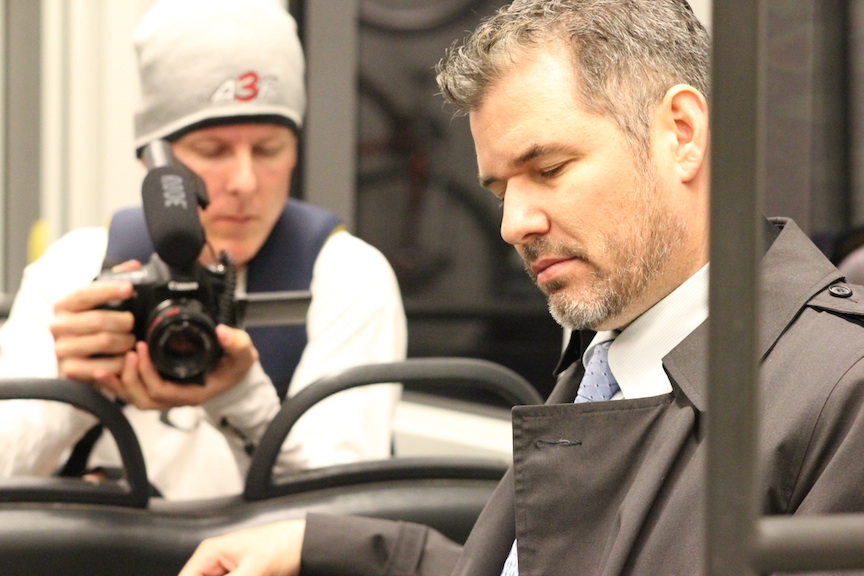
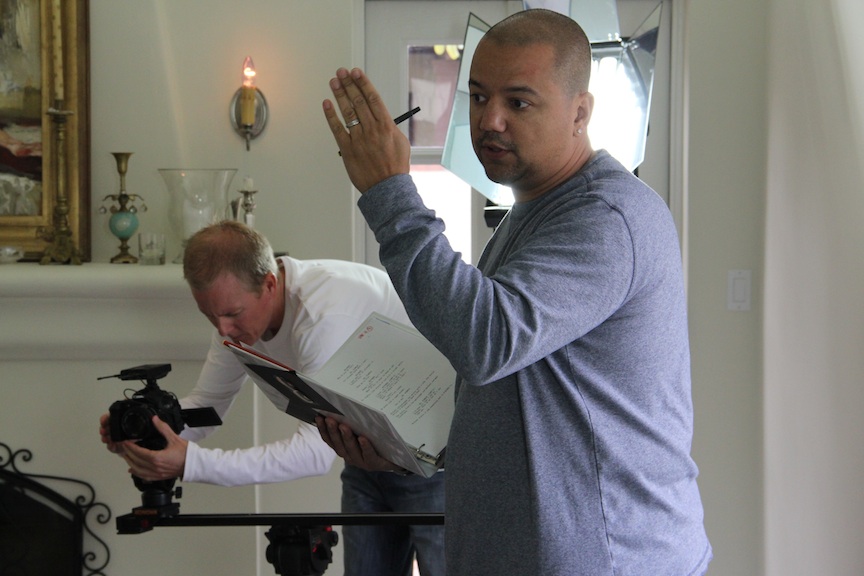
It feels like just yesterday that I attended the SuperComputing trade show and conference in Austin, Texas, 2008. That week I met Luciano, a man without a home for whom I provided a hotel for two nights in order that he could get off the streets. I flew back to Austin two months later to capture his story on film. I spent two nights on the streets with Luciano and his friends, his life unfolding for the camera.
While walking from my hotel to the convention center yesterday afternoon, a tall (much taller than me) man approached from my left side, I assumed homeless by his tattered apparel and streetwise stride, hunched, favoring one side a little more than the other.
He shouted while coming across the street, “Hey! Hold up man.” A bit winded, he moved faster to close in, “Hey, God bless you man,” pausing while he caught up, “Man, you some kinda business guy! Look at you, you look like the mayor of Seattle!” referring to my new pleated pants, dress shoes, and Puma jacket (which passes for business casual on a good day).
I laughed, “Thank you. But no, I am not much of a business guy, at least not like that,” I responded.
“Hey, I ain’t want’n to bother you or noth’n, but it’s been a hard week and I was just wonder’n if you could help me get a bite to eat?”
“I won’t give you any money, but I will gladly buy you dinner.”
“Really? Hey, that sounds great.” He was walking along side me then.
“Where do you want to eat?”
“Hey man, I don’t want to change your plans. So, where you head’d?”
“To the convention center. You know where it’s at?”
“Oh yes sir, just up this here hill. I’ll take you there and right next door is a Subway shop.”
“Sounds great. I’ll buy you a sandwich.”
He reached out and shook my hand, “My name is Myron.”
“I am Kai.”
“Kai? What kind of name is that?”
“A short one,” I smiled.
“Man, I like you. You’re all right.”
“Thank you. I like you too.” As I said this, and we neared the business district, I could feel eyes watching, people trying to understand the relationship between this man and me. I made a point of making eye contact with him as we walked and allowing our shoulders to bump every now and again as though we were best friends. I did not want, in any way, for him to feel ashamed or unclean.
Myron pointed to his shoes and said, “You know, if I take off these shoes, my socks would just plain fall apart. There ain’t much left to even call them socks. Know what I mean?”
“Yes, I had a pair of socks that were like that.”
“Well, if you can spare some change, maybe I could buy a new pair of socks.”
“Socks. Not drugs. Right?
“Yeah man, I promise. Socks.”
He refused the twenty and so I gave him ten dollars in cash. We talked about where he lived and how we moved through the world. He was polite, funny, and a great conversationalist. We arrived in front of the convention center and I remembered being there before for the 2005 or 2006 SuperComputing tradeshow.
We walked up to the Subway shop, it’s outdoor counter facing the street. Myron looked at the options and at the request of the sandwich artist, ordered a foot-long meatball sub. He asked if it was ok to get a drink, chips, and a cookie. I said he could get whatever he wanted.
While we waited for the sandwich to be made, interrupted by the usual questions for type of bread, cheese, veggies, and sauce, the conversation unfolded something like this.
“Ain’t you gonna get something Kai?”
“No, there will be food at the trade show in just about an hour.”
“You want a bite of mine?”
“Thanks man, but I am vegetarian. For twenty three years.”
“Twenty three– What? Twenty three years without eat’n meat!? Maaaan, you is crazy. No one can live like that! I am SO sorry for YOU!”
I laughed out loud, the woman at the counter turning to smile at us both, “Well, I seem to be do’n ok.”
“No man, that just ain’t healthy.”
“I ran forty two miles last week and do one hundred sit-ups every day!”
Myron just shook his head, looked at his worn, cracked fingers and long nails. Under his breath, “Twenty three years … you know what, I bet when you let one go,” and at that he bent forward to make it clear what he was referring to, “I bet it don’t stink at all!”
I laughed so hard I nearly fell over. He bent over and stood up a few times, just to get the most of the humor. Then he took a step forward and leaned on the counter, “Fellas. See this guy over here,” pointing at me, “he ain’t eat’n no meat for twenty three years! You think that’s ok? And when he farts, man, it don’t smell!”
The younger of the two said, “Yeah man, it’s ok.” The other just laughed.
Myron turned back to me, just as the sandwich was nearly done, “Kai. You mind if I say a prayer for you?”
“No, not at all.”
He put his hand on my shoulder and bowed his head, his shoulders still resting at a height taller than all of me combined. “Lord, thank you for bringing me to this man. I know now I’m gonna make it one more day. Amen.”
We exchanged a few hand-jive maneuvers, something I love about my many encounters with the homeless in so many cities. Each has a special ending, a flutter, a set of wings, a wiggle, or an explosion of fingers, some just ending in fist bumps. We walked back down the street along the front of the convention center. Dozens of geeks, some I recognized from over a decade of attending this family reunion walked past and through the glass doors.
“I don’t live too far away, just down there on First and Cedar.”
“First and Cedar,” I repeated.
“Yeah. So, you know, keep an eye out for me, ok? My place ain’t so fancy. It’s low income housing.”
“But you have a place of your own. That’s doing ok. You’re better off than some.” He nodded. I continued, “You know, I’ve been living out of my car and a tent for over a month.” I looked up to see what he might say.
He stopped walking. I thought he might be offended, “You put’n me on?!”
“No. I’m being honest. I left my home in Colorado two months ago and have been living a pretty simple life since. Like you said, low income housing. Now, I am a carpenter in a mountain village not far from here. I’m not say’n my life is like yours, but you know, we share something in common. A simple life.”
Myron smiled.
“I’ll look for you Myron. Maybe we can have lunch together later this week.”
“Yeah. Yea man, that’d be nice. See ya around.”
“I hope so. First and Cedar, right?”
He nodded and waved, opening the Subway shop bag.
I turned to enter the convention center.
The first person I saw, at the top of the three step landing was Steve Poole, the infamous “bomb boy” from Los Alamos who once invoked a perfectly timed, one finger salute from a Sr. Manager of Business Development for Motorola for interrupting a PowerPoint presentation with an accusatory question. “Is that– is that an Intel laptop you are using!?”
But he was more commonly known for his introduction to his work when one visited the Los Alamos booth at SuperComputing, “Bombs. We make bombs. Better bombs. Bigger bombs … F-r-i-e-n-d-l-i-e-r bombs,” his crazy white hair giving him the appearance of a modern day Einstein. He’s likely just as smart.
“Steve! How are you?” extending my hand.
Grinning, “Kai, it’s been a few years.”
“Yeah, needed a vacation from this place. Hey, I emailed you a few weeks ago, but it bounced. You still at Oak Ridge?”
“Yeah, that email doesn’t always work. You know, I just work here and there now.”
“You got a new email?”
“Yes.”
“Uh. Mind if I have it?”
“Yes,” smiling as only Steve can.
“Got it. Never mind. I’ll look for you on the show floor,” smiling back.
Two hours later, I got a call from Luciano, the man in Austin whose story I captured on film two years ago. He was returning my call to his sister a few days earlier. He is doing well. He is in rehab, has a girlfriend, email, and even a Facebook account. He sounded really good and asked when I was coming back to Austin to visit. I told him I hoped it would be soon.
The transition from Holden to Seattle, from stoking fires at midnight to SuperComputing 2011 was a stark contrast, but the unfolding of this day was exactly what I had asked for.
I was home, even in the big city, for at least a few days.
This is where I now live and work as a carpenter and videographer. No roads to the outside world, access by boat up Lake Chelan. No television, phones, or radio. Isolated in some respects, but so fully engaged in many, many more. This short film captures a few days of village life in this mountain retreat center in the Washington Cascades. The film touches upon three aspects of Holden: Living, Community, and Renewal–calling upon vivid images of laughter, dance, food, work, play, and prayer to present Holden in the light of its mountain splendor.
This marks the completion of my first film project, from acquisition to final edit, in fifteen years.
Northern Colorado Business Report
“Taking out the Trash”
By Kai Staats
4 November 2011
As Moore’s law has seen the regular doubling of processor power every two to three years, the cost of storage, both local and on-line, has declined at a steady, rapid pace, giving rise to a tremendous capacity for capturing our digital lives in words, photos, video, and sound.
What has accompanied, even compelled the need for this massive increase in storage space is in part the amount of data we generate. High resolution photos have surpassed print film while lossless audio now carries the quality of the live performance. What’s more, the human tendency to horde everything digital has been compounded by advanced searches which tend to lead to the abandonment of organization.
Many years ago, when Google first introduced Gmail, a battle ensued at my former company, my engineers believed the answer to all their email woes had finally been granted–a single repository coupled with a Google powered search.
However, month after month I witnessed a gradual degradation of response to both internal and customer email. I investigated, and at times, had to intervene.
“I sent an email last week, but have not yet received a response,” became a common theme.
“Are you sure you sent it to me?” was a common reply.
“Yes. Quite certain. Should I forward a copy to you?”
“No, no. Hold on, let me search … oh, here it is. Well, I didn’t see that one ’cause I have more than two thousand email in my Inbox and a few hundred unread,” stated with a grin and a sense of pride, as though the goal of the game was to accumulate the most unread emails.
“That seems like a problem. How about using labels and filters?” I asked.
“Why?! Look, with Gmail I just search and find any thread at any point in time,” and a quick demonstration ensued.
“But you didn’t see my email until just now, and the customer has been waiting for a reply.”
An uncomfortable silence followed, and then recognition of the problem at hand “Right.”
I knew the fight was not about Gmail vs Yahoo! or Kmail vs Apple’s Mail app. This was about implementing a system of organization that was well planned, scalable, and flexible over time.
I defended the use of folders and automated filters which delivered email to unique, associated Inboxes. He was not alone, most of my staff replaced even a minimal sense of organization with Gmail’s paradigm, despite the decrease in response time, and worse, lost communications.
In response, I initiated a competition: my more than twelve thousand email comprising the summary of ten years of communications, archived in the logic of several hundred nested folders against just a few thousand email and Gmail’s search put to good use. The goal? Find a particular email on an exact date sent to a known client about a non-ambiguous subject, granting at least three parameters by which one could search.
Challenge after challenge, I won every time. None of my employees could beat me in accuracy nor timing of information retrieval. Three, at most four mouse clicks and I could locate any email to any customer in just a few seconds.
Yes, I spent thirty minutes every now and again re-organizing my email directory structure to accommodate an increased load, or to gain a greater level of efficiency when I realized that re-sorting directories by one parameter was more effective than by another. But the time I spent in organization was more than compensated by the hours saved in daily operations and what’s more, I gained a strong visual component, a sense of ownership of my data.
What I experienced then, and to this day I believe holds true, is that the most important of all factors in an age of information overload is forming good habits of data organization and of equal importance, taking out the trash. To keep everything, all the time, independent of the number of folders, is to fail to process data on a regular basis, thereby failing to assign value across the board.
No matter where we store things, in a closet, a file drawer, or on-line, the process of managing objects and data is the same:
Most methods for teaching data organization seldom discuss deletion. But the process of determining what to throw out is the same as determining what to keep, establishing a mental image that is as effective as any advanced search function.
The next time Gmail responds, “Who needs to delete when you have so much storage?!” consider the clarity of mind you will have gained through managing your data.
They were called by candle, they were called by flame.
They came together, they came to pray.
A flicker of light, a glimmer of hope.
They moved to be touched by the hands of their friends.
But someone else was here too, even if for just a short while.
Called by candle, called by flame,
the God of the moment, this night she came.
Inspired by the music, she danced in the light.
Moved by the passion, she became the flame.
She sat atop candle tips, and looked into their eyes.
Some moved her to laughter, while others, she felt their pain.
The God of the moment, was pleased she came.
Hang on to that moment, hang on to the light.
Remember the dancing flames that illuminated this night.
That was the God of the moment, just passing through.
That was the God of the moment, looking at you.
Northern Colorado Business Report
“Living with Specialization in Userland”
By Kai Staats
7 October 2011
I crossed the U.S. / Canada border on I-5 listening to NPR’s Car Talk, Ray and Tom invoking laughter in the most stoic of listeners, as they always do. A woman called in to ask advice before she traded her beloved 1985 Volkswagon Vanagon for a Subaru Forester. She was understandably reluctant to give up the many years of stories, adventures, and dreams their family had shared driving across the land.
The woman asked about the engine and whether or not her husband could tinker with a new Subaru, doing most of the maintenance himself. Ray and Tom agreed that modern cars do not lend themselves to home mechanics as they have for all the prior years. The stuff under the hood is unfamiliar now, designed to be maintained by trained, industry specialists.
Two hours later I drove into Squamish, British Columbia, the rain washing my windshield clean of more than one thousand five hundred miles since I left home. I walked into the Adventure Center on Canadian HW99 at the edge of town. The young man behind the counter and his manager were discussing the power outage which has disabled all but one VOIP phone and computer terminal.
Neither of them was willing to experiment, fearing they might make it worse. They were waiting for the next day, Monday, when they could call support and talk to an expert.
Last week I stayed with a family friend, a professional photographer, writer, and naturalist with more than thirty years in the field. His life moves through his laptop and cell phone as he is seldom home for more than a few days at a time, and yet, the full capacity for electronic organization and collaboration unrealized.
I assisted him and his wife with switching from Yahoo! to Gmail, synchronizing Google Calendars to their Android phones, configuring email for their Internet domain, expanding their home wireless network with two Apple Airport Extreme adapters, establishing a central repository for sharing files, and connecting their home stereo system to streaming Internet radio.
I transferred user data from an old laptop to one brand new, doubled the capacity of the old laptop, reinstalled Mac OSX, and transferred user data again. They were thrilled, one of their daughters commenting over the phone, “Welcome to the twenty-first century!”
To be honest, I just followed the directions presented to me on-screen, doing little more than what I was told each step of the way. For as much of the effort as they had time, I engaged them in the process. But from their point of view, I am a specialist with many years expertise. Yet compared to code developers and engineers, I am just a layperson, an advanced user in user land. The many levels run deep.
It is not the doing that was the true barrier, for they can point and click as easily as anyone. The challenge is knowing where to start. Apple has not shipped with a printed manual for many years, believing their operating system is so simple anyone can just figure it out. I watched too many people struggle to know this is far from true. Searching Apple’s website is nearly useless and Google yields overwhelming results. You must know what you are looking for before you even begin the search.
Just a few days ago I stayed with a friend a few blocks from the Puget Sound. Their wi-fi went down some time ago. A friend had attempted to swap routers but to no avail for they had lost the passwords and did not know how to reset them. I explained that on the back or bottom of every router is a small button which when pressed with the tip of a ballpoint pen will reset the unit when you plug it in. The factory password will likely be “guest” or “admin” depending upon the brand.
Certainly, there are individuals in each generation willing to explore, to push their boundaries and dive into the depths of what an operating system or applications can do. But how many people have this comfort? I spent three full days upgrading my friends’ digital life, but how many working professionals have this kind of time? What’s more, If you do not know what you are missing, why would you ask for more?
We live in a world of special knowledge applied to special things. Specialization is job security at one level, and yet part of the reason we have so many unemployed.
Personally, I do not see technology as making things easier, for we are only introducing more complexity to our lives, always trying to do more. Placing a record on a turntable requires physical care, but not expertise. Connecting a digital audio archive to a wireless network and home theater requires a specialist. What’s more, the ability for one generation to teach the next is lost, for anything learned is useless in just a few years.
We have no choice but to pick and choose what we will maintain as our expertise, and to have the courage to ask for assistance for everything else. Maybe this brings us together again, or maybe it keeps us apart. What are your thoughts?