About Kai Staats

This author has not yet filled in any details.
So far Kai Staats has created 575 blog entries.

The Story of Achim

Preface
One morning in early September I awoke from a most powerful dream, the kind that I want to dive back into but can never quite get there again. I dreamed of a woman from Israeli whose name was Achim. I have never remembered the name of a fictional person in a dream, and yet, it was very clear to me when I awoke. Achim. Our connection was strong, even when we first met. Together, we could see into the future in an attempt to cure humanity of a horrible plague.

The emotions of the dream stayed with me, allowing me to hold the story until I found inspiration to write. Just a few days ago in Squamish, B.C., I met an Israeli woman at the farmers market. We talked for more than an hour beneath an awning to avoid the intermittent rains. Before we parted I asked, “Does ‘ahg-hem’ mean anything in Hebrew?” She responded, “Yes, it means ‘brothers’.” This was significant to the dream, as you will read …

The Diner

“I am your eyes to the future,” she said, “Take my hand and you will see.”

I entered the 5-n-diner as I had dozens of times before, its interior scarcely changed since the middle of the twentieth century when the silver shell café had been moved to its current location from some other place long ago forgotten, maybe just down the street, or maybe across town.

The wait staff had changed often in recent months, as the quantity of patrons had continually reduced. The plague unchecked had taken more lives than anyone could have imagined, nearly five billion all told.

Some left town, heading to smaller, less populated areas believing they may be safer there despite the statistics which demonstrated no variation of infection rates between population centers or the country side. Some returned home to spend time with family before they were taken too. Others simply didn’t come to work, unable to call in or to ask for time off. Too many passed alone, the onset of the final hours quick to take what it owned–the hope of every person the plague touched. Even those who were carriers without signs did not know for how long they would yet live.

The riots had long ago subsided in those early years when fear drove the masses to react. Now, only small pockets of outbreak occurred in reaction to the media when yet another cure was announced which ultimately failed. In some respects, life carried on, day after day as routine the best cure for the unknown.

The seats were each patched in several places, the stiff vinyl edges caught the pant legs of unwary patrons. The old Formica table tops glistened only from those corners which seldom received contact by a coffee cup or cleaning rag.

I would have sat at my usual spot, my own sense of routine necessary to me, a sense of safety in an unsafe world. But that day another patron was already occupying my space. My space. The words echoed in my mind as I realized how odd they sounded. Ownership no longer carried the same value. If your future is no longer governed by things in your control, then ownership of land, a house, a particular booth at a local café means less. Just the same, I found myself staring at the man wanting to ask him to move. He became uncomfortable, looked repeatedly over his shoulder and then back to me, concerned perhaps that he had done something wrong.

I broke my stare, apologized with a half smile, and moved to a booth on the other side of the isle. I lifted the menu into my hands, determined to try something new instead of the same cup of soup and salty crackers every day.

The waitress walked to the edge of my booth, but I took notice only of her shoes in the periphery of my vision. She stood for a moment, waiting. I remained focused on the menu. When she spoke, my chest heaved, her voice deeply familiar like a song my father had sung to me while I was in my mother’s womb. I nearly dropped the menu and looked up.

I knew her, not in this form, but as a woman who had visited me in my dreams a few times since my work to find a cure for the plague had begun. Take my hand and you will see. Her skin was dark, golden brown, her hair black and long. She smiled but said nothing, she didn’t even take my order. She just turned and walked away, returning in a few minutes with my cup of soup and a small ceramic plate which held a dozen salty crackers, most of them broken.

She extended her hand and said, “I am Achim.”

I don’t know why but I did not respond. I wanted to reach to hold her hand but was afraid I would never let go. She reached into her apron to hand me a soup spoon. Our hands touched and I instantly became dizzy, the spoon clattered to the floor.

Embarrassed, I responded, “Ack- Ackhem?”

She retrieved the first spoon from the floor and placed another on the table next to the soup bowl. She laughed in a world in which the sound of laughter had nearly been lost. Half the patrons in the café turned to look, some annoyed by her unusual outbreak, not unlike clapping in church. She didn’t notice and continued to smile.

“Not quite,” leaning closer until the mysterious space between her breasts hovered in front of my eyes, “Ahh-gh-heem” the back of her throat lightly engaged to give grace to pronunciation which I could not duplicate. She was playing with me, I could tell, holding her position there, smiling.

I smiled back but did not try again. Instead, I asked “What does it mean?”

“Brothers.” And then she stood up and leaned instead on the opposite side of the booth.

“That’s, … that’s odd. I mean,” feeling foolish for my approach, “… well, you were named ‘Brothers’. Why?”

She smiled again, “Our family is very close. When our mother died,” she momentarily lost her smile, “my brothers and father were spared. My father is yet grieving and has not spoken for many years. I took the name to let my brothers know I am here, for them …” her smile returned, “until the end.”

I did not leave the café that day. I did not return to the lab. I remained in the booth, reviewing notes from my research, drinking and eating what Achim brought to me. When she had time, she sat with me and asked about my work. But it didn’t feel as though we were meeting for the first time, rather just catching up.

That night we walked back to my apartment on the upper side of downtown, avoiding the elevated trains and the underground. I reached for her hand a few times but she withdrew. She held my elbow and wrapped her arms around my waist, but she never let her hands come into contact with mine.

The Apartment
Two days later she moved in. She didn’t ask and I did not protest when she showed up at my door, her belongings carried to my front porch by the taxi cab driver. We didn’t talk about it. It just worked. Our lives merged easily, as though we had never lived apart. The plague had taken the joy of conversation away from all but children who talk to themselves in their make believe world. For us, conversation was not needed to convey most of what we shared, cooking, long walks, and making love.

But after a few weeks of our living together, I found the courage to ask why she would not allow my hand to come into contact with hers. We were several blocks from home, her arm woven through mine as I had come to accept as the norm.

She stopped walking, turning me to face her. Her eyes held mine. I was paralyzed by an intensity she had not yet conveyed, “Are you certain you are ready?”

“For what?”

“To see the future.” She held out her left hand, pulled back her sleeve, and waited.

“I don’t understand.”

“You will. Take my hand.”

Suddenly, I was afraid as I no longer recognized the woman in front of me. She had gained a strength of conviction I did not understand. What had she been hiding from me?

I removed my right hand from my jacket pocket, hesitated, and then placed it in hers.

“Ok?”

“Wait.”

She closed her eyes and bowed her head.

At first I felt dizzy and had to step my right foot to the side to stabilize myself. Then my head was flooded with images of people I knew, my co-workers, Achim, friends I had not seen for many years. I saw people falling to the street, collapsing under their own weight. I saw others embracing, smiling for the first time in years. I saw a ceremony in which I was granted an award for the work I conducted in the lab.

I quickly pulled my hand back from hers, shaking, and looked up, “What just happened? What was that?”

“A potential future.”

“Whose future?”

“Yours. Mine. Ours. Everyone,” She paused, “the human race.”

“I don’t understand. What? How?”

“It’s just something I was born with, a gift I discovered when I was young.”

“You can see the future?”

“No, not really. I can only experience its emotion. I believe I am a conduit to those who can see. But there are very few. I have met a few others, ” she raised her head again, “and you, who can see what I feel.”

“You mean, I just saw, … saw the future?”

“Yes. It is rare, the connection we share. I have been searching for you for many years.”

Tears filled my eyes, my chest heaved again for I was very scared.

“You lied to me! You, … do you even love me? Or, or am I just part of some experiment?” I was nearly yelling, fear and pain taking over me.

Achim countered, defensive at first, “Yes.” She took a deep breath, closed her eyes for a moment and then opened them again, whispering, “I love you dearly. That is very real for me. B- … but, we have something we need to do together, something even greater than the love we share.”

I took a few steps back, feeling as though my world was suddenly spinning too fast. I could neither remaining standing in one place nor run away. Achim took my elbow again, turned me about to face the direction from where we had come, and we walked toward home. We talked nearly the entire way, saying more than we had for the whole time we had lived together. When the implication of what we discussed became clear, I realized that she needed me to see what she felt, and I needed her to learn which path I should take in my research at the genetics lab.

That night we sat on the floor, wrapped in blankets as the first of what would be many winter storms settled in. We stayed up all night, holding hands, learning to explore together. I verbalized what I saw in my head as she directed the emotion of the future into me. We were exhausted and fell to sleep as the sun rose behind the thickness of low clouds burdened with snow. I called in sick to the lab the next morning in order to stay at home with Achim.

We learned, over time, that we were not seeing a predetermined future, but a potential of what could unfold given all the avenues. Minuscule changes each step of the way gave birth to myriad futures, some of which ended with the extermination of the human race in a matter of months, others in years. The difference between the two extremes grew from subtle nuances in what we did now and in the next few weeks.

I grew afraid to return to the lab, to push in any direction at all. I felt paralyzed by the overwhelming weight of each direction I could take. Too many options to remember, too many to manage in our heads. To compensate, we incorporated my laptop to record the sessions, using interactive diagrams to capture the complex array of future trees. When the calls came in from the lab, concern for my extended absence, I stated I was working from home. I was making progress but needed more time. Achim was fired from the café.

When seldom left our neighborhood, food delivered two or three times a day. We went for walks in the fresh snow, watched movies, took hot baths, and made love when we realized we were not making progress. Yet, there was a sense of limited time that grew in our hearts and heads. The future was approaching the present too quickly.

Sometimes Achim grew frustrated with me as my lack of focus would cause her emotions to spiral out of control. She would curl into the pillows and weep until the strength of what she experienced had passed. Gradually we learned, together, to pause and jump between fragments of her emotions by way of the images in my head. Together, we formed a vehicle which traveled through time, a union more powerful than any I had ever imagined.

Finally, after nearly three weeks, we envisioned a future in which the human race survived. We then went back to the present, fine-tuning the variables of my experiments and the deployment strategy in order to bring the survival rate to a maximum. However, no matter what paths we took, what choices we made, the cure saved most, but not all, for it killed many of those who were carriers that did not show signs.

It was a conundrum that we could not find a way through. We tried, day after day, night after night, to find a solution in which everyone yet alive survived. It seemed impossible.

Toward the end of a late night session both of us seated on the floor. I had just pressed record on the laptop, closed my eyes, and held Achim’s hands. A few seconds later, when the images began to flow, Achim threw back my hands and screamed, “No! Not them! Please, not them!”

“What happened Achim?”

“I, I could see them, my brothers, ” she looked at the floor, “They will die.”

“I thought you only felt emotion? What do you mean you could see them? Are you certain?”

She was standing then, pacing the room, tears falling from her eyes, “My father, he can’t take more loss. Oh no, he will die also. Why? It’s not fair!”

“How do you know it was them? I didn’t see this? Maybe you were mistaken!”

She raised her voice at me for the first time since we had met, “BECAUSE I KNOW!”

She ran to the living room, to the hallway and then outside into the snow without a jacket or proper shoes. I saw her run down the sidewalk from my second story bay window, her footprints receiving fresh white flakes. I quickly put on my boots, coat, and hat and ran after her, my feel sliding with each footfall. I nearly lost my balance a few times but managed to catch her at the end of the block.

“Please, Achim, come back. It’s too cold out here.” I gave her my coat and held her, wrapping my arms around her torso and head. Achim wept, her body shaking. She lost the strength in her legs and I kept her from falling.

“Please, let’s go home.” And we did.

The Lab
I returned to the lab the next day but was reluctant to go without Achim, fearful of her being alone. I asked if she would come with me, and she did. For the next month we were inseparable, our combined work giving way to incredible progress in my research. I was able to make breakthrough discoveries, learning how the virus disrupted cellular respiration; how it caused the sudden collapse of several major organs at once.

My co-workers were concerned by Achim’s presence at first, but when the speed at which the lab made progress was realized, no one said a word. The world was like that then, we just accepted things for how they were. Achim sat by my side, holding my hand so that I could see if newly developed strains of antigens were the ones that would take us down the best path, each as clear to me as though it were presented on my computer screen. The lab hired two new technicians to keep up with the volume of virtual models I produced, giving them form in the wet lab where they were tested against artificially grown human organs.

Achim was still affected by the vision of her brothers’ deaths, but she never talked about it and I never asked. Inside, I held hope that we would find another way, a different path. It had been four months since Achim first moved in with me. We had worked together in the lab for more than three. She was as much a part of me as I was of her and our work together. The lab had come to accept her as one of them. No one asked what part she played, they only knew that with her at my side, were getting closer to a cure each day.

The lead lab technician came into the lab one late February evening. “We’ve got it,” he said with tears in his eyes, “We’ve got a solid candidate for the cure. It blocks the pathogen’s primary disruptive function and …”

I didn’t hear the rest as Achim stood and ran from the room.

I looked at him and then after her, jumped up and followed her out of my office and down the hall. I caught up with her and grabbed her arm, spinning her around more aggressively than I had intended.

“What?! What’s wrong?”

“My brothers. Now they will die.”

“No, it doesn’t have to be that way,” I tried to pull her close but she pushed me away, “We can keep looking to the future. We can find a path that leads to different end. We have learned so much together.”

“No, it cannot be that way. You know this to be true. If this is the cure, the real cure, the one that saves the humans that remain, then you must deploy it immediately. You cannot risk thousands more dying every day to try to find a potential future in which my brothers and others in the minority live,” she paused to look at her hands which she took from mine and pushed them into her pockets, “I will not allow you.”

The government regulatory agency was quick to process the solution we devised. It would be only a matter of weeks before the anti-viral agent would be deployed world-wide, to every human yet alive. We could not risk the potential of a carrier playing host to a dormant or resistant strain which might mutate after delivery, forcing us back to the lab for another few months, even years.

The End
Achim invited her twin brothers and father to come live with us for what time they had remaining. Those were wonderful, long days filled with laughter, joy, and play. Achim never let on to what she knew about them, that they would die from the same vaccine which would save the majority of the human race. It was not their fault they carried a genetic trait which would we would only later isolate–they would die from the same cure which saved the rest of humanity.

The vaccine was deployed and worked as intended, the pathogen which had reduced the population of our species by nearly eighty percent in less than ten years had been brought to its end. Achim’s brothers were dead. Her father died shortly thereafter, the strain of so much loss too much for him to bear. Achim was alone, all family but me gone.

I left the lab for the public’s attention to my work was international and polarized in a way I had never conceived for I was heralded both as a hero and a murderer. Achim and I moved to a small, seaside town in which we shared no prior memories, starting again in a life which was new. For the longest time, for what must have been more than a year, we did not hold hands. I didn’t ask and she did not offer, the fear of what she might feel and I might see too much for either of us to bear.

When later that year she gave birth to our two boys, she reached out and for the first time since we had developed the cure, held my hand, saying, “It’s ok now, the future is no longer mine. We are free.”

Achim’s story then became the story of our twins.

© Kai Staats 2011

By |2017-04-10T11:17:42-04:00October 8th, 2011|Dreams|1 Comment

Running Away from Home

One.
My first attempt at running away from home was in my mid-teens. I had just acquired my first backpack, camp stove, and sleeping bag, second-hand for sixty dollars from a man in Columbus, Nebraska where my family then lived.

The very first time I put it on I remember the sensation of autonomy, of having everything I needed to live resting on my back. It was as freeing and invigorating as taking my first road trip to Prescott and Flagstaff a number of years later, once we had moved to Phoenix.

I do not recall if I was upset with my parents (or if they were upset with me), but I do recall putting everything I needed for a few days into my Coleman external frame pack. I believe I wore camouflage sweatpants, a large red hoodie, and hi-top shoes.

My intent was just to walk north, out of town and into the country side, returning in a few days … or never. I walked from downtown Columbus a few blocks past the high school, zig-zagging north and west through residential neighborhoods, north and west until I hit the road which passed the man-made lake whose bottom was thick with brown algae ooze that squeezed between swimmer’s toes. The Columbus High track team called the loop bounded by this road on the west and one that ran along the hill top to the north the “Big Beer Can”, some half dozen or eight miles in all, if I recall correctly.

I walked along the road into the afternoon. Cars passed in both directions, passenger faces pressed to the windows wondering who I was and where I was going. Nebraska was simply not the place where a teenage boy was likely to be seen walking with a backpack, bound for farmers’ fields. It was likely to cause a stir. I recall the weight of the stares, part of me wanting to turn back for fear I would be recognized and my parents called by a concerned neighbor. But inside, a confidence grew which set me in motion a lifetime of exploration of the world, more often than not, alone.

I didn’t even stay overnight, let alone vanish for a few days, my upbringing invoking too much guilt for sleeping on private land, the fear not of being caught but of bringing shame on the same family which I had left just hours earlier. I walked back home that same day. It didn’t matter that I didn’t leave for good for I had not failed. Instead I gained confidence that I would be ok no matter where I went, no matter how I traveled. A backpack was all I needed and everything would be ok. I began to dream of traveling to places I had never been.

Two.
The second time I ran away from home was in 2004. I had worked for two years straight, never a day in which I did not check email or log on to the Internet. I had nearly died inside, the joy of entrepreneurship gone. I had no option but to leave or I was likely to lose all of me. I asked my office manager and friend Amanda if I could just be gone for a while. She encouraged me. I drove to Mexico where I spent two weeks with a friend and then flew to Cuba without cell phone, laptop, or credit card. I lived with a host family who provided food, friendship, and a sharp machete which I used to cut trails to the caves and cliffs. It was one of the most memorable times in my life, to just be a climber, each day shared with other climbers who owned next to nothing but made time to smile, sing, and dance. I made life-long friends whom I missed so dearly that I returned a month later for another two weeks. That was an incredible, rejuvenating journey which will some day invoke a full telling … but again, I came home.

Howe Sound

Three.
A little more than two weeks ago I ran away from home again. This time for good. My house is on the market, thirteen years of love, labor, and vision for how a one hundred year old house could be made energy efficient now a gift to the next owner.

In seventeen years the longest I remained in Colorado was, I believe, no more than ninety days. Now that I am free I think of nothing but finding a place to settle down, a safe space to just stop for a while and be. Despite my car packed to the roof with books, clothing, camera, climbing, biking and camping gear, the backpack is nearly empty, the intangibles all but let go. It was the breath of ghosts which blew me away, north and west again, this time across state and country lines.

Reading by Lantern

One thousand five hundred miles later I arrived in Squamish at 10:30 am on a Sunday morning. Beneath the campground sign was another written in marker on cardboard, “FREE 6 MAN TENT. WET BUT IN GOOD CONDITION!” I set it up and moved in, my nylon condominium in the forest of British Columbia. As with the first time I drove through Canada en route to Denali National Park for a ten day solo back packing trip in the early nineties, I have been met by sincerely warm, genuine smiles and desire to know how I am doing.

This town of just fifteen thousand offers the diversity of a city with ten or twenty times its population. Sixty percent of its residents are under the age of forty, a completely new Squamish than two decades ago when the saw and pulp mills provided the majority of the jobs. I see the same people two, sometimes three times a day: yoga class in the morning, the cafe in the afternoon, and the brewery at night.

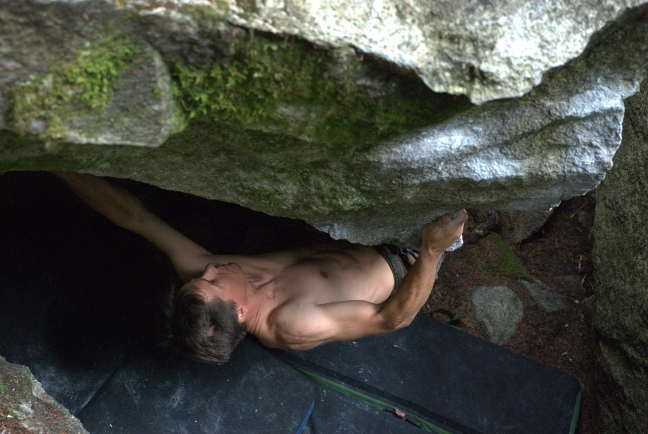
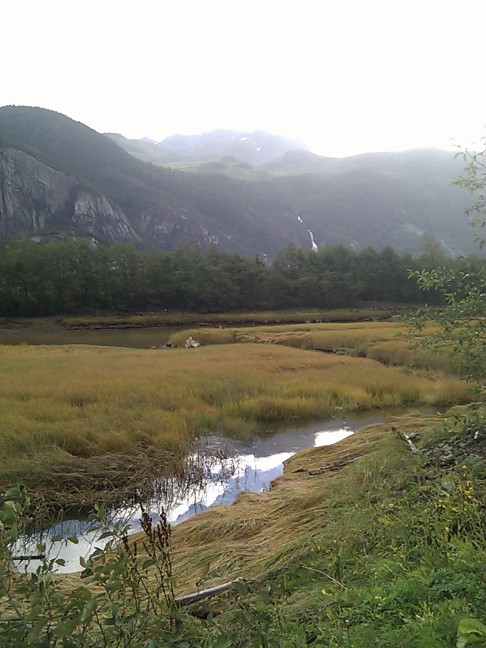
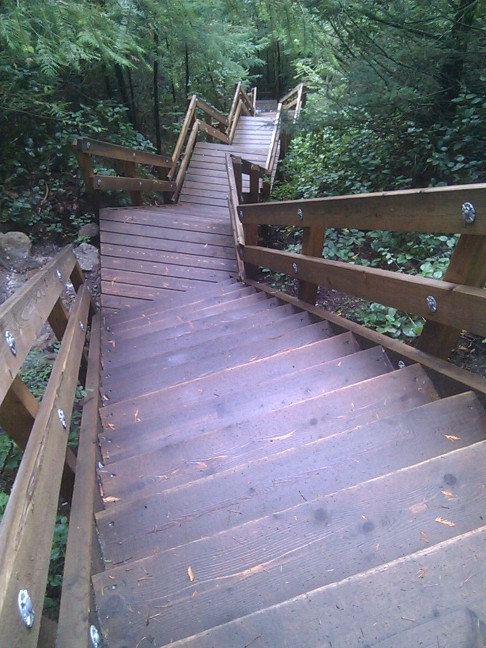
Jakub Climbing Kai Climbing Meadow Shannon Falls Stairs

I have yet to go a day without hearing three or four languages spoken or met people from any one of a dozen countries. I have climbed with visitors from Norway, Mexico, Czech Republic, Alaska (which truly should be a country of its own), and enjoyed breakfast and dinner at the camp ground with people from all over Canada. This morning I spoke with a man in his late seventies who could trace his family heritage 350 years to some of the first Dutch settlers in South Africa, his sense of pride conveyed in his proud stand and hazel eyes–not of the travesty of conflict his people inflicted, but of the steadfast heritage in one place that he does represent.

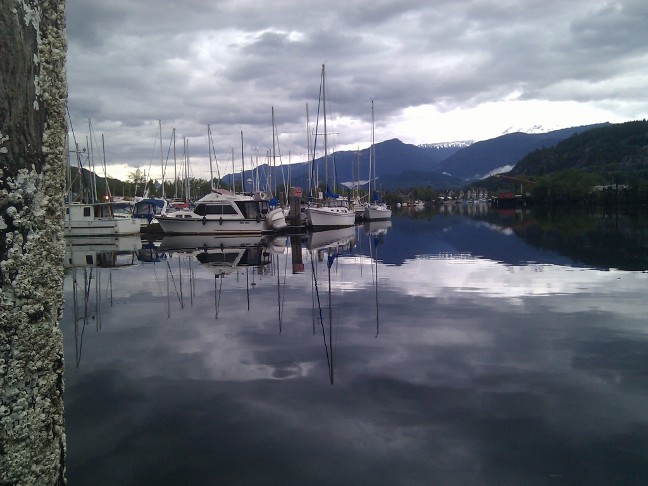
Squamish Marina

I met the Vice Commodore of the marina and gained from the experience of the Squamish Yacht Club, my interest expressed in purchasing a boat on which to live, to sail the world. A little more than fifteen thousand people and yet there are three yoga studios, a weekly farmers’ market and community organic farm; a music school, Indian, Chinese, and Japanese restaurants in addition to the usual McDonalds and Wendys. The Home Depot, Walmart, five-plex movie theater, several sporting goods stores, and three large groceries cater to the home of the 2010 Winter Olympics Whistler just up the hill.

An ocean harbor, estuary hikes, world class mountain biking, bouldering, massive multi-pitch granite routes, and water sports within a walk of downtown. Snow capped peaks are visible from the community rec center hot tub, the indoor pool offering a diving board, ladder swing, climbing contraption suspended from the ceiling, and an arsenal of foam boats for kids to wrestle with and overtake. What more could you ask for? It feels like it could be home, some day.

For now, I am both running away from and at the same time seeking home.
But this time the place I seek is a space inside of me.

By |2017-04-10T11:17:42-04:00October 4th, 2011|From the Road|1 Comment

Looking Up

Northern Colorado Business Report
“Astronomy keeps amateurs, pros looking up”
By Kai Staats
9 September 2011

When I was in my final year of high school and first two years of college I presided over the Phoenix Astronomical Society. In those years I was privileged to meet Eugene Shoemaker and David Levy, co-discoverers of the Shoemaker-Levy comet which later plunged into the atmosphere of Jupiter.

Now more than twenty years later, Gene has passed away, his ashes scattered on the surface of the moon while David and I had long ago lost contact. This summer, I dove headfirst into a documentary film project about astronomers and astrophysicists, my desire to capture their motivation to ask where did we come from, and why? A passion for knowledge expressed through looking up.

The second day of August I joined David, his wife Wendee, and three dozen amateur astronomers at the annual Adirondack Astronomy Retreat, hosted by SUNY in the mountains of upstate New York. It was a long overdue reunion with David and a wonderful learning experience for me, having been away from amateur astronomy for far too long.

In the process of working on my film and my return to astronomy, I came to appreciate two aspects which are both compelling and complimentary to each other. Astronomy, more than any other science, offers an accessible, functional bridge between amateurs and professionals, a gateway for the next generation to be compelled to learn.

Amateur astronomy enables anyone with some experience, patience, and a little luck to happen upon an event in the night sky which aids the professional community. While professional astronomers have at their disposal more advanced telescopes, the amount of time they have with them is limited by a long cue of researchers around the world. Furthermore, professional astronomers and professors often visit local astronomy club meetings to share their latest findings, young astronomers, as I once was, are inspired by direct interaction with professional scientists.

The sheer number of amateur astronomers world-wide is astounding, literally thousands of scopes peering into the sky every night. This makes for a world-wide network of data collection devices, some manually operated, some automated through computer driven tracking systems. What’s more, the opportunity for a budding astronomer to capture his or her first photograph of a colorful nebulae or the bands and moons of Jupiter is literally at their fingertips.

For the years I have been away from astronomy the industry has changed. Certainly, motor drives and tracking systems were in use, but we found our way around the night sky using hand held maps, large, many-page star charts printed in black and white. Now, micro-computers, stepper motors, and laptops attached by USB cables enable anyone with curiosity to engage in the oldest science of humankind.

As with the discussion around GPS versus topographical maps, one can argue that to know only how to use GPS units in the wilderness is a tremendous risk, for the batteries may die, or the lost in a creek. With aviation too, pilots are trained in the original, non-electronic means of navigation before working with on-board GPS and radar guidance.

There is part of me that says the same should be true with astronomy, learn it the hard way so that it becomes ingrained and a part of you. But when I consider the excitement of a child viewing the rings of Saturn for the first time, their mouth and eyes open wide, “Wow! Did you see that? Come look!” There is no right or wrong way to open the door to a lifelong passion for learning.

If in our instant gratification world a child can be turned on to the sciences, then by any means possible, point, click, and be thrilled. If they stick with it long enough, they will eventually know their way around the night sky and be able to tell their friends, “Right there, see that fuzzy thing? It’s a galaxy that if we could see it with our naked eye would be six times larger than the moon!”

While I am now just a bit over forty, I was a kid again for those three nights, staying awake ’till 4:30 AM, barely making it to breakfast hours after dawn. I was the recipient of patient assistance for astronomers are a generous lot, each generation offering something to the next. I spent an entire night taking my first photographs of Jupiter and M27, the Dumbbell nebulae, my new Canon 60D DSLR attached directly to a 13” Meade scope. Ah! The clarity, the color—it was amazing!

Even without assistance, someone new to astronomy can attach a USB cable to a relatively inexpensive telescope, train it on the North Star, and see on-screen a map of what lies overhead while the scope automagically moves to any object chosen by the mouse. Photographs can be logged, archived, and correlated to the map, an interactive show-n-tell.

With astronomy, every night is an adventure, an exploration of some one hundred billion stars, nebulae, and gaseous birthing chambers for the next generation of solar engines, pulsars, super novae, and black holes. The mind has no choice but to open when one looks through a telescope, to look up and ask, “Why?”

By |2017-10-21T16:51:35-04:00September 10th, 2011|Humans & Technology, NCBR|0 Comments

The God of the Rocket Ship

The Pious, the Righteous, the Holy Man’s Due
For all of recorded history the pious, the righteous, the holy men have told us what we should and should not do, who and what to embrace or avoid, how to live our lives too often through fearful restrictions of “no” rather than through proactive examples of “yes.” Why are we not encouraged to explore all there is?

They fight for the last breath of a way of life which is challenged by an interconnected world, giving fear a smaller place to hide. They defend the ancient ways because in a state of fear no one asks why.

At one point gods were the bearers of lightning bolts and thunder claps, the explanation for the migration of game and the success or failure of crops. Gods lived among us for thousands of years, producing offspring with supernatural powers. We now learn of Zeus as a myth of ancient times, but for the Greeks he was as real as are Jesus, Mohammad, and Buddha today.

Everyday we learn a little more about how the universe works, and every day our perception of God changes. If God is relegated as the filler of gaps, the things we cannot explain, then the more we rely upon our own experience, the more His kingdom takes on a different form. On Discovery’s new “Curiosity”, astrophysicist Stephen Hawking made a daring (for the North American audience) statement that God did not, could not have created the universe. While the show offered only a weak display of the discoveries on which Hawking and many others stand, the real issue is not if we should believe in a power greater than that which we can experience in these four dimensions, but what attributes do we grant that power in order to best guide us in our lives.

Of Expansion, Not Fear
The path to a higher level of living cannot be one of restriction and fear, for it is through the embrace of expansion and knowledge that we have found the greatest depth and beauty in a world we hold dear.

I do not believe in a greater power, but in the power of knowledge I do have faith. I believe in the power of people who come together to do good. I believe in both the private and shared experience of something greater than ourselves, an elated exchange between individuals who find connection to work through their pain. I believe the greatest celebration of what we have been given is to challenge the greatest gifts we do employ, our hearts and our brains.

If mathematicians spent two thousand years arguing the incremental value of “1” then calculus would have never been born and we would remain without moon dust on our boots or the birth of stars in our eyes. We would yet be an ignorant species, living in the security of our own mental bars.

Show me the maker of one hundred billion galaxies, each with hundreds of billions of stars, who cares not for the words we choose in our conversation, the way we dress, or how we share our bodies, as all animals do. Show me the great caretaker who does not track our sins on an eternal spreadsheet, but instead one who desires to give Her children the knowledge and power to explore the universe, to relish in the glory of space so much larger than our depraved, social din.

The Intergalactic Captain Comes
If God arrives in a rocket ship and calls from the upper deck of the captain’s lounge, “Who wants to see what I have built? It’s a-m-a-z-i-n-g! Everyone, please, come on board!” then I will be the first to believe in a maker greater than the power of one’s own mind.

Until then, I see individual spirituality and shared faith as a means to maintain hope, an anti-gravity to lift humanity above the weight of its antiquated, blind Pope. For the very confusion of our interpretation of everything we do will never give us clarity to truly see You. In this place, in this corner of intergalactic space, we are wasting time, two thousand years proving that we do in fact believe the right thing.

When do we stop reinforcing our foundation, and launch skyward to ride on a holy new wing?

Some say in death. Some say in a week. Some say never, while others, “It will be only the meek.” I say bring it on! I am ready to explore. Let’s welcome the God of everything and leave this humble, spinning abode. It’s time to rise above out petty differences, our boundaries so thin. It’s time to do something amazing, not the same thing over and over again.

Come God come, in rocket ship form! Show us you yet exist, the maker of our isolated, desolated, woefully focused home.

© Kai Staats 2011

By |2012-08-08T17:51:08-04:00August 21st, 2011|Looking up!, The Written|6 Comments

The Voice of a Bear

Last night I was too tired, too overwhelmed by the journey of the day to make it out to the hot tub. I watched a re-run of the original Star Trek series and then Mission Impossible, falling to sleep a few times on the couch, here at Buffalo Peak Ranch. I awoke this morning on the bed which lies adjacent to a large, east facing window, my face warmed with the rising sun. It’s an incredible way to wake each morning, naturally, without alarm. Just the increasing heat saying, “It’s time.”

There is a voice in my head which often declares, “I need to work. I don’t deserve to relax,” and the thought of sitting in the hot tub in the morning was today, initially pushed aside. But then it became clear to me that this was an old voice, perhaps that of a prior generation. I work each day. But there are no rules as to when, no right or wrong hour in which to engage. And so I walked to the platform on which the large tub sits, lifted one half of the heavy, water logged cover, and climbed in.

The steam rose from the surface of the water and molded edge of the tub. I settled in for no more than a minute when I heard the snap of a branch behind me, up the hill maybe a hundred yards or so. I spun ’round, attempting to locate the cause. I could not see far enough to recognize what was happening for the land drops into a gully of aspen and ground cover too thick to traverse without a struggle. It opens again on the far side, into a mixture of standing and fallen pine trees.

It happened again. Louder. Something very large was moving through the trees, but out of site. My heart pounded, but I logically assumed it was the three horses pressing against a fallen tree for a morning scratch, or a deer rubbing its antler.

I turned back to face the cabin, settling deeper into the water, only my head exposed.

Another crack, silence, and then what sounded like a tree falling, the echo of its crash resounding for a few seconds before I could hear only the humming birds again.

The top of a tree shaking, on the far side of the aspen grove. I stood up, sweating not from the warm water but from the simultaneous rush of fear and curiosity. I looked to my towel on the rack, over my shoulder to the cabin, and back again to the West, over the rail fence. What if it was a bear?

I waited, holding my breath. Nothing. Not a sound. I sat back onto the edge of the folded hot tub cover. I waited longer still. Horses. It must be the horses.

Then I heard the unmistakable bark of a bear, for I had hear them a few times when sea kayaking at Glacier Bay, Alaska six years prior. The top of a tree nearer to me moved while the others stood still. Then another closer. Still, I could not see what was moving through the thicket. Another bark. Another broken branch under heavy foot.

It came into the clearing between the fence and the trees, just thirty yards from me. It was massive. Not a cub, but a full grown black bear. Both beautiful and awesome, more than four foot tall at the shoulders. I had never seen one this large before.

It did not see me, at first. I slowly sunk back down into the tub. It noticed the motion and stood on its hind legs to assess the situation. My heart pounded. I didn’t know what to do. It sounds crazy, but I wished for a pot and pan to bang together, anything to make a noise it would not expect.

The bear dropped to all fours, grunted, and then lunged forward. It was coming directly toward me.

I did what I had learned in the books I had read on bear attacks many years prior, before ten days solo backpacking in Denali, Alaska. I stood up again and waved my arms as only humans can do. We are not a part of their natural diet, I reminded myself again and again.

“Hey bear! Hey bear!” continuing to wave my arms. I tried to stay calm, relaxed. Don’t show any fear. They can smell fear.

I looked back over my shoulder and contemplated running into the house, but bears move fast and love to give chase. The only barrier was the wooden fence, three horizontal logs with an X brace every fifteen feet. The bear stopped at the fence and peered at me between the top two rungs. I hoped it was satisfied, and would turn to go a different direction.

Instead, it rose onto his hind legs again, paused, and with almost no effort dropped onto the top and then middle rung, crushing them both with ease. I could not break a twig with any less effort, and at that moment it was less than twenty feet from me.

I spun, reached back across the tub’s cover and pulled on the edge, trying to flip it over me. It was too heavy, the angle completely wrong. I nearly cried as air rushed from my lungs. I pulled again and again. I looked back to the bear. It seemed momentarily startled by my motion, considering what to do next.

I had no choice. I jumped over the edge of the tub, ran around the platform to the far side and lifted the lid. It rose up, tall and wide. While holding it vertical, I jumped back in. The lid came down with me, weighing heavy on my head and shoulders. I slipped and fell into the water. I wished immediately that I had turned on the light, for I was immersed fully in the darkness. My face was forced under water by the weight of the cover against the back of my head. I swallowed water and choked, but forced the panic to retreat. I turned side to side, trying to get my mouth above the water line, but could not. I threw my hands over my head, trying to find my bearing in the darkness but my feet kept slipping and I was running out of air.

I held what remained of my breath and remembered there was six inches between the bottom of the lid and the surface of the water. I would only be able to breathe if I flipped over onto my back with my hands and legs spread beneath me for support of some kind.

I slipped a few times, choking on more water inhaled, but found a position which allowed me to breathe. I opened my eyes and tried not to panic. It was dark and hot. I could barely see. My mind raced, How long could I remain here? How long should I wait?

Fortunately, I had placed the tub’s automated circulation on stand-by. Everything was quiet. I could hear only my heart beat in my ears. Pounding.

My eyes adjusted. I could see the edges of the tub inside, the surface of the water just beneath my neck. I turned my head left and then right, one ear and then the other dipping into the water as I looked for the source of the light. It was on the south side of the tub, the side that faces the barn that there was an opening, a break in the cover where it hinged.

I felt a little more calm, for that also meant there was fresh air too. As long as the water remained warm, I could stay here for a while. And I did, for what felt like an hour.

I listened intently, holding my breath from time to time. Was the bear still outside? I could hear only the sound of my body half sitting, half floating in the water, my nose pressed to the underside of the cover. I was stretching my back and legs, trying to relax when I heard the deck moan and felt a subtle movement of the entire platform.

I looked to the gap, but it was dark. There was no light.

Oh shit! It’s right next to the tub! Shit! shit! shit!

Then the light returned, something moved outside from left to right. I could hear it breathe. It pawed the surface of the deck and the entire platform shook, sending ripples through the water which I felt in my chest. I hoped only that the weight of the cover would be enough to keep me safe. There was nothing I could do. I wanted to cry, or scream, but knew either would only make my situation worse.

I held my breath again. Waited. The bear circled the entire tub. I could hear his pads and claws. He was slow, almost contemplative. I imagined he was trying to learn how to get inside.

I began to shake, as though the temperature had dropped fifty degrees, I couldn’t stop. I thought of being in Kenya, malaria overwhelming my body in just a matter of minutes. I felt out of control. I couldn’t stay here. I panicked, held my breath, rolled over onto my stomach, and moved to stand up.

The cover lifted, just a bit. I peered out into the light, looking again at the direction from which the bear had come. The fence was shattered, reminding me of the strength he deployed.

With my hands and arms overhead, the majority of the weight on my neck and upper back, I looked to the left, to the right again, and then directly ahead.

It was right there, in front of me, it’s massive nose over the lip of the tub. I could smell its breath and it looked directly into my eyes.

I slipped and fell back into the tub, the full weight of the lid crashing down onto the bear’s nose, which it immediately withdrew. I was submerged for a moment and inhaled more water. I tried to stand up, but my head hit hard against the underside of the cover. I remembered that I needed to roll on to my back, and forced myself to breathe, slowly, pressing my lips together when I exhaled. My heart was in my eyes, in my hands and head. I waited. I heard nothing.

What came next was confusing, for I thought I heard someone crying. Subtle at first, and then much more bold. Yes, someone was outside, crying. I must have hit my head harder than I realized, or perhaps I was dead. Was someone else out there? The hot tub repair man was not slated to arrive or another two hours. It didn’t make sense.

I looked to the opening and the slit of light.

The crying stopped. But was soon replaced with sobbing. A deep pain expressed by a deep, dynamic voice, “Oh! My nose! My nose is broken!”

What the –?! That’s impossible.

I held my breath, rolled back to my stomach, face in the water, found my balance and stood up. Just part way at first, and then fully, the lid of the tub now balanced in the up right position.

The bear was off the deck, sitting in the grass, upright, his paws covering his nose. Tears streamed from his eyes when he looked up at me, “Why d-d-did you do that?”

Startled, “Do what?”

“My nose. You, you broke my nose!” he growled, the back of his paw stroking the side of his great face.

“I’m, I’m sorry. I slipped … here, inside,” pointing to the tub in which I obviously stood. I felt horrible. “Just a moment. Please.”

I thought, What am I doing? but moved ahead. I sat on the edge of the tub, holding the lid so it would not crash down again. I stopped, turned to the bear and asked, “Are you … are you going to eat me?”

“What? Are you kidding? Look at my nose! I coul–I couldn’t eat a mouse if it jumped into my mouth, let alone eat you!” It paused, the tears fewer than before. It shook its giant head and again I was scared. One bite, one swipe of his massive claws and I would be dead.

Talking more to myself than to the bear, “Ok. I am. Um, I am going to just get out of this … the hot tub … now. Ok?”

The bear looked at me, and then again to the ground.

I stepped slowly to the deck, lowering the lid until it came to a close. Drops of water fell from my body to the deck, each releasing a small puff of vapor against the morning light.

I could not believe this was happening.

I looked to my right and saw the door of the cabin. I could probably make it inside, if I ran. But I knew that a bear this massive could crush the door, no matter how I locked it. I accepted that If he had wanted to eat me, I would already be his meal.

I looked back to my left. The bear remained where he was.

I walked closer, one step at a time. He sat upright and dropped his paws from his nose, asking, “Does it look bad?”

I smiled, hesitantly, “No, it doesn’t look bad at all. It’s not bleeding. Do you mind if I take a, um, closer look?”

He shook his head, lowering himself a bit. I stepped from the deck, noticing that his hind feet were larger than mine, his front pads and claws much larger than my hands. I reached out to his nose, but withdrew. He looked up and into my eyes to say it would be ok.

“This may hurt a bit … I want to see what kind of break you may have. Ok?”

“Ok,” he responded.

I reached out again, touching the bridge of his nose, lightly at first and then with more pressure. He flinched, pulled back and bared his teeth. I involuntarily took a few steps back, tripped and landed onto the platform which held the tub. I automatically retracted my feet and arms, rolling into a defensive ball.

He almost seemed amused, apologized, and promised to hold still.

I gathered myself and rose awkwardly back to my feet. I walked forward and touched his nose again, pressing on the top and sides. It was a massive, beautiful nose, and it did not feel broken, just deeply bruised. There was a soft, swollen spot on top but no sharp edges or fragments that moved.

I explained as much to the bear, and he seemed to be relieved.

“Good. That’s good,” he said.

I sat down again on the wooden platform, my elbows on my knees. I just stared, not knowing what to say. He too seemed short on words, sometimes looking at me, sometimes over my shoulder to the bird feeder outside the front door of the cabin.

After a few minutes, he offered, “I like humming birds. I wish I could move they way they do. I feel awkward, sometimes.”

Surprised, I didn’t know quite how to respond, “Oh?”

“Why are you out here alone?” He was kind, careful with his words despite his size and power.

“I lost someone a few days ago, someone I love very much. This place is healing for me.”

He looked puzzled, “Where did you last see him? Maybe I can help you find him. I have a good–rather, I had a good nose, you know.”

I sensed humor in his words and laughed, “Not like that. She is not missing, rather, simply no longer a part of my life.”

“Oh. I see.” He rose from his seated position onto all fours again. I was instantly reminded of his incredible build. Eight hundred, maybe a thousand pounds or more. The buffalo in the pasture across the road were almost small in comparison, despite their broad heads.

He continued, “What did you do?”

“Everything I could.”

“Maybe that was too much.”

“Yes” I looked to the ground, “maybe that is true.”

He paused, and looked over his shoulder to the ridge to the south and west, “I lost someone too.”

I was taken back, just getting used to the presence of a talking bear when I was again caught off guard by the depth with which he did communicate. For a fleeting moment the scientist in me realized how much we had incorrectly assumed about the animal world. Would this bear be willing to conduct an interview?

“Oh?”

“Yes. A wonderful she-bear. Beautiful to me in so many, many ways. My best friend too.”

“I can only imagine,” I nodded my head and then looked to the ground, “What happened?”

“We were unable to confront our fears.”

“Scared? A bear?”

“Yes, even bears get scared. We put on a good show, crashing through the brush, knocking down trees, scaring campers (which is great fun, by the way). But ultimately, we are very soft in the heart, and we have a lot to say.”

“I am surprised, and very pleased to learn this.”

He moved closer to me but I was no longer afraid. I reached out to stroke the top of his broad head, and rub his ears. He seemed to like this a lot, and to the best of his ability, smiled. He licked the palm of my hand until the salt was gone. We didn’t say much more than this, for the day was young. I went back inside, changed clothes, put on my hiking boots, and requested that the bear show me his domain.

We hiked for countless miles, learning about the terrain I had only begun to understand. The bear was a great teacher, and I felt, a healer of some kind. He had many questions about humans too, mostly why we encroached year after year on their land. He seemed embarrassed to admit he had rummaged through human garbage, in tough times. I apologized as best I could, on behalf of our selfish kind. He said it didn’t matter, in the long run, for all things worked out in the end.

The sun set upon the bear and me, sitting on a giant, fallen pine. We watched as the shadows grew long, the warm rays cooling until there were none. He thanked me for the day, and apologized for the broken fence, explaining that he was rather clumsy, for a bear. He wanted only to talk, all along. His nose was feeling better already, and my heart was lifted too. We promised to meet again some day, in this friendship that was new.

There were encounters with other local residents too, as described in When the Coyote Calls

© Kai Staats 2011

By |2019-10-05T15:06:12-04:00August 18th, 2011|At Home in the Rockies, Dreams|0 Comments

Solar Powered Hot Tub

Northern Colorado Business Report
“Solar Powered Hot Tub”
By Kai Staats
12 August 2011

This summer I collaborated with three friends on the design and installation of a grid-tied, battery backed 5.6KW, 24 panel photovoltaic array on a 260 acre ranch near Bailey, Colorado. Despite the challenges of a relatively large-scale renewable energy project, it was an incredible pleasure beginning to end, given the stunning beauty of the location and contagious energy of the tireless individuals who were as eager to dig a seventy five foot trench as they were to learn hands-on about electrical wiring.

Twenty four, four foot deep holes filled with concrete provide the foundation to six aluminum frames which hold four panels each. We rewired three electrical boxes, migrating mission critical circuits (ie: lights, outlets, water pump, refrigerator) to the panel which is now isolated from the grid and powered by the battery-backed inverter. Best of all, there is ample power for the hot tub.

At 8,000 feet the ranch is surrounded by ten thousand foot peaks, undulating hilltops and ravines which harbor horses, deer, coyotes, bear, and buffalo. Any sense of guilt at having enjoyed such a job site is completely washed away when I consider that the power required to heat the hot tub is more than offset by the new solar PV array.

The introduction of a passive solar water heater would certainly be more efficient than converting sunlight to electricity which in turn heats the water, but as with most adoptions of technology, change is best taken one step at a time. This is true not only on the small scale of one ranch in the middle of thousands in Colorado, but also for the worldwide effort to transition to renewable energy.

Too often I hear the argument that we will never be able to rely entirely upon renewable energy sources, that the efficiency of solar panels and wind turbines is simply not high enough to produce the power required.
This skepticism is parallel to the naysayers of so many human achievements—and a failure to recognize the relatively brief history of research and the commercial application to renewable energy. As with all evolving technologies, renewable energy will not achieve full market play until market demand and the resulting mass production forces a higher level of efficiency. In this case “grid parity,” or the ability to produce energy for the same or lower cost than traditional methods such as coal, nuclear, or gas. The good news is that we have achieved this in certain markets, and are moving to find grid parity in a greater diversity of regions.

The history of photovoltaic energy production goes back to 1883 where Charles Fritts created a solar cell which converted just one percent of sunlight into electricity. In the late 1960s Elliot Berman and an Exxon research team increased the power-to-cost ratio by five fold in just two years. Fast forward and solar cells are manufactured today for roughly $1 per watt, compared to $250 in 1954. A two hundred and fifty times reduction in the cost of manufacturing in roughly sixty years without a market nearly as substantial as the housing, automobile, or even bicycle industries.

So what is holding solar power back?

I will not dive into the politics of renewable energy, for that alone could fill a few columns. At a lightly technical level there are some hurdles which have only recently been surmounted. The entry at wikipedia.org/wiki/Solar_cell provides an in-depth journey through the history and technology of the photovoltaic principal. The basic concept, however, is this: humans see what we call the visible portion of the spectrum while silicon-based solar cells are able to convert only a portion of that light energy into electricity. While the visible spectrum represents a good bit of the energy produced by the sun, this does not constitute the full energy available for conversion to electricity.

We are missing the tremendous potential for conversion of infrared and ultraviolet light energy. Relatively recent research into combinations of elements to expand the sensitivity of the solar cell has increased the efficiency of energy conversion.

In our own backyard, the National Renewable Energy Lab is researching cells with upwards of 40% efficiency, more than forty times greater than the original solar cell just 150 years ago. While southern California and Hawaii have achieved grid parity using traditional silicon based solar cells at efficiencies at or below 20%, the near-future potential for doubling this efficiency lies in the ability to reduce cost of production, the result being that multi-spectral systems are available to you, me, and those who have solar powered hot tubs in the mountains of Colorado at a market friendly price.

Until that time, I am pleased to sit back after a hard day’s work and know that the warm water which gives me comfort was generated, even if indirectly, by energy from the sun. I believe the near-future holds an exciting, rapid evolution for renewable energy production, soon becoming something greater than an alternative, rather, simply the way it is done.

By |2017-10-21T16:48:59-04:00August 12th, 2011|Humans & Technology, NCBR|0 Comments

To See Again

I am able to see again, to observe and engage the world around me in a way that compels me to write. It’s been a while, more than six months, maybe a year since I felt this way. It’s good to be in this place again.

By |2011-08-09T15:35:03-04:00August 9th, 2011|The Written|1 Comment

The Good Sam’s Utopia

Transient Homes
Certainly, Good Sam’s was not my first pick, but at thirty seven dollars for one night it was half the cost of the next accommodation in this beach side, New Hampshire town of Seabrook, one mile from the intersection of I395 and I95 and on the Atlantic Coast.

I was granted the very last tent spot 47A which has no official parking spot, but does sport the highest spot in the campground at some ten or twelve feet from the roadbed, a picnic bench, fire pit, and a view down and into the court yard of the half dozen adjacent RVs, none of which is more than thirty feet distance.

The smell of camp fires mixed with bug spray, cleaning supplies from the nearest bathhouse, outdoor cooking, and diesel from a large truck which just passed by. Across the road and a few meters down, a father crept beneath the window of the RV in which his kids were playing cards, popped up to slap the glass and yelled in his best monster voice. The kids screamed and then laughed in quick succession. The same interaction likely plays out night after night and neither grows wary, at least not until the children grow to be teenagers and dread the very presence of their father as much as the mandatory, summer family camping trip.

In the toilet and shower facility I quickly discovered that the men’s and women’s units were separated by a wall but shared an open ceiling space, all conversations moving without resistance into the adjacent facility. Two girls, perhaps in their late teens dared each other to pee in the shower, I gathered, without taking a shower at all.

When I finished brushing my teeth and left to walk back to my rental car, I recognized the voices of the girls who exited their side of the bathhouse at the same time.

One said to the other, “Where are we”?

“I don’t know. You live here, and you don’t know?”

“No. I’m lost.” She then turned to me, “You know where we are?”

Given that we were in a campground whose density of patrons matched that of Japanese tube hotels, and roadways the narrow streets of old Barcelona, I played along, “No. No clue. I was hoping you knew,” as I approached my car and reached into my pocket to grasp the key remote. A few more steps, and I pressed the unlock button. The lights flashed and the horn chirped.

“Is that your car?”

“Yup.

“Oh, so you DO know where you are.”

“No, but I do know the location of my car.” She didn’t catch the subtle challenge in that response and said only, “Oh!”

I stopped to open the back and they continued. I lost track of them quickly as the road was dark, lit only by the camp fires, porch lights, and rope lighting of the RVs.

Escape from Ourselves
I sat on the bumper and looked around. The Good Sam’s campground took on a new form in my mind. I was less offended by the obvious eye sore and more interested in the social experiment at play.

For the prior three nights I had been staying in cabins whose tenants were amateur astronomers, assembled for the intent purpose of sharing their passion for observing, for exploring the night sky. They maintained the utmost respect for each other by using only red lit headlamps, car dome lights, flash lights, pen lights, and perimeter lights on their scope legs and bodies.

Here, I originally found the stimuli overwhelming as loud voices contended with car doors slamming, kids screaming, fire crackers, televisions, radios, and the laughter of drunken adults who freely expressed all they had withheld since their last escape to the great outdoors.

With the words of the second girl, “You live here” I realized the unique qualities of this place in that it was congregation of semi-permanent residents with transient campers, like me. In a subtle way, everyone in this place agreed to a certain level of compliance to an unwritten set of rules which enabled the place to function without major confrontation.

The residents understood that their neighbors may come and go, staying one, two or a half dozen night before moving on. Those who passed through understood this was home to some people, and therefore deserved a level of respect for property and space.

I walked the entire perimeter and all interior roads twice, once to explore and then again to capture some time lapse photographs, the shadows of the night giving way to streaks of illumination as burning wood yields dancing flames. This is what I experienced.

A couple sat to the side of a fire, an open bottle of wine and two glasses reflecting the light. They said little, mostly staring into the flames. Several fires burnt unattended, the flames dropping between my first and second pass. A father played cards with his daughter at a picnic bench, their faces illuminated by the blue glow of a lantern reflecting from the inside of a suspended tarp. A dozen teenagers sat ’round a large fire on the edge of the campground, one boy played guitar and sang, his audience completely engrossed. A half dozen adults spoke aloud from stackable plastic lawn chairs, a block party unfolding.The side of their RV was adorned with string lights up and across the awning supports and around the bumper. Some RVs showcased plastic deer, white picket fences, water fountains, and an American flag. A preteen boy raced by on his BMX bike, apparently able to see well into the midnight spectrum where the rest of us walked with caution. A man in his sixties leaned over a picnic bench, his glasses low on his nose as he attempted to read the instructions of a manual printed in too small a font. The battery powered lantern to his side cast a cold, nearly white light upon his face, the bridge of his nose the divide between the light and dark portions of the rising, crescent moon.

Everyone came to this place to get away from home, with the understanding they would be living a simpler life for the duration. One bowl, one plate, one spoon. A small cook stove with few pans. Simple foods, and for most, no television, laptop, or cell phone. This is a retreat from the very things we work our entire lives to acquire, only to be overwhelmed by them in return. These people, myself included, are happier living this way. And yet, they will soon return to the complexity of ownership of more things, things which were not forced upon them but acquired of their own accord.

Ironic, it seems, that we must escape the very life we have created for ourselves. What keeps us from just living this simple life every day? Why are we afraid to stop acquiring, to say “Enough already! I don’t need any more.” There seems to be a process which takes us from tent to camper to RV, from Coleman fuel camp stove to four-burner propane kitchenettes. Is this the process which also takes college students from Raman noodles and masonry block book shelves to IKIA and eventually a custom built home which is challenging, if not impossible to afford?

I cannot help but laugh when I walk by the RVs whose small yards harbor miniature flower gardens, a sense of order and beauty surrounded on all sides by the chaos of an over crowded, noisy, dusty campground. They have established their island in this flotilla of drifters and weekend bums.

The Good Sam’s Utopia
I grew up with Star Trek which presented a vision of neat, clean, highly organized society filled with people who were content for their station in life. Everyone was important, everyone was needed, well educated, and capable. In contrast, Arthur C. Clarke’s “Rendezvous with Rama” books present an accurate portrayal of human society unfolding in a confined, isolated space. How many years would it take for highly trained military personel and researchers to resort to their human tendency of wanting more, to take more at the cost of their neighbor? How many generations would it take for humans to carve out camps which battle each other for resources? How soon would God intervene, showing her face in the diversity of fragmented expressions which somehow oppose each other, despite their common body and figure head?

But somehow, if I were to envision utopia, I am not certain it would be all that different than this–given a few hundred people in a completely new setting, the first to colonize the Moon or Mars, a campground is more likely an example of how humanity will touch the face of the next world. Synthetic reminders of a home far away, time made to play musical instruments at the end of a day, children free to ride their low gravity bicycles from the living quarters to the community bathhouse as long as they come right back and don’t bother the others, a loose sense of community and a respect for personal space.

Perhaps, if we are lucky, the first off-world colonies will not follow our own history played out again and again as the Rama saga depicts, rather, a Good Sam’s campground will provide the model for a perfect, human utopia.

© Kai Staats 2011

By |2017-04-10T11:17:42-04:00August 6th, 2011|From the Road, Looking up!|0 Comments

Andromeda’s Claim

When the Clouds Cover the Stars
When the clouds cover the stars, the astronomers come indoors. The guitars are removed from their cases and laptop lids are closed. We gathered to share the songs which have been sung for five decades, since the revolution that temporarily gave comfort to those who were different from the rest. It was a time to be accepted. Here too everyone is accepted, no matter how awkward, no matter how socially odd in the real world. Here, everyone has a talent, a gift, a shared passion to teach and to learn.

Wendee and two others transition to a semi-private discussion of the politics of government, cuts in education, and how amateur astronomy remains a bridge for children, from raw passion for learning to applied sciences when the school systems fail again and again. Federal mandates curb creativity and threaten the individuality and creativity of otherwise capable teachers.

Steve, Bob, and Brad sit in the same order at the same table at each meal, and this night as well. Each is a bit cantankerous, sarcastic, and yet more generous with their time in three days and nights than some parents are in a life time with their children. They relish the opportunity to help someone, like me, snap my very first photograph of a distant planet, nebulae, or cluster of stars.

I pull up a backward facing chair and lean onto the table to their front, elbows and shoulder braced for what I know will be a fight.

I say, “So, tomorrow, I would like to interview the three of you, at the same time.”

Brad is quick to respond, “Yeah? When would that be?”

Bob adds, “I am not certain we are worthy of an interview.”

Steve stares at me for a while before saying, “I’m not available. Very busy, you know.”

Brad quips, “Yeah, you gotta talk to Steve’s agent.”

Bob again, “So why do you think we’re worth interviewing?”

Without hesitation I respond to all three, “No, not really. Individually you are boring, not worth my time. But together you’re entertaining. I need comic relief in my documentary.” We all break character and laugh. I conclude, “Allow me to rephrase: I am going to interview the three of you so all you have to do is pick the time. No option. Got it?”

Steve comes back, smiling, “Hey! He is catching on pretty quick. He’s gonna be one of us pretty soon!” They all laughed and agreed to 1:00 pm the next day.

Stories Unfold
My interviews have gone well. Good content, great stories. David tells of his phone call with a professional astronomer who confirmed his discovery of Shoemaker-Levy 9, the famous comet that crashed into the atmosphere of Jupiter. I am captivated, as though it was happening all over again.

I recall many years ago when David came to speak to the Phoenix Astronomical Society for which I served as President at that time. He had made his discovery just a few days prior to our club meeting at which David was speaking. He entered the room and there was silence. David cleared his throat, looked around the room, cleared his throat again and said, “As you may have guessed, there is going to be a change of subject for my presentation for the evening.”

David wears a light blue T-shirt which reads, “Don’t blame me! I voted for Pluto!” The value of this otherwise comical tribute to Clyde Tombaugh is given full weight when one considers that David wrote a biography of Clyde’s life in the ’90s, a copy of which remains on my bookshelf.

A New Adventure Every Night
It’s 12:30 am and a half dozen remain in the dining hall, watching the live Doplar radar and Star Trek out-takes on YouTube, hoping for a break in the clouds. Staying up till 1:00 am is consider the bare minimum, three to four the norm. Sleep ’till 10:15 the next morning and eat breakfast at 10:30.

Every night is an adventure, an exploration of some one hundred billion stars, nebulae, gaseous birthing chambers for the next generation of solar engines, pulsars, super novae, and black holes. Even with an eight inch diameter telescope, one that can be carried underarm, a ten minute exposure illuminates a half dozen other galaxies with spiral arms, hot, glowing centers, tilted and thrown about in what appears to be, from our point of view, a chaotic array of tossed white dishes in a black, spotted basin.

The mind has no choice but to open when one looks through a telescope. It is nearly impossible to walk away from a night of observing and return unaffected to that other world of political battles, economic downturns, looting, warfare, and starvation. The contrast is tremendous. I am compelled to ask of the congressmen who squabble over the appropriation of dollars, of religious leaders who proclaim holy wars to cleanse the world of unbelievers, and of military generals who order their soldiers to use rape as a weapon against the opposing tribe, even if knowingly naive, “Look up! Have you ever seen something so beautiful?”

When viewing an impressive photo of the Andromeda galaxy, the closest neighbor to our own, I considered that our human race could perhaps have enjoyed a very different history if only we could see the outstretched arms and rich, dynamic body of another galaxy with our naked eye. It is, after all, six times larger than the moon in the night sky.

Andromeda’s Claim
The sun, moon, and planets are our celestial partners, tightly coupled on the same, nearly level playing field. They move and interact with us directly. We have over time attributed the planets with the power of gods, suggesting that their color and motion in the sky is that of emotion expressed at how we manage our lives. But to consider that the lives and deaths of creatures whose very bodies are but an infinitesimal fraction of the mass of the soil on which they walk, somehow please or displease a power so great that it created hundreds of millions of planets in each of a hundred billion galaxies seems dreadfully egocentric and selfishly unaware.

If we could see the Andromeda galaxy overhead, perhaps we would recognize that we were never alone, and did not need to invent gods to micromanage our affairs. Perhaps we would have understood long ago that the heavens are unaware of what we say, with whom we share our bed, or whether we live clothed or bare. We are an incredible aggregation of self-organized matter, a moment of entropy in reverse. We are the heavy stuff of long ago dead stars, not the finger puppet of something greater or something less.

Six billion humans, each the center of his or her own universe … or a universe which likely harbors far more than six billion planets capable of life, each unique to all the rest.

If we could see the Andromeda galaxy overhead, perhaps then we could recognize the fallacy of believing that our lives are worth destroying in order to gain what we do not already have, when in fact we are simple travelers on an interstellar ship, spinning at 1600 kilometers per hour, orbiting our local star at more than one hundred times this velocity, racing toward the star Vega at 70,000 kilometers per hour.

With resources limited and running low, the only way we will ever arrive to where it is we want to go is to give of ourselves without concern for what remains to call our own. If only we could see the Andromeda galaxy overhead, perhaps its light would remind us that we are not alone.

© Kai Staats 2011

By |2017-04-10T11:17:43-04:00August 3rd, 2011|From the Road, Looking up!|0 Comments

To Hold the Sun

Kai Staats - Buffalo Ranch Solar PV Install

Kai Staats - Buffalo Ranch Solar PV Install Kai Staats - Buffalo Ranch Solar PV Install Kai Staats - Buffalo Ranch Solar PV Install Kai Staats - Buffalo Ranch Solar PV Install

Kai Staats - Buffalo Ranch Solar PV Install

The owner of Buffalo Peak Ranch, Leigh McGill, desired to have a battery backup for the cabin and barn. Lightning strikes and falling trees (since the Hayman fire some ten years ago) frequently cut power for hours, even days at at time. While we could have installed a simpler grid-tied, battery backed or even auto-generator system, it was determined that to generate our own power from the Sun was a preferred solution.

We worked with The Solar Biz, an established, New Mexico based, family-owned distributor of all things solar to design and procure the system, my company Over the Sun, LLC the reseller and installer.

Kai Staats - Buffalo Ranch Solar PV Install

As many projects do unfold, it was more work than anticipated. We set concrete forms to support the PV panel runs, a good 32 or 36 inches below grade to avoid frost-heave. The racks required some modification, but nothing a hack saw and drill could not remedy, and in the end the panels sit side by side, perfectly aligned.

Our four man team was comprised of Trevor (ranch hand), Clint (son of the owner), Chris (renewable energy engineer out of Fort Collins, my co-worker and friend), and me. We worked well together, logging long hours for a few weeks in total.

The deep trench was started with a ditch-witch, but in the end, much of it came down to a pickax and shovel (and Clint’s strong back). The pipe was laid in place and then the heavy, thick cables lubricated and pushed/pulled through, chasing a braided, nylon string which was inserted into each piece pipe, one by one. I forget the exact length, but moving more than one hundred feet of cable is not a simple task. Each bend in the pipe, each joint offered more of a challenge as it neared the end.

Kai Staats - Buffalo Ranch Solar PV Install

I built a utility wall from which the Xantrex inverter and charge controllers hang. The eight 6V batteries (48V array) rest on a sturdy shelf beneath. Ample power to run the electric oven, fridge, microwave, and heaters in the fall and spring. This was my second Xantrex wiring effort (the first being my house in Loveland) and while familiar, it remained a bit tricky. But in the end, having rewired both electrical panels on the house in order to isolate mission-critical circuits for backup power, it works perfectly.

I cannot think of a place in which I’d rather work. At more than 7000 feet elevation, there are elk, coyotes, fox, deer, bear, horses and domestic buffalo. It is a place in which I feel truly calm. It is one of my favorite places in the world.

With 24 220W panels, the system generates a theoretical maximum 5200W. It produces more when in direct, early afternoon sun. But generally, we see between 4-5k with less than 10% total system loss (D/C from the panels to the charge controllers, batteries, inverter). It’s a good, functional solution that will generate more power, over the year, than is consumed meaning eventually, it will pay for itself in addition to its obvious functionality.

Even the hot tub is solar powered. That makes me feel good.

By |2017-04-10T11:17:43-04:00July 31st, 2011|At Home in the Rockies|0 Comments
Go to Top