About Kai Staats

This author has not yet filled in any details.
So far Kai Staats has created 575 blog entries.

Postcard from Mars – a SIMOC update: March 10, 2018

At 8 pm this evening, the ASU Capstone team that has been developing the SIMOC game interface will have completed the first working prototype. This brings to fruition six months development of this unique agent model, and lays the foundation for its continued evolution.

As with all software projects, we begin with the blue sky as our goal, and a belief that we will reach that far. In October, November, and December of 2017 we engaged two calls each week, Saturday and Monday evenings. These 1-3 hour brainstorming sessions were a chance for the entire team to explore the possibilities of a scalable, mathematical model with a gaming interface.

We continually juggled the need to build a scientific foundation, a tool to be used for research with the goal to provide a gaming interface that engaged the non-scientific community (while yet producing scientific data, under the hood). While I have extensive experience in software development through my ten years as CEO of Terra Soft, and each of the ASU team came on-board with skills and experience ranging from Python to C, bash to CSS and SQL servers, none of us have built anything quite like this. None of us was truly the leader, nor anyone following. We all pitched in, challenged each other in the conversations, and slowly laid a design foundation that seemed to work.

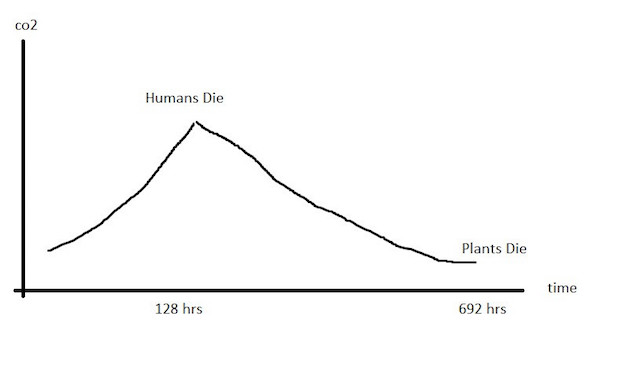
ASU undergraduate astronomy student Tyler Cox came on-board in July 2017 to get the ball rolling. He built the first, working agent-based model (ABM) using Python and the Mesa library. He was able to quickly demonstrate a functional “astronaut in a can” model in which the initial parameters determined if the human crew of astronauts lived or died (they mostly died). Even our simple model with a light interaction between humans, a few species of plants, and a contained atmosphere proved tricky as even a minor imbalance in the system lead to catastrophic results.

SIMOC data flow by Ben Mccord

In January the capstone team duplicated Tyler’s work on an Amazon web server, integrating SIMOC into an SQL database instead of the original JSON configuration files. Following a minor setback in which we realized Unity was overkill and a good ol’ web interface would suffice, we reset our expectations and started again. The end result goes lives tonight at 8 pm Arizona Mountain Time. It will be simple, and a little rough around the edges, but the Launch screen, Configuration Wizard, and Dashboard (game interface) will be complete (for now).

I have enjoyed the pleasure of working with the following ASU undergraduate students through the Computer Science Capstone team: Ben McCord, Greg Schoberth, Terry Turner, Thomas Curry, and Yves Koulidiati. In addition, we have this year welcomed the incredibly talented, widely published space artist and habitat designer Bryan Versteeg of Spacehabs.com as a backbone to our design process. And most recently, Kevin Hubbard comes to us with a strong foundation in the social sciences, his intent to introduce a means by which we can integrate human social behavior into a more advanced version of our model.

By |2019-07-07T13:53:05-04:00March 10th, 2018|Looking up!, Ramblings of a Researcher|Comments Off on Postcard from Mars – a SIMOC update: March 10, 2018

A Fear of Silence

It seems we have grown afraid of silence.

Despite the increasing isolation, we no longer know how to be alone.

We now talk to our computers, to our cars, to the machines that provide our music and to our phones. Talking, talking, always talking. Yet, we no longer longer just talk to each other.

It seems we have grown afraid of silence.

It seems we don’t want to be alone.

By |2018-02-19T02:45:19-04:00February 19th, 2018|The Written|Comments Off on A Fear of Silence

Postcard from Mars – a SIMOC update: February 5, 2018

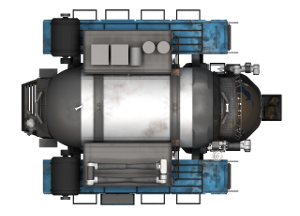
Rover by Bryan Versteeg Just two weeks ago our work on SIMOC resumed. The holiday break was longer than anticipated (by me). I feel we lost some momentum from the pace we set last fall, but we are regaining now, shooting for a working prototype by the Interplanetary Initiative meeting March 5.

The team made a decision last week to abandon Unity as our game play engine, instead building a Javascript web interface. While we will have less total functionality, we are now more closely aligned with the current goals of this first version of our game play interface. And we will far more easily achieve the desired cross-platform support through a web interface. This decision cost us a week-long sprint of agile programming. Not a tremendous amount of time, but a loss that could have been avoided had I. A lesson learned, but no long-term damage done.

Greenhouse by Bryan Versteeg With the start of the new year we welcomed Bryan Versteeg, world renowned space artist onto the team. He is now leading the design of the game play interface and playing “pieces”, the icons that represent the growing, off-world community.

By |2019-07-07T13:55:01-04:00February 5th, 2018|Looking up!, Ramblings of a Researcher|Comments Off on Postcard from Mars – a SIMOC update: February 5, 2018

What I Learned from the Road V

This week my film LIGO Detection took second place at the Raw Science Film Festival, in the category of Professional Documentaries. It was a truly enjoyable experience, a show well run.

After two days with my family friend and mentor Carl Berglund in Pasadena, the rains came and the road I had traveled from Santa Barbara to Pasadena was closed. People lost their lives to the fire, and then the mud slides that came with the rain. It seems so much is happening on such a frequent, large scale. Sometimes it feels as though we are living in the doomsday science fiction movies I watched at a teenager. Do zombies come next?

Tuesday night I arrived to a cool, wet Joshua Tree National Park. I slept in the passenger seat of my car, sharing a camping spot with a former stranger as we almost always do this time of year, This park is one of the most popular rock climbing destinations in North America, the camping spots doubled-up November through March. But climbers are generous that way, sharing space, food, a campfire and stories.

For five days I enjoyed the frigid nights, cool mornings, and warm afternoons. The rapid change of temperature reminds one of how a desert is intended to feel, the heat of the day rapidly giving way to the chill of the night once the sun has set.

It was a time for climbing, running, writing, cooking, living out-of-doors, and spending time with new friends. It was a time of renewed focus and reduced anxiety, a time for living simply, or perhaps, simply living.

Other essays in What I learned from the Road

By |2025-08-06T20:11:41-04:00January 17th, 2018|From the Road|Comments Off on What I Learned from the Road V

Counting raindrops in Pasadena

Following years of drought, months of fires, and weeks of hope for rain, it finally came.

The fine black dust that covers the rooftops, the hand rails, the pool decking, and the leaves of the trees is finally washed clean. Every drop is welcomed, every cloud asked to linger unrestrained. In the high density living of this LA suburb, the rain has the same affect as it did in Tokyo ten years ago—the air cools, the aromas are enhanced, and the blankets are brought out from storage to provide warmth and comfort against the welcomed chill.

By |2019-08-02T16:27:33-04:00January 9th, 2018|From the Road|Comments Off on Counting raindrops in Pasadena

A Raspberry Pi for the Holidays

Raspberry Pi desktop through VNC

It may not look like much, but this is pure joy. Not since the development of Karoo GP for my MSc have I enjoyed discovering the potential of a computer. I recognize I am a bit late to the game, for the Raspberry Pi has been out since 2012. But for me, I finally made time to configure, launch, and explore the Pi 2B gifted to me for Christmas 2015.

The Sunfounder 37 Modules Sensor Kit has proved to be a great deal of fun. Nothing less than simple to execute, the experiments open a new world for automation, data collection, and robotics. I can’t wait to dive back in soon, to learn more.

Now, I have VNC running directly to my MacBook Pro which also provides Internet access. I have loaded Kodi, the multimedia player, and will tomorrow conduct a test-run of the Raspberry Pi with a 7″ touchscreen LCD as my principal provider of music in my Subaru. If successful, I will remove the Kenwood deck and instead install the Raspberry Pi plus amplifier and once again have full control of my driving environment.

By |2018-11-25T17:14:17-04:00December 29th, 2017|Critical Thinker, Humans & Technology, Ramblings of a Researcher|Comments Off on A Raspberry Pi for the Holidays

SATA, Thunderbolt, USB, and SD cards

An update to my post Digital Film – Storage, this brings the I/O performance, transfer bandwidth, and storage capacity numbers up to speed. I offer this in part for my own quick reference, in part to compare to the industry standard just a few years ago, and in part to keep companies such as Apple from spewing marketing bullshit. While the latest, greatest Thunderbolt might offer an increased capacity, the reality is that the drives themselves are very much limited by their ability to get data off the spindle or out of the Solid State interface.

USB I/O PERFORMANCE
USB 1.0 (LS) – 1.5 Mbit/s (187.5 KB/s calc)
USB 1.1 (FS) – 12 Mbit/s (1.5 MB/s calc)
USB 2.0 (HS) – 480 Mbit/s (60 MB/s calc)
USB 3.0 (SS) – 5 Gbit/s (625 MB/s calc)
USB 3.1-2 (SS+) – 10-20 Gbit/s (not yet to market?)

SATA and THUNDERBOLT I/O PERFORMANCE
SATA 1.0 – 1.5 Gbit/s (150 MB/s real-world)
SATA 2.0 – 3 Gbit/s (300 MB/s real-world)
SATA 3.0 – 6 Gbit/s (600 MB/s real-world) *
SATA 3.2 – 16 Gbit/s (1.97 GB/s real-world)

Thunderbolt 1 – 10 Gbit/s (1.22 GB/s calc)
Thunderbolt 2 – 20 Gbit/s (2.44 GB/s calc)
Thunderbolt 3 – 40 Gbit/s (4.88 GB/s calc)
(source)

* The fastest single drive on the market today delivers 6 Gb/s which could, if the drive is running at its maximum performance, saturate a USB 3.0 connection yet it remains 40% slower than the slowest Thunderbolt.

SD CARD PERFORMANCE
DS – Default Speed: 100 Mb/s (12.5 MB/s)
HS – High Speed: 200 Mb/s (25 MB/s)
UHS1 – Ultra High Speed I: 832 Mb/s (104 MB/s)
UHS2 – Ultra High Speed II: 2.5 Gb/s (312 MB/s)
UHS3 – Ultra High Speed III: 6.6 Gb/s (832 MB/s)

SD CARD CAPACITY (SIZE)
SD: 2GB or less
SDHC: 2-32GB
SDXC: 32GB-2TB
(source)

By |2017-12-29T04:30:04-04:00December 29th, 2017|Critical Thinker, Humans & Technology|Comments Off on SATA, Thunderbolt, USB, and SD cards

When a hero dies

Luke Skywalker, young If you were not born in the ’70s, if you do not feel books and movies as deeply as you do real life, if you were not instilled with a sense of magic and hope by the original Star Wars trilogy, then you will not understand when I say, When a hero dies, a part of each of those who believed dies too.

A good story takes an inherent risk in its telling. A story might engage or totally alienate the reader; a work in film might be praised or pass relatively unnoticed, long forgotten in the cold-storage archives. A good story does not need to be modified to grow the audience, rather, the story itself is compelling.

Luke Skywalker, old If a film is engaging, we should be moved to ask How are we affected? What do we take away? How do we see ourselves in the story unfolding, and how is our own view of the world changed? Perhaps the story received is a simple comedy, designed to give us a moment of joy, or one that haunts us for hours, weeks, even years. The depth of connection to the characters can bring us back again and again to the same story and to its sequels. A new universe is given form, and in that time and space, the story becomes our own.

But when a story is driven by a market opportunity, when the dollars grossed on the opening days are the primary motivation and the chief reward, the potential to feel anything for the action on-screen is lost. Written without connection to the characters developed in the original films, without shame for infiltrating the central theme with marketing to a me-too generation, Stars Wars: The Last Jedi abandons those of us who waited forty years to once again feel the pain of loss beneath dual setting suns, the fear of a man who will kill his own son to maintain power, and the joy of victory against impossible odds.

Instead, we feel only remorse for Disney’s agenda to build a franchise, profit before story in film.

By |2017-12-28T16:55:14-04:00December 21st, 2017|Film & Video|Comments Off on When a hero dies

FOR SALE

We have succumb to a future once foretold in science fiction films. Not the one in which we explore strange, new worlds and seek out new civilizations. Rather, the one in which product placement agents know our most intimate desires, our habits, our favorite colors. Advertisements interrupt our conversations to remind us what we prefer for breakfast, how to spend our weekends, and where to save on new attire.

We are so completely inundated with advertising that like the audible drone of a near-by highway or cacophony of car alarms on a windy day, we are told to accept it as the norm despite the slow erosion of our soul.

We celebrate programmers and the algorithms they deploy. News stories promote the accuracy of tracking of our behaviour, celebrated as a technological breakthrough, something to behold! And with that we welcome the invasion of our privacy, the compromise of our digital and physical lives, and the aggravation of all that makes us individuals into the neurons of an AI in which we are seen as wearing neon “FOR SALE” signs, perpetually held just out of our own reach.

To express concern is acceptable. To fight is to fail to contribute your part in the new global order. To leave the system altogether, Rolodex, day timer, and cash in hand would be … unthinkable.

By |2017-11-24T23:16:23-04:00November 24th, 2017|Critical Thinker, Humans & Technology|Comments Off on FOR SALE

Hydrogen is back!

Riversimple hydrogen car

Many years ago, while at ASU, I was a member of the American Hydrogen Association. We worked toward the proliferation of a hydrogen powered fuel economy. Under the leadership of Roy MacAlister, they converted a Datson 280z (a very sexy car) to hydrogen and drove it from Phoenix to Flagstaff (200+ miles rt) entirely on water. They even lined the rear window sun shade fins with a small PV array to help with the electrolysis of water.

But hydrogen tech disappeared for two decades. Just recently Toyota brought hydrogen cars into California, and now, a Welsh company is building 20 prototypes of a hydrogen powered car (as sexy as the 280z).

What I find fascinating about this is the full story, the patience and persistence required to bring something like this to fruition. My grandfather Ray Kruse spoke of a time in the ’70s when Winnebago (the RV company) was experimenting with a hydrogen fleet. But they were challenged by the oil companies (according to my grandfather) who forced them to halt further development. UPS too experimented, and stopped.

Hydrogen makes sense from an energy-density point of view, time to refuel, and working with an existing infrastructure. But one big question remains–where will we find the most abundant element in the universe? We don’t have enough clean water to pour into our gas tanks. Salt water is too expensive to desalinate (at current technology). And that leaves us with hydrogen-packed fossil fuels, which puts us right back where we started from.

Damn.

By |2017-11-16T14:02:47-04:00November 16th, 2017|Critical Thinker, Humans & Technology|Comments Off on Hydrogen is back!
Go to Top