The legacy of Rainer Weiss

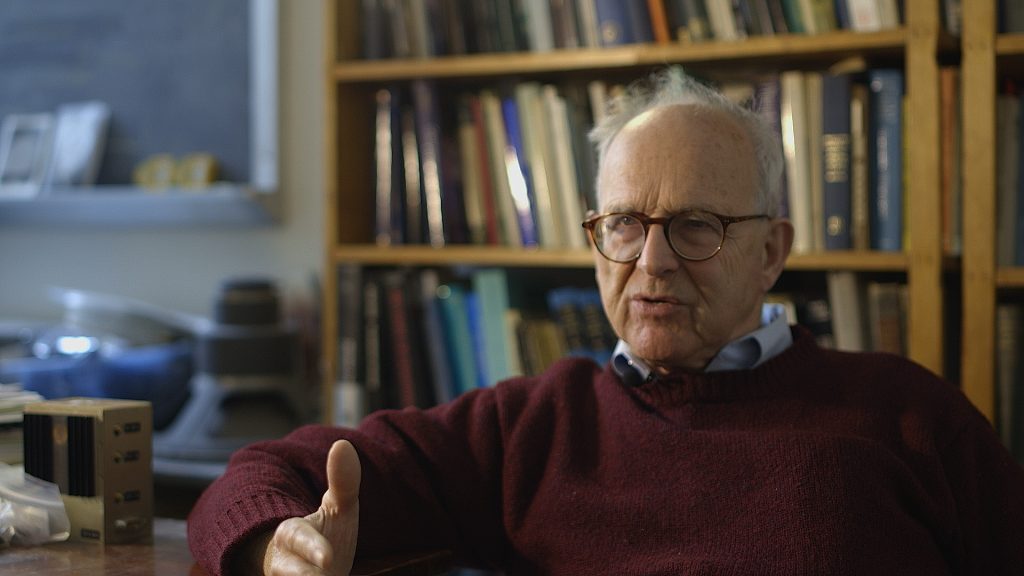
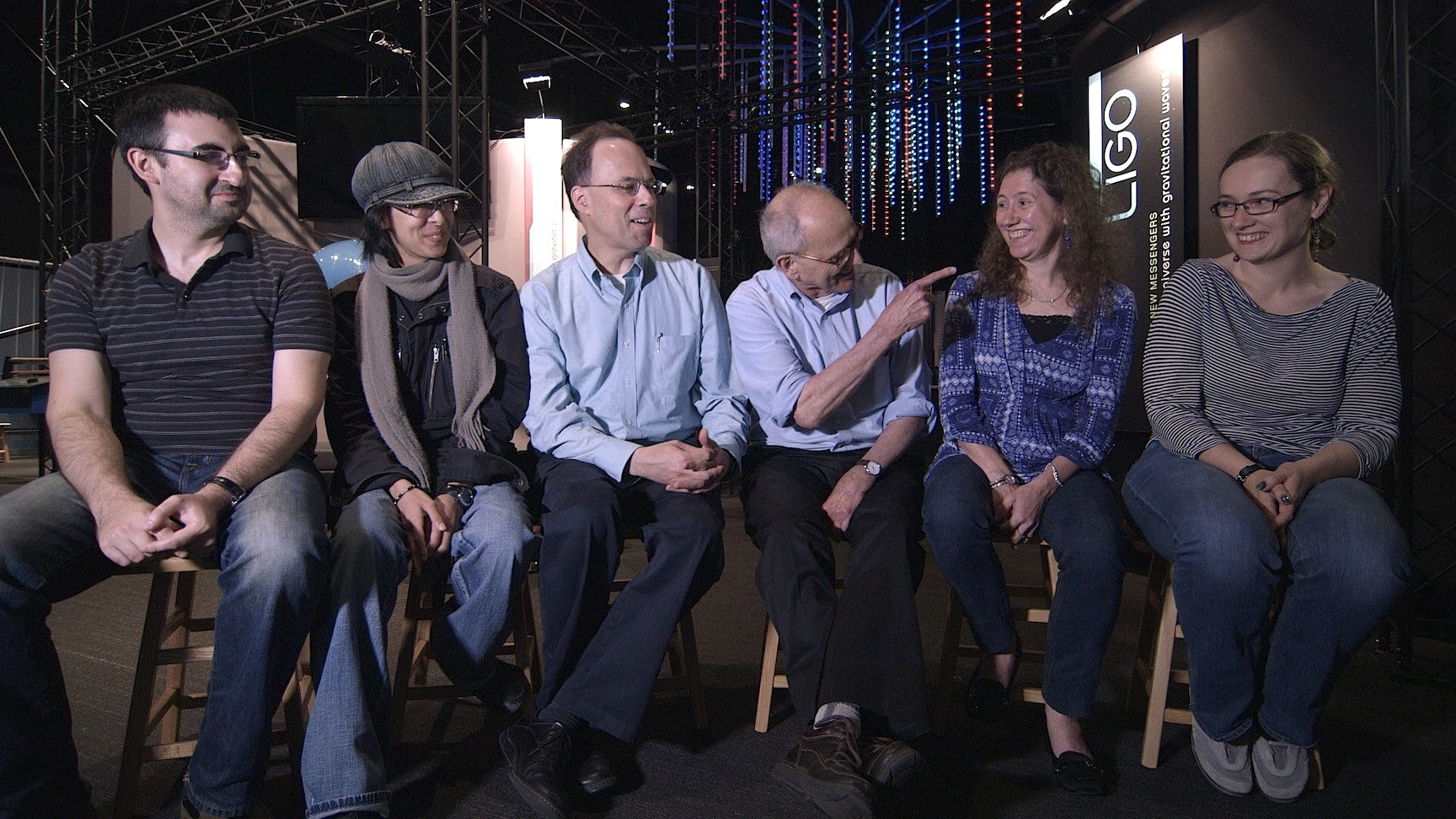
Rainer Weiss in the film "LIGO Generations" by Kai Staats

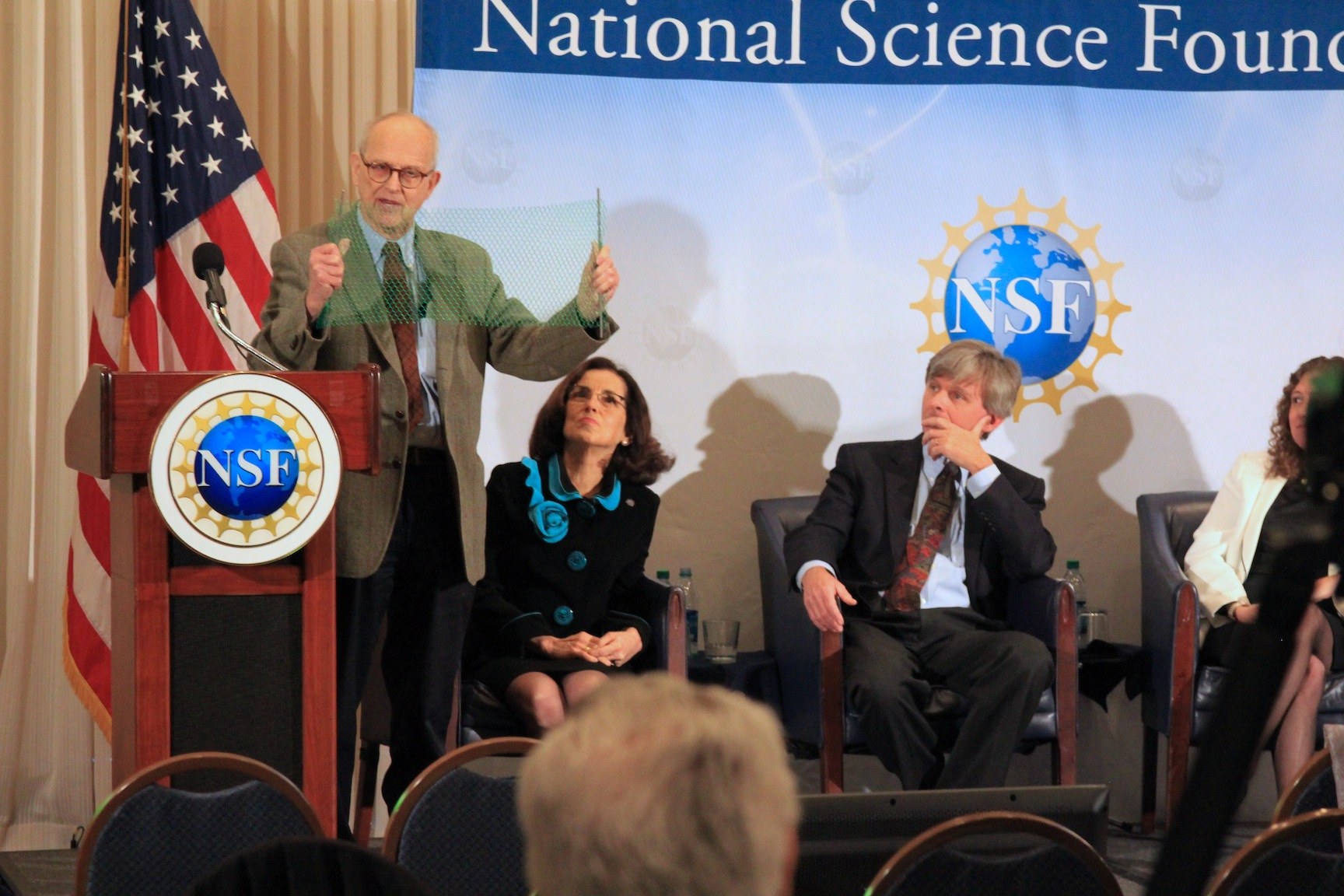
Yesterday, August 25 saw the passing of MIT Professor Emeritus Rainer Weiss, co-designer of LIGO, the gravitational wave observatory, renowned experimental physicist, and Nobel laureate. As noted in an article by MIT, “During his remarkable career, Weiss developed a more precise atomic clock and figured out how to measure the spectrum of the cosmic microwave background via a weather balloon. He later co-founded and advanced the NASA Cosmic Background Explorer project, whose measurements helped support the Big Bang theory describing the expansion of the universe.”

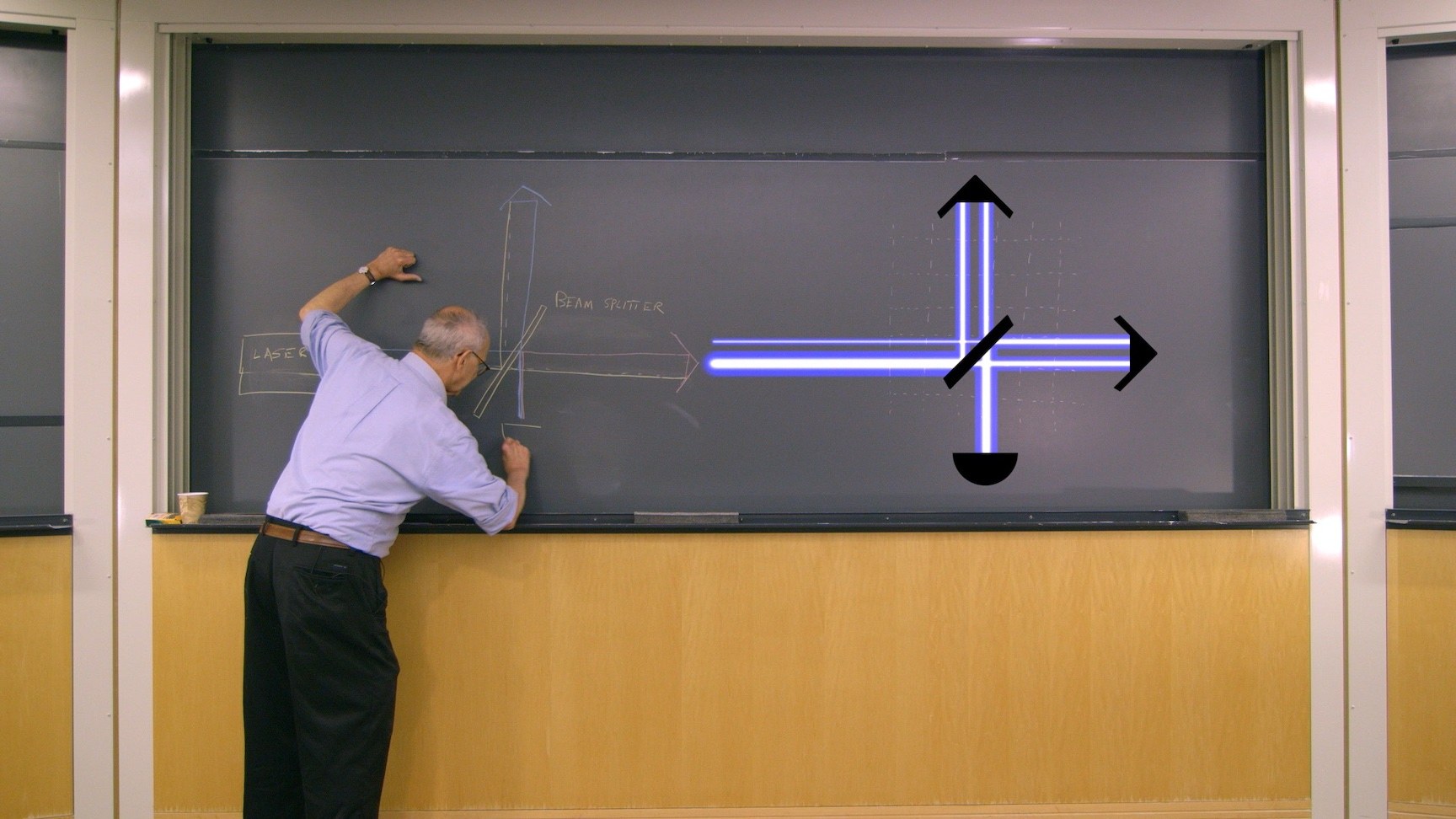
I first met Rainer in 2014 when working on my second film for LIGO and the National Science Foundation, “LIGO Generations”. I was immediately aware of his keen focus on our conversation, someone not distracted by a cell phone or computer. He welcomed me into his office, and gave me his full attention for the duration of our first interview. We spent time together kayaking (with Nergis Mavalvala) and in the basement of the physics lab where Rainer drew a simple diagram of a complex subject—the means by which a laser interferometer captures the passing of a gravitational wave.

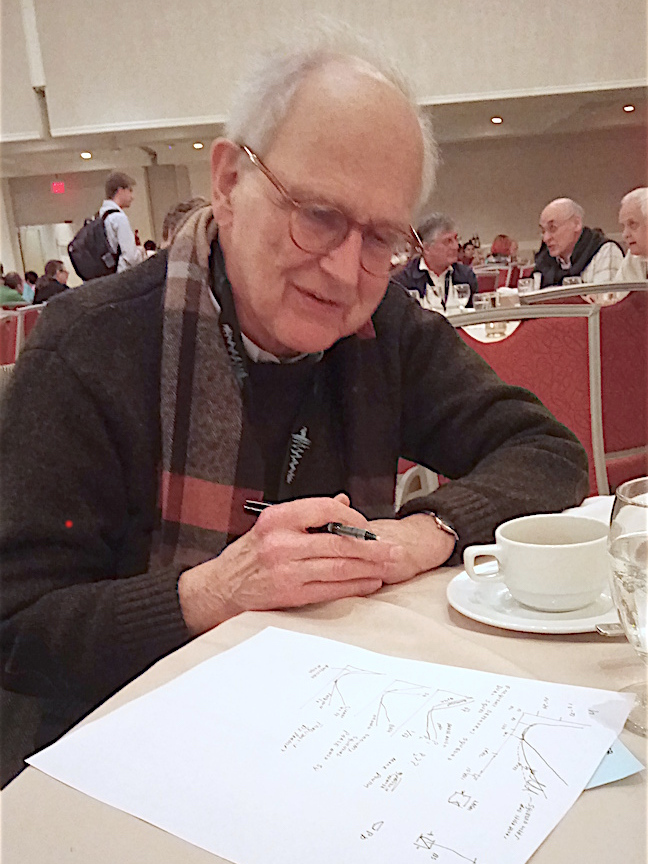
Rainer Weiss teaching Kai Staats about gravitational wave detectors. Rai was always teaching. He never tired of sharing a physics explanation for otherwise mundane things, the separation of water droplets as they fall from a faucet, the colors of a rainbow, or noise filters in hi-fi audio. At one of the annual LIGO Scientific Collaboration gatherings he shared with me the frequency curve in which the detectors operate, and how the teams were working to improve the sensitivity in order to observe more distant and less massive mergers. I will keep his sketches for as long as I am yet on this Earth as a bold reminder that teaching and learning are two of the most fundamental things we as humans share, and they are almost always best when done in person, hands waving, eyes connecting, stylus on paper.

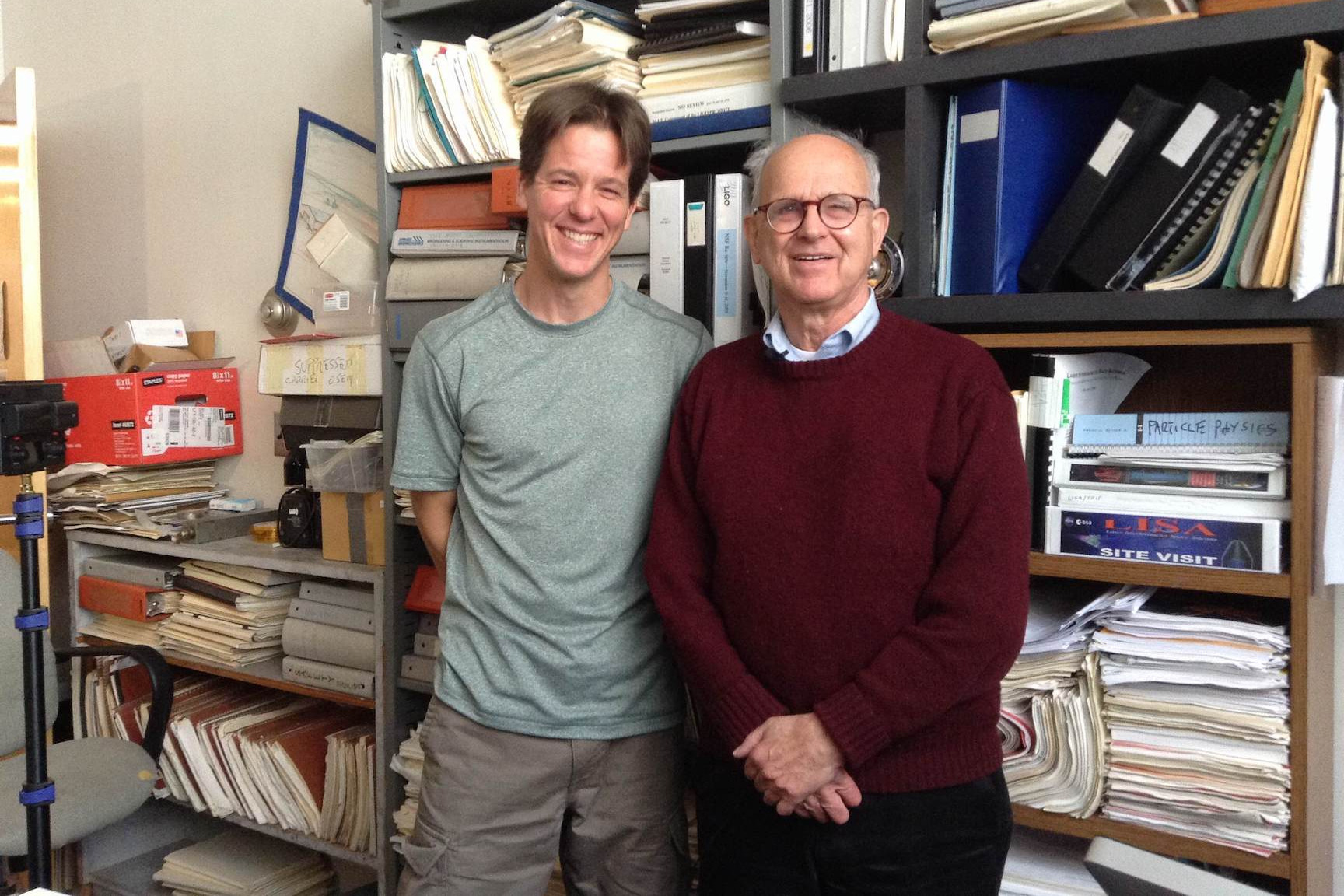
While I did not spend nearly as much time with Rai as did his colleagues and students, I find myself looking through photos and stills, watching sections of my films about LIGO, and reading the emails he and I exchanged as recently as November last year. In the context of a world too quickly embracing artificial intelligence, I embrace the stunning beauty of an authentically intelligent human being, and am reminded of what the human brain is capable of doing when given time to solve problems. My life was enriched through our brief interactions. Certainly, hundreds more to a similar or greater degree. Rainer Weiss moved an entire generation of curious minds to see the universe in a whole new way.

Stories about Rainer Weiss: MIT | New York Times | SCIENCE

LIGO, A Passion for Understanding | LIGO Generations | LIGO Detection

By |2025-08-29T02:03:52-04:00August 26th, 2025|Film & Video, Ramblings of a Researcher|Comments Off on The legacy of Rainer Weiss

Remembering who we are, and what makes us strong

To my team

In my position as a Director Research at the University of Arizona, my official job description (if one was ever written) includes design, development, construction, and maintenance of our research facility. In order to accomplish this, a diverse and talented team is essential. Each of you brings to this growing project a unique and valuable set of skills, experience, and gifts.

I don’t always speak like this, describing each of you in this way. Rather, you most likely see me as the one who pushes hard to meet deadlines, the one who drives to Home Depot three times in one day to keep you engaged laying the foundation for world-class research; the one who insists that our measurements are accurate and our level-er is level to within 1/16 of an inch when in fact no one will ever notice–except us.

What motivates me to keep going, despite the challenges of the incredibly complex University bureaucracy and my long weeks is three-fold: a) to create novel, word-class research that helps our species become interplanetary; b) to bring attention to the ways in which we can be better custodians of our home planet; and c) to see each of us grow, to gain skills and knowledge, to accomplish things together we could not do as individuals.

Our current team of 18 includes five people of color and multiple gender identities. We have first and second generation family roots in six countries (Canada, India, Italy, Kenya, Peru, and the US). We are a living, breathing celebration of what it means to be international in a country that, while not the perfect “melting pot” symbol advertised in my childhood, does continue to support the creativity that can only come through the mixing of unique experiences and points of view.

As researchers we apply curiosity, observation, and reason in equal proportions. As custodians we apply self-awareness and good habits, recognizing that in fact everything we do shapes the world around us. And as members of this team, we embrace our quirks, uphold our skills, and celebrate our diversity through collaboration at work and friendship beyond.

With the abrupt change in the administration of the United States, I cannot sit idle and say nothing. I cannot just pretend that everything is going to be okay. While it is not my place to, in any shape or form, dictate your political views, what you believe, or who you engage—it is my duty to uphold and protect each member of my team and to continue to promote logic, reason, science education, and care for the very planet on which we live.

My world view has been shaped by more than thirty years in education and humanitarian work around the world: working at an orphanage in Baja Mexico with my parents when I was just five years old, building a half acre playground in rural Poland in my twenties; running water lines, installing electricity, and helping build a food storage system at an orphanage in Kenya; designing and building the first research-grade astronomical observatory in Tanzania; bandaging the feet of migrants on the US-Mexico border; and producing documentary films about the Israeli occupation of Palestine. I’ve dedicated my life to helping others through work, care, and education. Some of the most valuable things I’ve contributed are simply a new way of seeing the world, getting people to ask hard questions and then seeking the answers.

At the base of Mount Meru, Tanzania, students copy word-for-word every page of a single text book that the teacher reads aloud and writes on the chalkboard. That was in 2019. Rote memorization remains today the principal form of education. So when a student asks questions that the teacher cannot answer, they are often scolded, or in the case of the orphanage in Kenya (where I met my my adopted children) they were beaten with a cane. [My job, then, as a board member of a non-for-profit was to document the bloodied backs of the students, then work with the teachers to implement new teaching methods that did not involve corporal punishment.]

Why is it like this? Because in that culture the teacher is the keeper of the knowledge, and the students are to learn from the teacher. If a student asks a question the teacher cannot answer, it is seen as a weakness in the teacher’s position and title, the student is at fault. The concept of the teacher and student learning together, side-by-side remains, for the most part, elusive. In this paradigm, curiosity and asking questions are met with fear, anger, and pain. If you live your entire childhood in such a place, you grow up without what I believe is one of the most important aspects of being human–asking these basic questions: How? Where? When? and Why?

The ability to ask these questions is what makes our species unique. This is what enables us to look beyond our current situation and envision a future that is better. These simple, single syllable words are the most powerful words we can utter for they are at the foundation of every scientific discovery, every invention, and every aspect of our very being that has a chance to improve.

If curiosity is beaten out of us, if we are afraid to ask questions, if we shutter in the shadow of those who are in control for fear of retribution for the very questions we ask, then we are no longer free to be human, and we will have lost the core of our humanity.

In just the first three days of the return of the administration of Donald Trump, the United States was removed the US from the Paris Climate Accords; any and all efforts to provide a fair and equitable environment for those who for too long were afraid to express their sexual identity were removed from every single federal office; and people who have lived in this country for decades, and their children who are born on this soil are forcibly removed at the hands of armed and masked officers.

The subsequent three months has seen an unprecedented overturn of every social and legal norm for the office of the president, such that history books will see this as a turning point for whatever will next unfold.

Persons of color now live with a heightened sense of fear. Every member of the Navajo Nation has been advised to travel with their Tribal ID, a card that is not issued at birth for it is not required under any law but is now employed to reduce the chance of harassment or exportation as ICE raids expand and gain power.

Schools, places of work, and churches are bracing for armed raiders who forcible remove people, separated from their parents or children, held in detention centers, and then exiled to a country in which they might not have lived for decades, or never at all. This spring Arizona State University lost 80 students to Homeland Security. These are students, not spies, not conspirators—mere children who came to this country to learn. In May the University of Arizona was given warning of the same and we wait to learn of the outcome. For fear or retribution, no one, not even ASU’s powerful president Michael Crow has risen to take a stand.

Many of us have experienced violence in our lives with our parents or siblings, in the military, or in challenged neighborhoods. But this level of internal violence inflicts a wound not only on those who are directly affected, but across the entire nation. It will ripple through generations as a new norm, making it “okay” to take violent action built on false narratives, lies, and deception.

How democracy falls and dictatorships rise

  1. Create an enemy within your own borders by ethnicity, religion, or color of skin;
  2. Convince the public that the “enemy” is not deserving of due process, not treated as human;li>
  3. Engage a police or military force that executes your policies when votes fail, then remove the non-human “enemy” by force;
  4. Establish a framework for retribution such that even those who are strongly opposed to your motives will stand at your side, afraid to go against you, hoping instead to gain your favor;
  5. Impose your will through fear of retaliation such that association, even conversation are controlled.
  6. Erode the framework of democracy in the name of “safety” from the very horror you have created.

The vast majority of Germans were not against the Jews, but those same people were afraid to stand up to Hitler as he gained control. The CEO of Apple Computer, the president of the Navajo Nation, and Jeff Bezos were all at the presidential inauguration. I cannot claim to know their belief systems, but I do know that Apple Computer has long stood as a company that embraces diversity, long before DEI was a policy and norm. While the more than 500 recognized Native American Nations in this country stand to gain nothing but ridicule and pain under the Trump administration, gaining favor of the new leadership is safe, even if it echoes the very history that decimated Native American populations and moved who remained to designated reservations.

Facts matter
Do your best to not repeat what you hear unless you have substantiated the facts and figures from reputable sources. There is truth. Not alternative facts but real, solid truth, some of which I would like to share with you here to get our brains engaged and intelligence churning.

“All who cross our southern border are rapists and murderers and drug dealers.”

Before 9/11 the US had for more than 100 years welcomed more than 250,000 undocumented workers to cross the border, work in our fields to harvest crops such that our fruits and vegetables could come to our kitchens at an incredibly low cost. For the first time in US history, the border was shut down for “fear of terrorists” entering through Mexico, when in fact the pilots who flew the planes into the twin towers and Pentagon came into the US through Canada several years earlier.

There are approximately 11,000,000 undocumented workers in the US today [Pew Research]. in 2024 9,949 arrests were made by the US Border Patrol (not including 10,000 re-entry arrests), of which only 221 were for a sexual offense [CBP]. I heard that 47,000 total arrests of undocumented residents [NPR] were made in the US last year which equates to 0.4% (0.004) of the population.

According to the FBI 73.5 million out of 249.4 million Americans have a criminal record [Politifact], as many as have a diploma [Brennan Center]. That is roughly one-third or ~30%. This means that the undocumented population has a 75x lower criminal record than documented America. Even if this number is off by a factor of 10x, the original statement is completely false.

“Build the wall!”

Q: How do you go over a 20′ border wall?

A: With a 21′ ladder.

During the first Trump administration the head of the US Border Patrol took a reporter to the back lot of a border station and showed her hundreds of ladders, confiscated at the foot of the wall. It takes less than $30 (or something home made) to beat a billion dollar fence.

“The cost of power is too high in the US.”

The United States has a lower cost of power, across the board, than just about every country in the world. Why “Drill, baby, drill!” when the US produces more oil than any other country in the world? We are already paying far less than more than 2/3 of the countries on this planet [globalpetrolprices.com].

Deep sea oil is too expensive. The only way new oil discovery will happen is if the US government subsidizes the process, which it has been doing for decades. Remember, oil companies don’t want the cost to be low, as they make less money. The only way to bring the cost of power down is to invoke renewable energy which beat the cost of coal-fired power over a decade ago.

“We’re going to reduce the cost of living.”

No president, not a single one in history has control over the price of fuel at the pump, or eggs, or bread anymore than he does the cost of a computer or cell phone or any other item produced by publicly traded companies built on publicly traded commodities. It’s impossible.

The reason the Chairman of the Federal Reserve and his (or her) body of advisors is intentionally isolated from the President, Congress, and the Supreme Court is so that no body of power can control the financial reserves or interest rates. These are experts who manage this important function of our country’s financial foundation, and who have in the past five years demonstrated an exemplary recovery from a very, very difficult financial situation. Despite the COVID recession, American spending is at an all-time high with salary increases surpassing inflation by an average of 2% in 2024.

“The illegals are taking our jobs! Ruining our economy!”

In Arizona alone, the undocumented residents contribute a net gain of more than $1B per year through purchase of fuel, food, disposable goods, rent, and paying taxes. As they are undocumented, they do not gain Social Security when they retire or receive any health benefits at their places of work. They are, from this point of view, the most advantageous contributors to our economy who demand the least, who use the least (not the most) resources. Anyone can do the math. It’s simple.

When I was a kid many of my classmate in Columbus Nebraska walked beans and detasseled corn every summer. Now, most white kids do not walk beans or work in the fields. Most of that labor is done by our neighbors to the south. If the US sends them home, then we need to prepare for union labor and the cost of corn, oranges, apples, spinach, potatoes—all of it go up by 2x, 5x, or 10x at the store.

In our hotels and at our construction sites, it is people of color that continue to do most the work. Undocumented workers are not competing for positions in schools or hospitals or law offices or most any occupation, rather, they fill a growing niche as the social-economic foundation as this economy continues to evolve.


In closing, again, it is not my place to motivate how you vote or who you support. But as we build a platform for research and science education we embrace and uphold who we are as individuals, and who we represent in the greater world. Your knowledge represents the knowledge of my team. Your ability to engage in critical thinking is a reflection of the very reason we have labored for five years to build this platform for research and education.

I ask that you move through these next four years with diligence, with commitment to challenging false narratives and spreading fact-based truth. I invite you to do your own research, to build a vocabulary of justice that celebrates all humans independent of the color of their skin, sexual orientation, or place of birth.

We can each fight back against a regime of fear by asking questions, challenging false narratives, and being prepared to provide research-based facts.

Ask yourself, “How have your own life experiences shaped your world view, and what do you bring to this team?”

Thank you.

Kai Staats, MSc
Director of Research for SAM at Biosphere 2
University of Arizona

By |2026-02-08T11:39:22-04:00June 14th, 2025|Ramblings of a Researcher|Comments Off on Remembering who we are, and what makes us strong

Keeping Cool – window films

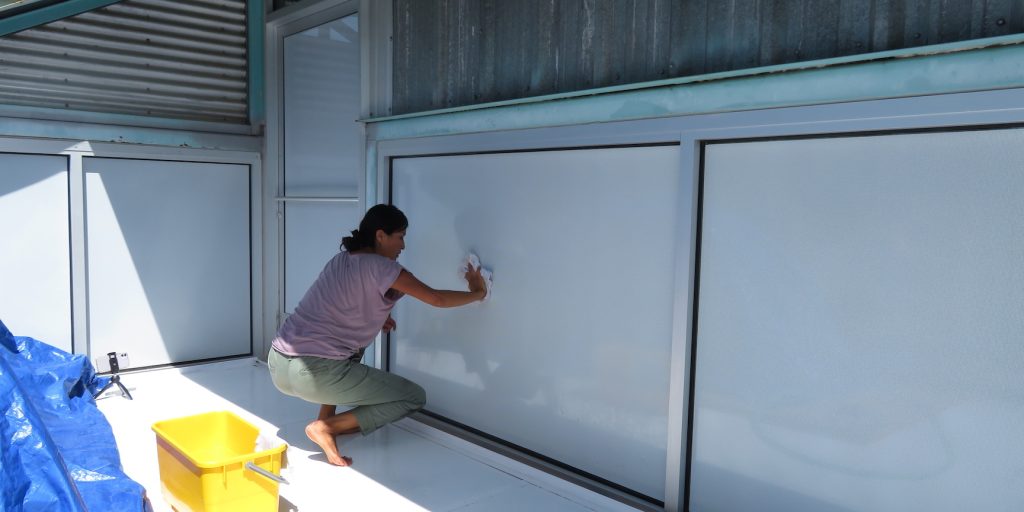
Colleen applies vinyl film to the exterior of a window.

Interior and Exterior Films
We are all familiar with window films (sometimes referred to as tint with automobiles). Modern films are designed to block UV light that damages plastic, cloth, and furniture; optical light (what we can see) to reduce glare; and infrared (what we can feel) to reduce total thermal transmission from the sun into our homes or cars. It’s all light, just shorter and longer wavelengths (yes, you learned this in high school, but probably forgot :).

Most films are applied to the interior of glass windows, or at the factory to the interior of the first pane of glass in a double-pane insulated window. The films are rated for transmission as a percentage, i.e. “75% optical transmission” means the film blocks 25% of the in-bound light we can see, and allows 75% to pass through. Most block 99% of UV and upwards of 90% IR.

In a casual study I conducted at my place of work, I noticed that non-treated glass remains relatively cool to the touch (ambient room temperature) as full spectrum sunlight enters the room and heat the objects it strikes. When an interior window film is applied, yes, the objects in the room remain cooler, but the glass itself heats up. If the glass is heating, that means it is generating heat energy, or infrared light, and is in fact heating the room, even if to a lesser degree (50% in / 50% out). This deserves further study, to learn how much the glass is heated through the process of reflecting IR with an interior film, and how much heat energy ends up in the room anyway.

That said, if you apply a film on the outside of the glass window the heat energy is reflected without heating the glass, and as such is more effectively keeping the interior space cool. But most translucent films are not intended to be applied on the exterior as they will dry-out, get scratched, and fall off prematurely.

There is an alternative …

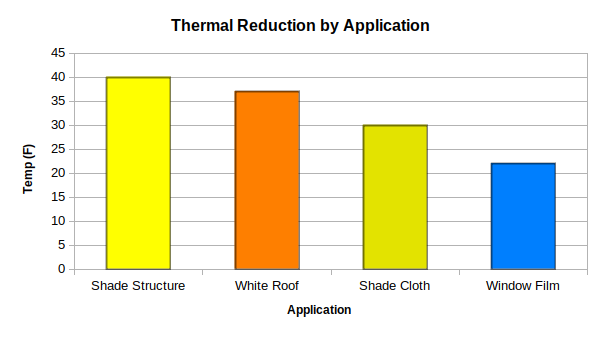
Temperature differences by Kai Staats and Colleen Cooley

Save a bird. Reduce your electric bill too.
We live in the San Pedro River valley where more than 300 species of migratory birds travel twice each year. And year-round we enjoy a local population of doves, finches, woodpeckers, humming birds, ravens, hawks, and many more. Sadly, they too often see the reflection of the blue sky in the early or evening hours and fly into our windows, either stunned for a few minutes or breaking their necks.

We tried curtains on the inside, and hand-cut paper snowflakes taped to the windows too. We successfully hung shade cloth in front of two windows, but this solution is not feasible all around for a variety of reasons, including the amount of structural modification and resulting loss of visibility.

Then we discovered the not-for-profit company CollideEscape whose various exterior window films provide up to 100% guaranteed elimination of bird collisions. This vinyl film is the same as that applied to city buses, painted-on advertisements making the windows appear opaque on the outside when in fact the passengers can see just fine.

We applied these to all upper windows. It worked perfectly. Not a single bird collision on those windows with the film. In the process we also discovered that the film drastically reduces the interior temperature where sunlight falls, by as much as 30F. This was initially noticed by sitting in our loft to determine how our view was changed, inside-to-out.

With two windows side by side, in the same morning light, one had the vinyl film, the other did not. The temperature difference was immediately noticeable on our faces and forearms, and confirmed with a mercury thermometer placed in the light of each window. We have since covered all our basement windows too and noticed a significant change in the temperature of the carpet where the sunlight falls. An infrared thermometer noted the temperature of the carpet (yes, carpet does get hot) dropping from 107F in direct sunlight to 85F behind a glass pane covered with the CollidEscape film, the lower temperature just seven degrees over the 78F room temperature (as measured on the carpet beyond the sunlight of any windows) at that time. Our basement is noticeable cooler than the last few years, which aids in cooling the entire house.

This essay is part of a series about Keeping Cool in your Home

By |2024-08-15T13:14:30-04:00August 12th, 2024|At Home in the Southwest, Ramblings of a Researcher|Comments Off on Keeping Cool – window films

Keeping Cool – paint your roof white

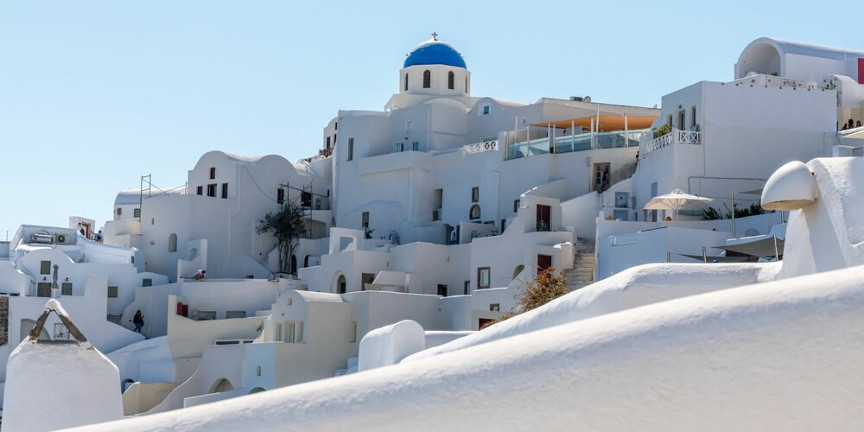
Houses of Santorini, Greece by Richard Silver

History
It doesn’t take a physics lab full of PhDs to find simple solutions to complex problems. Sometimes we need only look to other parts of the world and what they’ve been doing for centuries. All along the Mediterranean coast homes are painted white with limewash or whitewash to reflect the intense sunlight, keeping the interior of the homes cool. In Iceland, they do the opposite, building with black roof tiles to absorb solar heat.

The modern (with lab and PhDs) version of whitewash is Purdue University’s world’s whitest paint. Developed by Purdue professor of mechanical engineering Xiulin Ruan, this new paint is fighting global warming by keeping surfaces cool to reduce the need for internal air conditioning. According to Ruan and his team’s models, covering 1% of the Earth’s surface in their technology could mitigate the total effects of global warming, a fact encouraging them to continue pursuing formulas suitable for surfaces like asphalt and roadways.

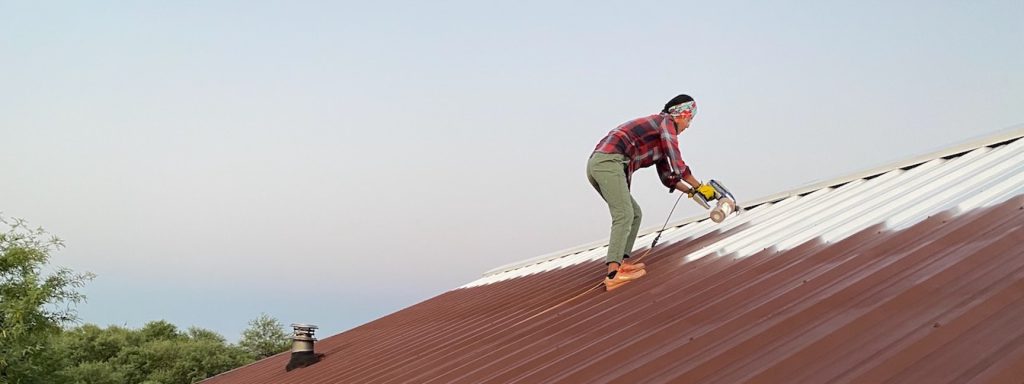
Colleen applies a coat of white paint over primer.

Our Home
Colleen and I have spent the past year mitigating the increasingly warm summers by reducing the amount of thermal energy our house gains during the day, and increasing the amount of thermal energy released at night.

It is important to note that our home is a rather unusual construction, not at all ideal for anywhere but the temperature climate of San Diego or coastal Hawaii. That said, it came with the property, provides exceptional views of the surrounding wildlife year-round, and is enjoying a successful remodel toward thermal mitigation.

It is important to note that we live at 3000 feet elevation with winter, night lows dipping into the mid-20s with days at 50-70F. Summer will see three months in the mid-90s by mid-afternoon with a few weeks over 100F, sometimes pressing 110F. With each summer night, even on the hottest day in the year, the air cools to the low 70s or high 60s. This is the way the desert is suppose to be, and was until the introduction of concrete, asphalt, and air conditioning (which we will address later).

Too hot to touch?
Our first major effort in thermal mitigation was painting the roof white. As with most of the homes in this southeast Arizona region, galvanized sheet metal is a preferred material as it lasts, with minimal care, thirty to fifty years.

However, as anyone who has touched sheet metal in the Arizona sun knows—it gets really hot—dangerously hot. When you touch but cannot hold your hand to the surface for the intensity of the heat, you have reached your ‘threshold of pain‘. This is the minimum temperature at which your body feels pain and you have a natural reaction to remove yourself from that situation. This varies from person to person, and from object to object. 110F air is tolerable while a 110F Jacuzzi will require some getting used to. We can generally hold our hand to or walk barefoot on 110F concrete. But if that temperature climbs to 120F or 130F, it becomes unlikely you will stand there for long. I use 132F as my own threshold of pain for what I can tolerate with bare feet or my hands.

In the course of our work on our home, we have used an infrared thermometer which has been compared to both a mercury and bi-metalic coil thermometer and validated to within 2 degrees Fahrenheit. This gives us a high degree of accuracy up to twenty, even thirty feet away.

Our house is built such that our roof extends over the outer walls by 4 feet. This casts needed shade in the summer, and with the low sun in the winter allows direct sunlight to enter our home and heat the concrete floor through the large, double-pain windows.

With the infrared thermometer we are able to measure the temperature of the metal roof from the underside of the overhang such that as we painted each section, we could readily determine the effect of the new paint application with the same ambient air temperature and immediate solar gain.

Choosing the right paint
There are many brands of paint on the market today. Most of the products are now water-based (acrylic), moving away from oil-based to reduce toxic chemicals consumed (and wasted) in manufacturing. While acrylics have come a long way, and make sense for bedroom walls and refinished desks, nothing beats the durability and weather resistant nature of a good oil-based stain or paint.

At my work at Biosphere 2 I became familiar with the oil-based Rust-Oleum brand Rusty Metal Primer. My team found it to be an incredibly durable product, readily applied with brush, roller, and sprayer. The Gloss White top coat is far more reflective of solar radiation than an elastomeric, and without the need for pressure washing every six months to keep it from collecting dust and losing its reflectivity.

Rust-Oleum will tell you that you need to use a special, water-based primer to adhere to galvanized metal. However, my test proved otherwise—a screwdriver only marginally able to scratch the primer after 24 hours drying. This is likely due to the fact that the metal roof on our house is nearly thirty years of age, with the galvanized metal losing its sheen.

In July 2023 we worked from 4:30 am ’till 7:30 am three mornings in a row to apply the primer. Due to our work schedules we returned to the project a week later and applied Rust-Oleum High Gloss White, again with an airless sprayer. With just one coat we achieved a quality finish (a second coat will even the highs and lows). We painted the two main sections (north and south) that together encompass more than three quarters of the total surface area. This [2024] summer we completed the east section of the roof with one day of prep and two days painting (primer and white respectively). The west end remains.

When complete, the total number of gallons of paint for our 1500 sq-ft roof will be 7 gallons primer and 7 gallons white. At $37 per gallon that is roughly $500 in paint. A new roof of the same size would be between $10-30,000 for materials and at least double for labor, if contracted.

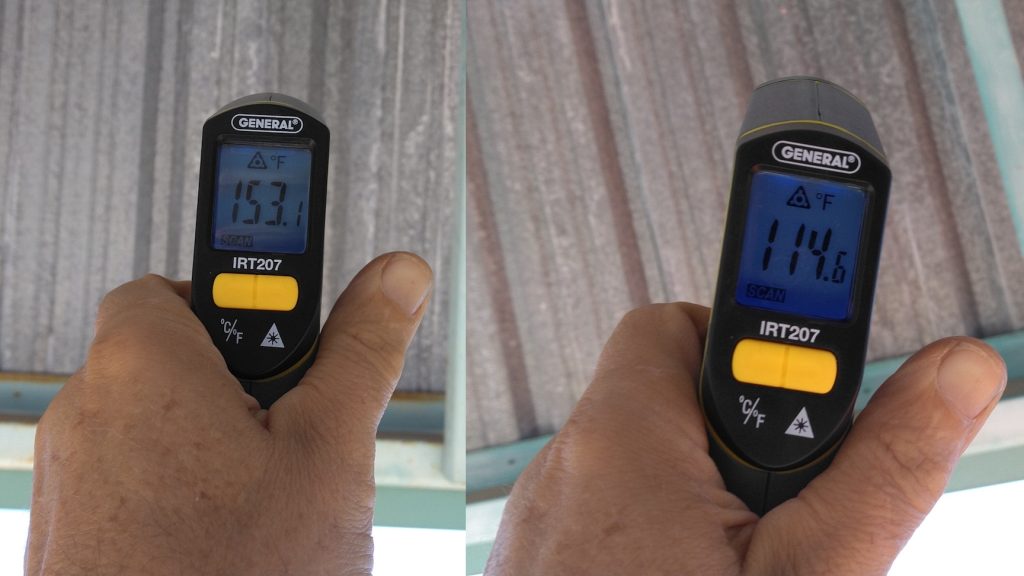
Before and after a coat of white paint, by Kai Staats

From 153F to 115F
Using or infrared thermometer we were thrilled to discover that we reduced the surface temperature of the galvanized steel from ~150F to ~110F (actual high temperature ranges between 135F and 153F; with the underside low ranging from ambient air to 115F for the painted surface, corresponding to humidity, cloud cover, smoke particles, and time of day).

While we have 4″ foam insulation beneath the corrugated steel over 2″ tongue-n-groove pine ceiling, over the course of a day the heat eventually gets through. We used to feel the radiation (infrared) on the backs of our necks and bare arms despite the air temperature maintained at 80F with mini-splits, much in the way that a desert canyon wall will radiate heat after sunset.

Temperature differences by Kai Staats and Colleen Cooley

Now, that radiant heat penetrating our home is reduced, the thermal gradient from ground level to the loft (20 feet) has been reduced to just ~5-8F degrees, which is 10F less than before the paint. Furthermore, in a comparison of May 2023 to May 2024, despite the 3F increase in average temperature, our electric bill went down $22. There are other factors, perhaps, but the point is—we are both feeling and seeing a difference.

What we experienced first hand is confirmed in this and many other similar articles:
The surprisingly simple way cities could save people from extreme heat.

“New research suggests cities are ignoring the power of cool roofs at their own peril. A study in the journal Geophysical Research Letters earlier this month modeled how much cooler London would have been on the two hottest days in the extra-hot summer of 2018 if the city widely adopted cool roofs compared to other interventions, like green roofs, rooftop solar panels, and groundlevel vegetation. Though simple from an engineering standpoint, cool roofs turned out to be the most effective at bringing down temperatures.”

By |2024-08-15T13:33:33-04:00August 12th, 2024|At Home in the Southwest, Ramblings of a Researcher|Comments Off on Keeping Cool – paint your roof white

Keeping Cool – an applied investigation in thermal mitigation

So much of what we hear in the news and read on-line about climate change is the rising cost of electricity to cool our homes, and the increasing burden on already oversubscribed electric power grids. Emphasis is placed on the consumption of electricity, not the reduction of electric consumption. In a warming climate, reduction of thermal gain equates to a lower electric bill.

Yes, local solar photovoltaic systems augment (grid-tied) or remove (off-grid) reliance on the electric grid, but not everyone can afford PV arrays, or do not have permission from the apartment manager or rented home owner to modify the roof or electric panel.

No matter if you are moving toward renewable energy or simply wanting to reduce your electric consumption and associated electric bill, and improve the quality of your interior comfort in the midst of increasingly uncomfortable summers, there are a number of things you can do to reduce thermal gain—the amount of heat trapped inside your home during the day, and then remove that heat by night.

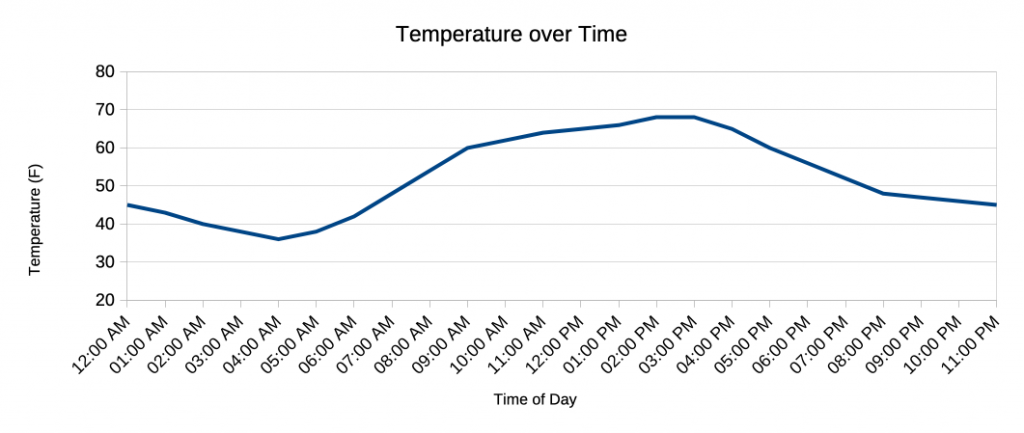
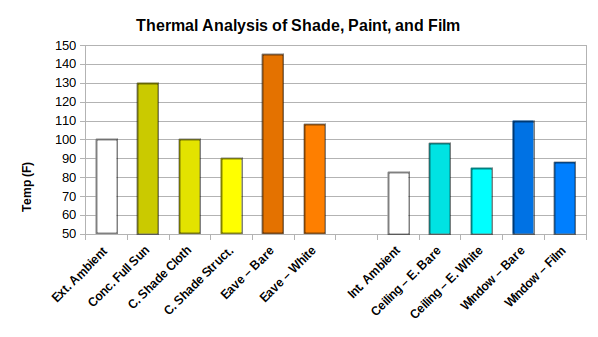
Temperature recordings by Kai Staats and Colleen Cooley

Above graph: “Ext. Ambient” is the air temperature at the time of recording. “Conc. Full Sun” is concrete in full sun. “C. Shade Cloth” is an adjacent slab of concrete positioned below a shade cloth. “C. Shade Struct.” is a slab of concrete that remains in shadow all day, each day, i.e. beneath a porch roof. “Eave – Bare” is the temperature of the underside of the steel roof overhang, original galvanized coating. “Eave – White” is the temperature of the underside of the steel roof overhang, the top side painted gloss white. “Int. Ambient” is the interior air temperature. “Ceiling – E. Bare” is the temperature of the interior wood ceiling below original galvanized steel roofing, with 4″ foam insulation between. “Ceiling – E. White” is the temperature of the interior wood ceiling below the painted gloss white steel roofing, with 4″ foam insulation between. “Window – Bare” is the temperature of the glass itself without any film. “Window – White” is the temperature of the glass with an exterior application of the while vinyl film.

In this series of essays we will introduce, explain, and demonstrate various means to reduce the interior temperature of your home. Many of the concepts are explored are the direct result of work we have done to our own home, here in Cascabel, Arizona. The results are immediate and noticeable.

The concepts explored will include:

  • Reflecting sunlight via white paint and white vinyl film; and
  • Reducing sunlight transmission via window films
  • Reducing sunlight transmission via shade structures
  • Thermal mass
  • Passive versus active cooling
  • Swamp cooler versus air conditioning; and
  • Types of air conditioning (cooling)
  • Cooling by plants, and green roofs

This landing page will be updated, with links to each new essay as added.

The first two essays are posted:

Stay tuned!

By |2024-08-13T18:06:58-04:00August 12th, 2024|At Home in the Southwest, Ramblings of a Researcher|Comments Off on Keeping Cool – an applied investigation in thermal mitigation

Life on Spaceships and Mars, NPR PRX

"Life on Spaceships" by Moral Repair - interview with Kai Staats

Life on Spaceships
Moral Repair: A Black Exploration of Tech

In this Episode Annanda and Keisha Explore The Big Question of, is it worth the expense to go to Mars given the needs on Earth? And what would it be like to live on Mars or in space? They interview Kai Staats, Director of Research for SAM at the University of Arizona Biosphere 2, to get the space tea.

Listen to the full interview …

By |2024-07-17T17:37:14-04:00July 17th, 2024|Ramblings of a Researcher|Comments Off on Life on Spaceships and Mars, NPR PRX

Discovering the Mars yard at SAM

Dr. Cameron Smith, anthropologist and developer of pressure suits at Smith Aerospace Garments explores the new Mars yard at SAM while encumbered by one of his pressure suits, the same worn by crew members at SAM for their EVAs. In this short film Dr. Smith exits the functional airlock of the SAM habitat and then engages the reduced gravity simulator set to the Mars gravity of one-third that on Earth. He explores sedimentary rock layers, an ancient lava tube, a geologically recent rock fall, and gypsum veins.

As with the completion of the pressure vessel and receipt of the first three crews, this marks a milestone in my work at Biosphere 2 and SAM. To learn more visit samb2.space

By |2024-06-27T17:54:31-04:00May 9th, 2024|Ramblings of a Researcher|Comments Off on Discovering the Mars yard at SAM

Third crew enters SAM

Crew Imagination I enters SAM

The third crew to enter the Space Analog for the Moon and Mars sealed the outer airlock hatch today, March 10, 2024 at 10:00 AM. Friends, family, and colleagues were welcomed to tour the SAM facility as the crew prepared for their six days and five nights journey to the South Pole of the Moon. Christopher Cokinos, Liz George, Julie Swarstad Johnson, and Ivy Wahome entered SAM carrying their personal bins.

Read the full story at samb2.space/2024/03/10/crew-imagination-i-enters-sam/ … and the continuing story of SAM design, construction, research, and visiting crews at samb2.space/blog.

By |2024-06-27T17:50:13-04:00March 10th, 2024|Ramblings of a Researcher|Comments Off on Third crew enters SAM

Second crew enters SAM

Crew Inclusion II at SAM

Inclusion II, the second crew to enter SAM, the Space Analog for the Moon and Mars, sealed the outer airlock hatch today, May 10, 2023 at 10:05 AM. Interviews with the French Televisions commenced at 8:30 AM and continued until 9:45 AM when one by one, Bindhu Oommen, Keridwen Cornelius, Sahda Haroon, and Andy Squires entered SAM carrying their personal bins.

As with the first crew, this marks an extraordinary point in my professional life.

Read the full story at samb2.space/2023/05/10/second-crew-enters-sam/ … and the continuing story of SAM design, construction, research, and visiting crews at samb2.space/blog.

By |2024-06-27T17:50:56-04:00May 10th, 2023|Ramblings of a Researcher|Comments Off on Second crew enters SAM

First crew enters SAM

Arizona television station KGUN covers the first team entering SAM at Biosphere 2

Today the very first visiting research crew entered SAM. Five years and five months from concept to design, fund raising, construction, the Space Analog for the Moon and Mars (SAM) is now operational. This represents the single largest project I have ever undertaken, and the most diverse, creative, diligent team I have ever employed. We have built the world’s only operating, hermetically sealed and pressurized other-world habitat analog. This is something for which I am truly proud (and totally exhausted).

Inclusion I was welcomed by three television crews, two radio crews, Linda Leigh of the original Biosphere 2 mission, Executive Director of Biosphere 2 Joaquin Ruiz, Deputy Director of B2 John Adams, and more than 60 persons watching the first closure of this unique hermetically sealed, pressurized habitat. Interviews commenced at 5:00 AM and continued until 10:00 AM when one by one, Cassandra Klox, Eiman Jahangir, Bailey Burns, and Sheri Wells-Jensen entered SAM carrying their personal bins.

Read the full story at samb2.space/2023/04/27/first-crew-enters-sam/ … and the continuing story of SAM design, construction, research, and visiting teams at samb2.space/blog.

By |2023-10-28T11:56:45-04:00April 27th, 2023|Ramblings of a Researcher|Comments Off on First crew enters SAM
Go to Top