Kai Staats: writing

An Evening with Scott Simon

“Baby, We Were Made for Each Other”

Last night Sarah and I attended an evening with NPR’s Scott Simon, hosted by KUNC, in Boulder. Scott is on tour to talk about his life at NPR, and to promote his new book, “Baby, We Were Made for Each Other,” about the experience of adopting two children.

For me, meeting Scott was putting a face to a voice as familiar to me as that of my own father, for I have listened to him nearly every Saturday morning for more than a decade, perhaps as many as fifteen years. His thoughtful approach to sharing not just sound bites but complete stories is the very essence of NPR’s philosophy which draws more than thirty million listeners every day.

Scott is a deeply intelligent, engaging, humorous individual who knows how to deliver a story in such a way that the audience laughs and learns at the same time. But by no means was the entire evening filled with humor, for Scott himself was moved to tears as he spoke of the loss of Dan Shore this summer, and the joy of his two adopted daughters. With him, many of us in the audience were moved as well.
Scott spoke of his friendship with Senator Paul Simon whose adopted son’s birth certificate stated he was Native American. Only at age twenty eight, when he was reunited with his birth mother did he learn he was actually Swedish. The mistaken identity was the result of a hilarious misunderstanding at birth, which when told by Scott caused the entire audience to nearly fall from their chairs.

Scott tells of his oldest daughter, now six, throwing a tantrum in a restaurant. Scott, his wife, and daughters excuse themselves from their friends to go home.

His daughter says to Scott’s wife, “Mom, I was hungry.”

His wife responds, frustrated, “Then you should have eaten the food you left on your plate!”

“No, when I was in my mother,” referring to when she was in China and her mother did not have the resources to keep her healthy, even before birth. And then she continued, “Why didn’t you come for me then?”

For as hard as we laughed that evening, we cried as well.

It is a rare individual who can be on the road as often as Scott is, speaking to people two, three or a half dozen times a month and on every occasion deliver his stories in such a way that each audience feels they were the first to receive him on what must surely be the beginning of his tour.

A Passion for Public Radio

I took from this evening two things: an appreciation for those a man who moves people without ego and without fear; and a deepened sense of appreciation for public radio.

In speaking with the station, content, and music directors of KUNC I found myself engaged with individuals who have been involved with KUNC for as many as three decades because they truly believe in what they do.

I was reminded that public radio is not just an alternative to commercial radio, but is an expression of a strong philosophy for how news is to be recorded, edited, and reported–for how the art of communication and story telling must be carried into the 21st century if we are to maintain some semblance of integrity in an otherwise heavily filtered world of sound bites and political slants.

There is not a day that goes by that I do not listen to NPR, in my home office or via satellite radio while driving. And as my friends, co-workers, and climbing partners will verify, there is not a day that goes by that I do not quote some portion of a story I have heard on NPR.

While this is may begin to read as a publicity piece for NPR, I do ask that for those of you who listen to public radio, please contribute to your local affiliate station; and for those of you who do not, you don’t know what you are missing

By |2017-04-10T11:17:43-04:00October 12th, 2010|At Home in the Rockies|0 Comments

Seven Days on the Colorado

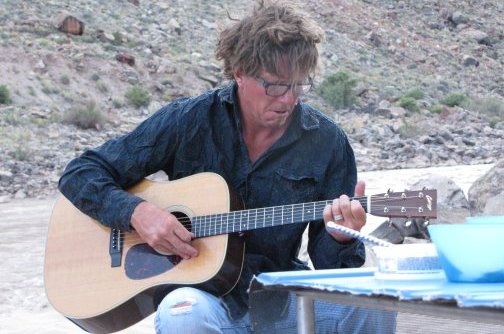
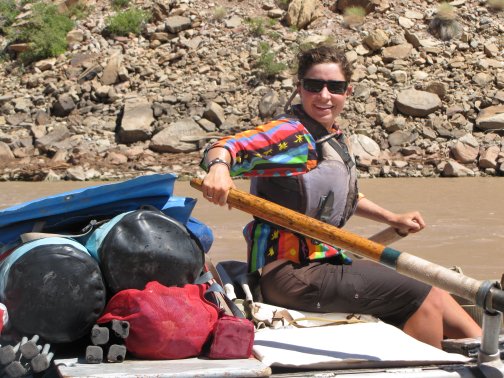
Colorado River Noah Paul, Morgan, Jim Jim playing guitar

Colorado River

I am sitting in a cafe on the West end of Bluff, Utah, less than a mile from the San Juan river and the tall sandstone wall which defines the Northern boundary of the Navajo Nation.

Nearly every seat is filled. Between the expected sound of steamers and coffee grinders and juice mixers I hear German, French, and English. I am surprised, for this town is comprised of but a few hundred people tucked into a small pocket of Southwestern Utah. Yet, Bluff attracts tourists from around the world in the summer months, a landing spot to study archeology and launch point for the San Juan river.

floating in style

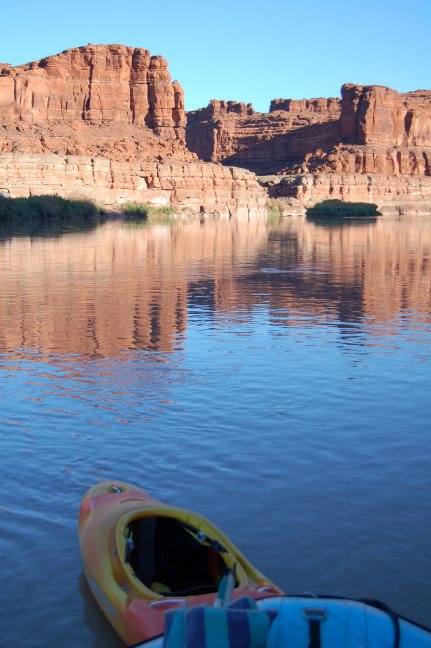
Noah is sitting across from me, both of us winding down and out of our recent seven day excursion on the Colorado river, putting in west of Moab at the terminus of the Potash mining road, taking out on the north side of the eastern reach of Lake Powell’s stagnant waters, across from Hite.

Living History
I was the fortunate guest of Wild Rivers Expeditions, a more than 50 years old commercial outfitter whose founder Kenny Ross is known for a life spent on the San Juan and Colorado rivers prior to the dams and regulations and deep, cold blue water, where warm red rivers once freely ran.

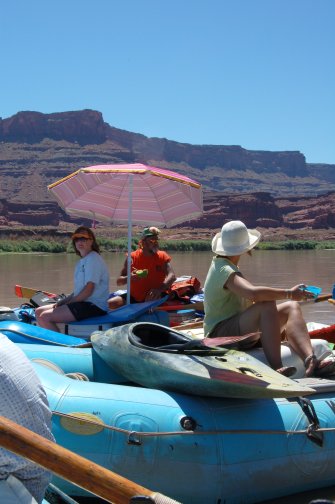
There were eleven of us on this journey: Kristen (the owner of Wild Rivers) guides Jim, Noah, Colleen, Morgan, Marcus, Kate, Paul, and guests Herm and Val Hoops.

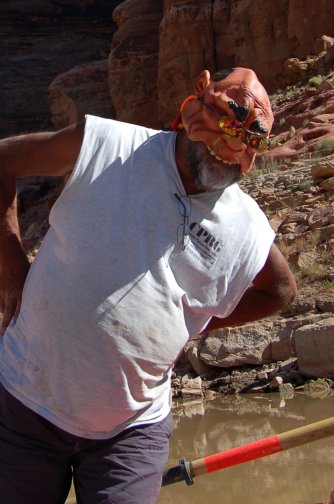
Herm's mask

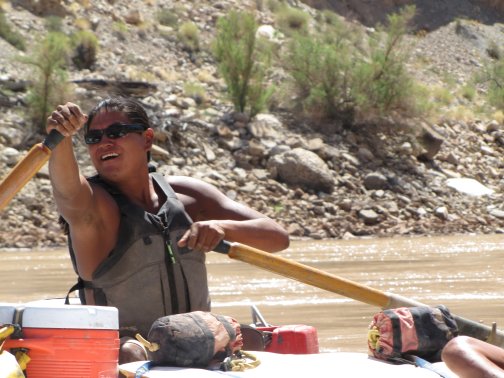
Herm’s history with the rivers of the Southwest goes back four or five decades, his stories of rapids run, battles (and pranks pulled) with Park officials, and drinking beer with Edward Abbey started on day one and ended, literally, on the final stretch as we passed beneath the steel girder bridge before the takeout where he pulled a Halloween mask over his head and then turned ’round grinning, his belly shaking as he laughed. He then passed the mask to all who desired to pose for the camera on our flotilla comprised of five lashed boats pushed against the wind and across the lake by a single motor at Marcus’ control.

Day One
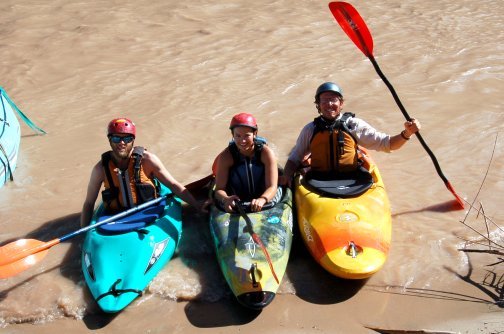
We pushed off of the boat ramp with five boats and three kayaks, nintey gallons of water, at least four hundred pounds of food, and a quantity of beer that seemed improbable, but in the end the exact amount required by those who consumed.

Jim rowing

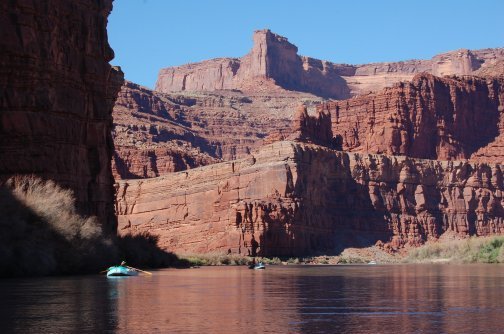
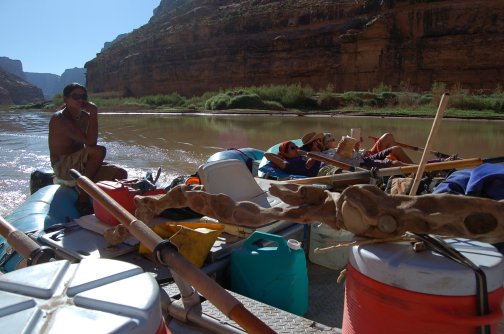
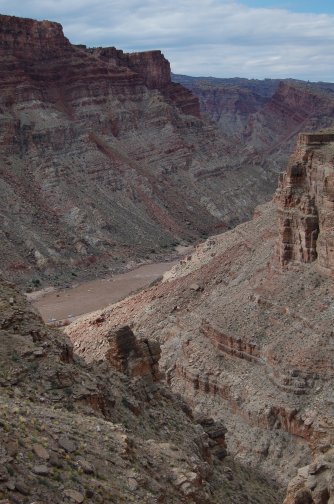
The upper canyon is a dreamy mix of perfectly flat yet steadily flowing red-brown, warm water. The campsites are numerous, nestled beneath massive uplifts of beige, red, and blue-black sandstone and limestone whose histories are best described by those who make a living in their study. But one does not require a degree in geology to appreciate the raw beauty of complex striations, overlapping layers of sand and organic deposition squeezed, shifted, split, and lifted by time, pressure, and patience.

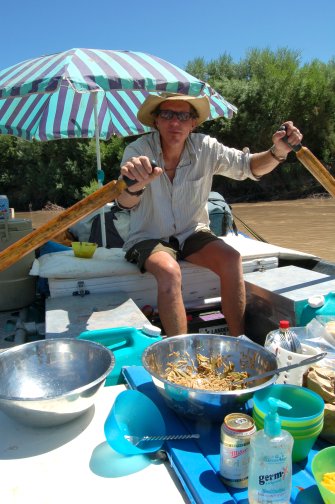
Jim cooking

We floated that first day until half past ten in the night, the hot sun long since below the canyon walls, the full moon then illuminating our way. The oars hardly touched the water for the current was sufficient to keep us moving in the desired direction and free of the walls, boulders, and trees that would otherwise provide only a harmless bump to the boats.

We found anchor at a rocky ledge, unloading the bare minimum to establish camp. I placed my paco pad and sleeping bag a few meters upstream from boat “94”, my head at the edge and eighteen inches above the water’s surface. As I was not ready to sleep, I dangled my headlamp just above the water, mesmerized by the reflection of the red LED shimmer in the soft movements of the river beneath.

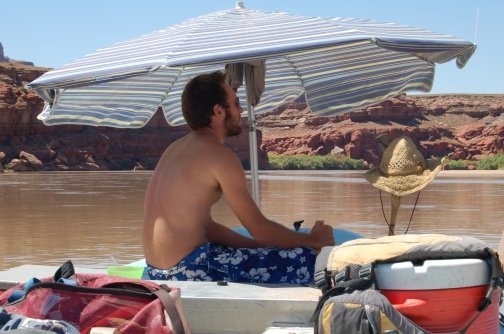
The next morning I rose before the others and hiked for an hour, finding opportunity for a little bouldering en route to the bottom end of a wash and pour-over which came from the higher ridges of the Canyon Lands to the north. Stark reds contrasting bright yellows and greens. The slight chill of the night was rapidly replaced by the bold rays of the sun which forced the dew to evaporate from sleeping bags slung over rocks and oars. Soon, we were again floating downstream, then under the protection of umbrellas, sleeved shirts, and sunscreen.

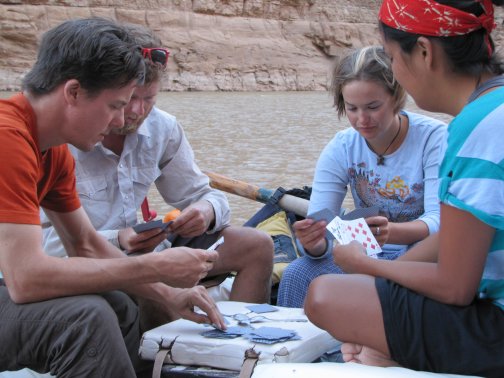
Paul, Morgan, Colleen, Kai playing spoons

Without Time
Throughout the trip I read from a book I have had in my library for too long, “A Tour of the Calculus,” fulfilling one of my goals for 2010 as I desire to rekindle my love for mathematics. This, however, gave my companions a nearly bottomless supply of fuel for humor. But when I asked for help to understand some of the foundations presented in the text, and the same who made fun were unable to assist, we all realized how much we have lost since our college classes and I was for the most part (but never entirely) allowed to read in peace.

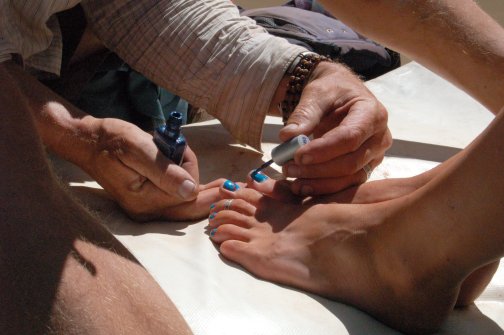
painted toes

I look back and realize I do not know nor do I care when I lost track of time. Without watch or mobile phone, the concept of time was wonderfully abandoned. I could not, without counting backward, have told you the name of the day on which we found our feet again on the ramp across from Hite. It simply didn’t matter. Days of the week and hours of the clock are useful only for communication between two or more persons who need to plan for something in the future, something not immediately within their reach.
Marcus motoring

When the entire world is but a river and a set of boats and the people who guide them, the world is wonderfully simple and beautifully without the need for the management of time. While Einstein said something like, “Without time, all things would happen at once,” time passes on a river not by seconds, minutes, nor even days, but by movement past geographic markers. Remarkable cliff bands, contributing side streams and ancient dry canyons, and fine, white sand beaches make clear that all things are unfolding in slow succession, in the proper order, where distance traveled is a living, breathing function of speed and ever patient time.
 

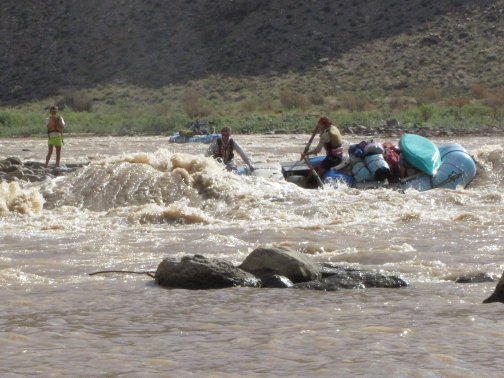
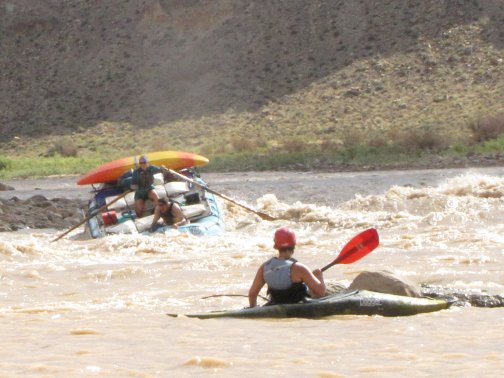
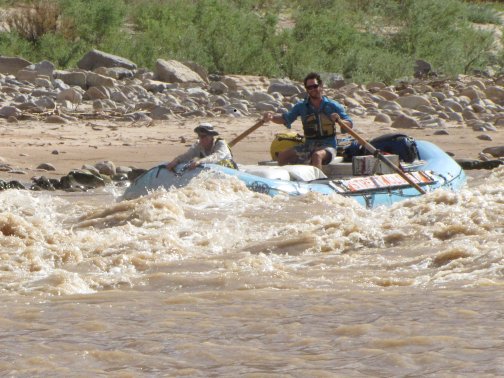
Kate rapids-1 rapids-2 rapids-3 Marcus

Stories from Water
By camp fire I listened into the night of the stories shared between Herm and Kristen, speaking of more than fifty years of Wild Rivers through three successive owners, each a contributor to the history of the Southwest. The politics of water and waterways and the people who use them are as complicated as any such matter. Public hearings and private deals paint a history of use and abuse of what will continue to be a subject of controversy and litigation for centuries to come as fresh water in the Southwest, as with many places in the world, is in growing demand but of diminishing supply.

As our boats passed through more than twenty rapids, some in the Class 3-4 range, it occurred to me that we speak of the people who have move through these places, the ancients with the knowledge of their artifacts and the modern people by name and photos, each leaving their mark in one or more ways. But what of the water itself?

Water has for a substantial part of the history of the planet made the journey from cloud to snow capped peak to melt water, from mountain stream to the Colorado and back again to the ocean (as it once flowed) only to be taken from the surface by a warm wind and lifted to the clouds once more.

Does the water molecule recall each journey and look forward to the next? Does the water enjoy giving foundation to the river wave as much as we enjoy riding over the top?


Noah sliding Noah sliding Paul Noah Kai

Gooey, Stinky, & Happy
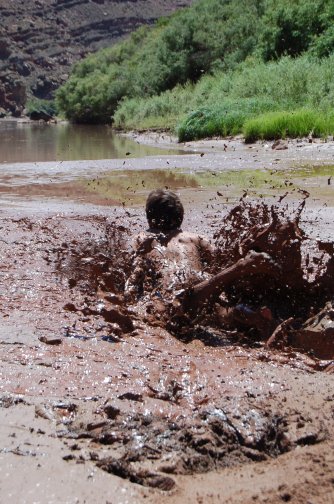
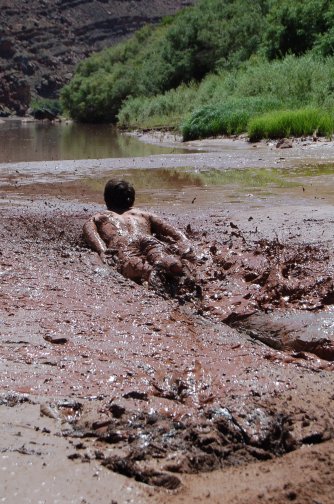
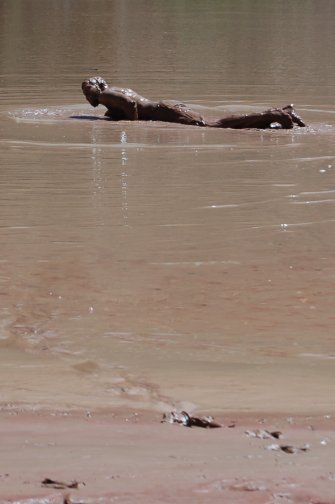
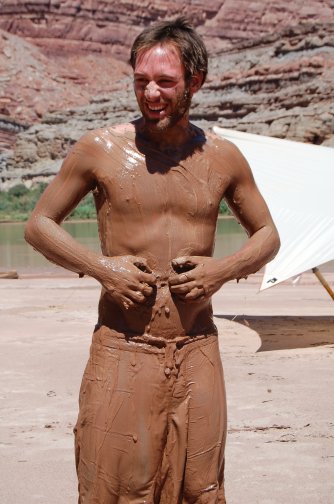
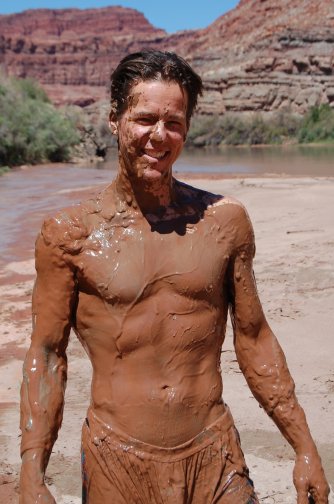
In certain places, there was this wonderful, gooey, stinky, brown-red muck that rested in long, warm swathes adjacent to the sand beaches and dunes. To stand in the mud with bare feet offered an incredible sensation. Warm, wet, and welcoming.

But the odor was to me too close to that of the sheep fold on my grand parents’ farm in Iowa and so at first, I avoided the whole thing. However, once off the boat, the more I struggled the more I sank, up to my thighs at one point. There was no turning back, for my pant legs were coated and I was only sinking further. When I let go of concern (and my pants as well), I followed Noah’s lead and ran along the sandy crust, diving chest down and head first onto the mud, sliding as far as momentum would carry me.

I had to remember to keep my mouth closed, despite the desire to grin, for fear that I would swallow the goo. I made the mistake of turning on my side which resulted in the packing of my right ear with mud, both ends of five cotton swabs later required to remove it all. I am not yet convinced I am clean, subtle gurgling sounds give fear that some ancient microbial life has found refuge in my brain, eating my memories for breakfast and my dreams for dinner at night.

Into the Dolls House
At our third camp, at the bottom of the fifth rapid we stayed for two nights. A strong wind pummeled our camp as the sun set, followed by scattered rain showers which continued into the morning. Noah and I left camp early just as Herm and Val rose to make breakfast. We hiked the back route to the Dolls House in the Maze District of Canyon Lands, a place notorious for its wild, twisting, challenging rock. Surprise Valley, roughly three quarters distance from the river bottom to the Dolls House was indeed a surprise, a welcomed wash of green after a steep climb up loose scree.

Canyon Lands, looking back on camp

As Noah and I lost the trail above Spanish Bottom, having come in from the southwest, we climbed instead straight up a cut high to our left. Not entirely comfortable, the scramble was by no means simple and involved a few slightly exposed climbing maneuvers. At the top, we were pleased to find the way not only possible, but welcoming onto a high slung saddle. En route to join the Dolls House trail, we found two ancient graineries with sand mortar tucked slabs of sandstone yet in tact.

Canyon Lands, Surprise Valley

Marcus, Paul, Colleen, Kate, and Jim came later, trying at first to follow our tracks but in seeing our forward and then back again confusion, they continued high above Spanish Bottom, cutting across deep red soil to find the end of the switchback trail. Marcus later laughed, saying we appeared to have been lost, and then disappeared, having moved from soil to rock.

Canyon Lands, Dolls House

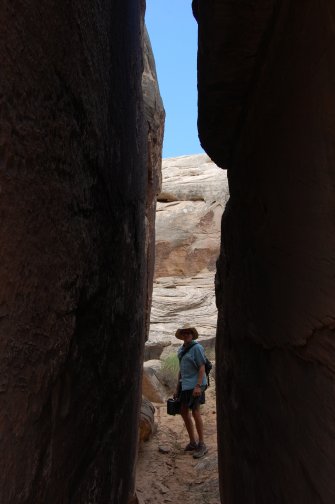
To describe each of the narrow slots and caves in which we walked, slid, and climbed would be too much for this single entry, but one stands out in my mind. The Dolls House trail cuts across the very top of a long, narrow grassy valley, moving into a long slot created by a split in a massive formation. Near the top, to both sides are splits which welcome only those whose girth is lean.

I removed my hat, glasses, and pack, then turned my feet opposite each other, sliding in a few inches at a time. I found myself stuck within the first few feet, the rock pressing hard against my ribs. But when I blew out all the air in my lungs, my chest relaxed and I was able to continue. When I breathed in again, I was immediately jammed. And then it occurred to me–I stood on my toes, breathed in deep, and lifted my feet from the ground, and did not fall! I waved my arms and legs, and Noah laughed hard. Only when I laughed too did the air escape and I sank back down to the sandy bottom again.


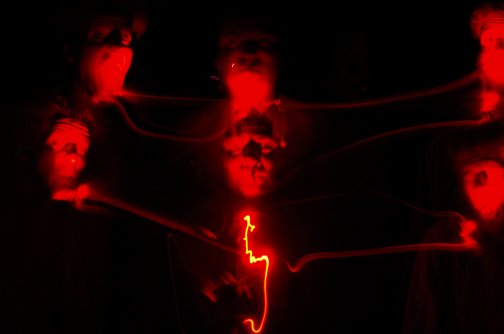
light art: 'Exhale' by Marcus

Stagnant Waters
Lake Powell is advertised on countless post cards, posters, and travel brochures as a paradise in the midst of an otherwise harsh desert of the Southwest. Scarcely clad golden men and well endowed women lounge on houseboats or dive from red sandstone cliffs into turquoise blue water. High powered personal water craft and skiers are drawn to this place every summer for long weekends of recreation.

The western waters certainly provide an incredible contrast, a man-made wonderment in what would otherwise be a deep river gorge, as it was when Colonel Powell traveled its length and before him, natives of this land who for millennia traveled along the deep canyon in order to raise crops along tributary deltas, storing grain in high, protected storage facilities.

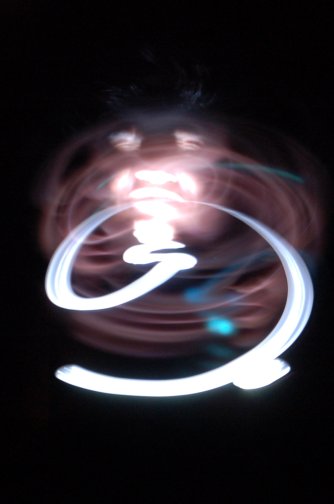
light art: 'Scream' by Kai

What is not advertised is that when richly laden warm water meets cooler stagnant flows, the silt drops to the lake floor. Not an insignificant amount, between 60,000 and 100,000 acre feet per year are deposited in Lake Powell, currently on the eastern reaches near Hite.

While calculations give a wide range of estimations for how long it will take silt to fill the entire space behind the dam, from three hundred to as many as one thousand years, the current situation is one of immediate concern and public conversation. The Sierra Club demands that Glen Canyon Dam be removed to restore natural, seasonal water flow, saving more than 1,000,000 acre feet of water from evaporation each year, while others warn of economic disaster for local economies if the lake top recreation were removed. In the end, the Colorado River Compact remains the primary reason the dam exists, to ensure that ample water reaches downstream customers per the 1922 contract.

As I am neither a geologist nor an economist, any data I present here would simply be a regurgitation of my own research. Instead, I will share the impact Lake Powell had on me.

In the eastern reaches of Lake Powell, where it is difficult to discern where river ends and lake begins, massive piles of silt cling to bleached sandstone walls, some thirty to forty feet above the current water line. From the last rapid (currently #23) to Hite there are virtually no places to camp, let alone walk, for the water meets silt which meets canyon wall.

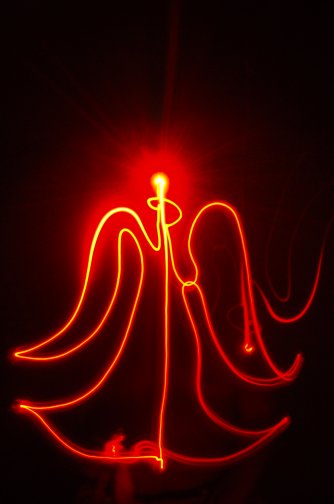
light art: 'Waterbird' by Marcus

It appeared to me as I might imagine a flooded city, a bathtub stain high above the flash waterway on decimated buildings whose foundations are encased in mud and debris. The lower canyon invokes this sense of sadness as I see human engineering giving rise to something entirely contrary to the postcard and advertisements. It just feels wrong, as one might feel when looking up to see a car wedged in the lower branches of a tree or a building on its side, far from its foundation.

Only when the water level rises again will the deposition of the last high water be covered, temporarily making all things appear beautiful again. But beneath the surface, the silt will continue to fill the space between the canyon walls.

I look to a future not of thirty or another fifty years, but hundreds of years and wonder who will be here to manage the dam. Who will maintain the silt level by allowing discharge through the turbine bypass tubes? Who will check the concrete for cracks or open the gates when the fierce Colorado winters give way to saturated Utah springs?

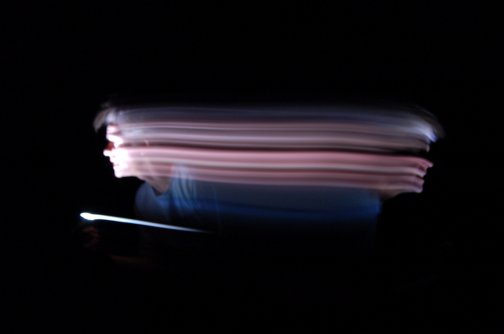
light art: 'Faces' by Kai, Marcus, Paul

If humans do not remove the dam, the cavitation and wave harmonics of massive seasonal floods will cause large portions of concrete to break free, pulling sandstone and rebar from the canyon walls. As the water moves to flow freely again, what silt was laid down will be carried downstream by the slow cutting of a meandering channel and by the rapid flash floods which will tumble concrete blocks until they disassemble into their basic elements of sand, aggregate, and cement.

The dam will be torn down, with or without congressional approval, by the natural process of reverse engineering that created the Colorado river way. The tools will not be diamond tipped blades nor dynamite, but the machinery of time, gravity, and tiny particles of sand.

For now, boatmen and their passengers will continue to enjoy what portions of the river they may run, telling stories of those times before the dam while looking to a future when the entire river will again be free.

By |2019-02-18T01:31:13-04:00September 7th, 2010|At Home in the Southwest|0 Comments

President, Professor, & Preacher Williams

Williams Syndrome
In an experiment, a group of children with Williams syndrome showed no signs of inherent racial bias, unlike children without the syndrome.

Without Fear, Racial Stereotypes Fail To Take Root
A few people are completely and utterly blind to race: children with a rare genetic disorder known as Williams syndrome …

Imagine for just a few moments what this world might be like if our leaders, our public officials, those persons who hold positions of power were required, by law, to have Williams Syndrome.

What if patrol officers and police chiefs, if principals, preachers, teachers, congressmen and presidents did not, could not distinguish between white, brown, or black?

How would the laws be written, how would the jails be filled, how would the monies be earned and distributed if CEOs too were unable to differentiate between you or me? What an interesting world this would be.

By |2017-04-10T11:17:44-04:00August 5th, 2010|Out of America|0 Comments

No more … no, more.

When the paper no longer arrives, will you miss the sound of it sliding across the porch, coming to an abrupt rest against your front door?

When the bulk mail and government subsidies are no longer enough to keep the mail service alive, will your dog miss the excitement of the mailbox clatter and you, the discussion of the daily weather?

When the bank teller and shoe cobbler and the small appliance repair shop share the same place in our history books, will you miss the opportunity for someone who always remembered your name?

Soon, we will never again purchase music or rent videos from a store. We will increasingly work from our home, learn from our home, even travel from our home through a virtual world.

How, then, do we claim to live a more connected life?

The next generation will not likely know what it means to hold music in their hands nor blow dust from the cover of a book. E-readers will offer instant access to everything, which may improve literacy or reduce appreciation … or both.

Ironic that in a growingly connected world, it seems to me, people are actually more alone despite their always being online. Reaching out through instant feeds and sharing hundreds of snippets of noisy nothing while failing to explore the depth of silence.

In a world of “no more” it seems to me the ideal application will be one which turns off all our gadgets, gizmos, and devices in order to say clearly, “no, more.”

By |2017-04-10T11:17:44-04:00August 2nd, 2010|Critical Thinker, Humans & Technology|2 Comments

200,000 Job Openings

…. your hands are swollen. They’re cut up. They’re stained. And the women that oftentimes they’ll work on their knees and their knees are brown so they won’t wear skirts because they’re ashamed of showing that off to people. I mean those are just the realities that farm workers face every single day. So it’s a grueling effort, a grueling job that takes place and they get very little recognition for what they do. But the reality is, that if it wasn’t for them, we would not have food on our tables every single day.

An excerpt from an interview with Arturo Rodriquez, President of the United Farm Workers, which has created a program called Take Our Jobs!, inviting unemployed U.S. Citizens to take a stab at agricultural labor, helping put produce on the shelves of every grocery story in this country.

Take Our Jobs!
July 31, 2010
By Ariana Pekary, producer

“It seems so simple: if the complaint about increased immigration is that the new people are taking jobs from American citizens, then you should proactively hire legal citizens for those very jobs. That’s what the United Farm Workers union has set out to do with a program called Take Our Jobs. We’ll see how successful they will be at getting Americans to work in the 100-degree heat for minimum wage. Bob talks with the union’s national vice president Giev Kashkooli about the program.”

It was refreshing to hear what in this place and time I believe everyone needs to be reminded of–the U.S. food industry relies heavily upon a migrant worker population.

Not only are the migrant workers not “stealing our jobs”, but it is very unlikely that any U.S. citizen, in particular of the middle class, will be willing (or able) to work an entire season (let alone a few days) in the physically grueling condition that we all take for granted every time we purchase readily available fruits and vegetables in our local grocery.

Looking for a job? Minimum wage. 10-12 hours a day. No health benefits. 200,000 openings.

By |2017-04-10T11:17:44-04:00August 2nd, 2010|Out of America|0 Comments

No More Deaths

desert

Introduction
The controversy surrounding undocumented migrant workers is fueled by politics and economics, ethnicity and racism, social justice and international relations. As I am not an expert in any of these subjects, and have limited exposure through my volunteer work with No More Deaths, I will do my best to call upon my own experiences first, pulling in what data I have to support other than first hand accounts.

In subsequent entries to this “Out of America” category, I do hope to challenge some of the stereotypes and misinformation which surrounds this subject, answering questions asked of me and those which I have formed myself.

The following is my first entry, a story from just three hours out of three days on the border.

Of Boundaries & Borders
This past weekend presented an anomaly, a break from the intense late June heat with borderland temperatures in the high eighties or low nineties by mid-day and what felt like high fifties at night.

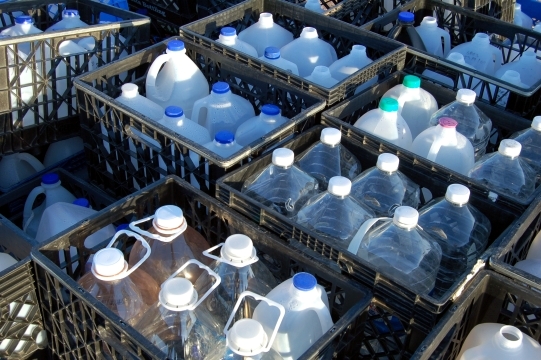
On my third day out, five volunteers for No More Deaths, myself included, drove for nearly an hour over very rough terrain, from bumpy roads to creek beds in which our four-by-four truck loaded with seventy gallons of water was routinely forced to a crawl, its driver carefully picking her way over basketball size boulders and steep, loose inclines likely impossible to pass without a low-gear transmission.

The desert trees clawed at the sides of the truck, the squeals of thorns and branches against metal and glass reminders that very little in the desert is soft, friendly, or welcoming.

En route to our final destination, we dropped a dozen or so water jugs several meters off the road at a designated water drop, and then packed food and water for migrants in addition to that which we carried for ourselves.

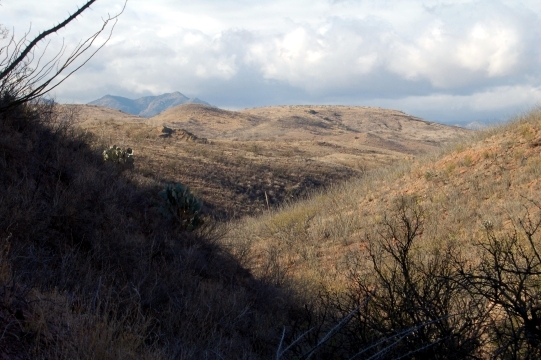
The five of us set out for the high saddle, likely over five thousand feet in elevation, two, maybe, three miles from the bottom of the wash where the truck was parked. Even with topo maps, a GPS unit, and two people who had been on this trail before, we found ourselves in a tight ravine, off course within thirty minutes from start. Such is navigation in this harsh terrain.

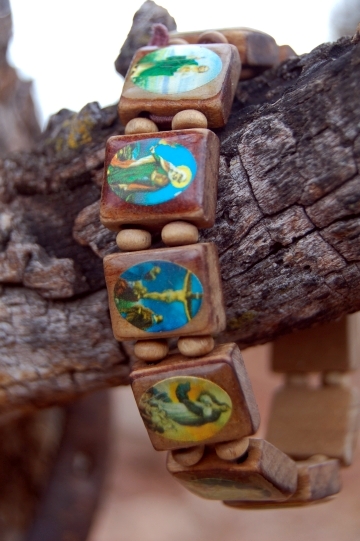
candles bracelet clothing childstoy

Stories in the Sand
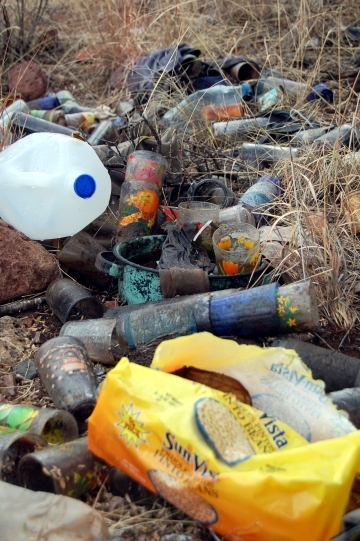
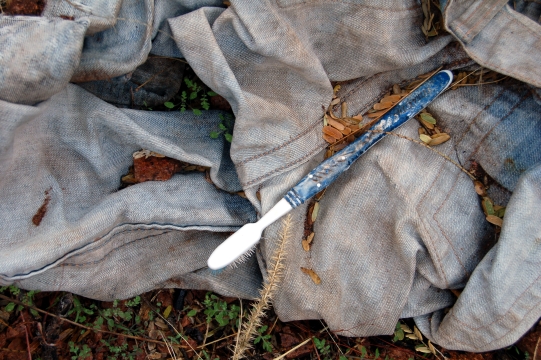
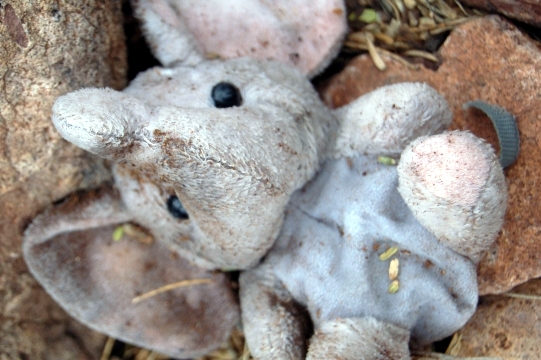
As I have come to expect, there are signs of migrants in nearly every desert passage, high, low, narrow or wide, on or off the set trails. Footprints, water bottles, blown-out shoes, backpacks, and discarded clothing are clear signs of who has come and gone. The brittle nature of the bottles, sun baked degradation of the clothing, rubber, and plastics helps determine how much time has passed since those items were left behind when their owners passed through.

It is unlikely we will hike for more than ten minutes in any direction, on any trail, without crossing something left by a human in flight. There are running shoes whose soles are torn, ripped back, or completely missing; wing tips, penny loafers, cowboy boots, women’s high heels and children’s dress shoes too. We once found snake skin loafers with smooth leather bottoms mid-way up a very steep climb which was challenging even for me with proper, full hiking boots whose tread was designed for just such an endeavor. It was obvious that whomever once wore them realized the folly of continuing in what was likely his third or fourth day in transit from Mexico north.

There are countless thousands of stories to be told every month, millions over the years, the voices of passers by lost to the high desert wind but recorded in the trails themselves and in the personal belongings they have left behind.

The coyotes, the ones who are often paid to lead men, women, and children from south to north are, from the stories we have heard, often ruthless and without scruples.

“Victory trees” hold women’s underwear and bras to showcase those who have been raped by the coyotes, the others in the group helpless to do anything for fear of being misguided or left behind after paying incredible fees for the passage.

Everyone carries a backpack the size and style of a school book bag with thin shoulder straps and no waist belt. As the migrants are often told the entire journey is but two days walking at most, they bring little more than one or two small bottles of water, seldom more than a single liter if combined.

We have been told that on the first or second day over the border, the coyotes point to a distant glow in the night sky and announce they are but hours from Tucson. The migrants change into a fresh set of clothes, clean jeans and shirts, dress shoes and socks. They brush their teeth and hair, apply makeup and deodorant in order to appear less like migrants and more as locals, employed, and already embedded in our communities.

They drop the backpacks, soiled clothes, and toiletries in growing piles in shaded washes and then set off for what they are lead to believe is the final leg of their journey.

Three, sometimes five days later, they are without food, water, functional shoes, or hope. The coyotes long ago abandoned them, easily out-pacing their clients by day or night in order to return to Mexico and start again.

If they have a mobile phone, the battery is often dead or the coverage impossible but from saddles or peaks where they are also more likely to be spotted by the border patrol.

No, not all migrants come with coyotes. And no, not all are left to die in this manner. But the stories told are too often the same as I have shared, and the results repeated—giving up and heading back to the border, seeking the border patrol and suffering the consequences, or death.

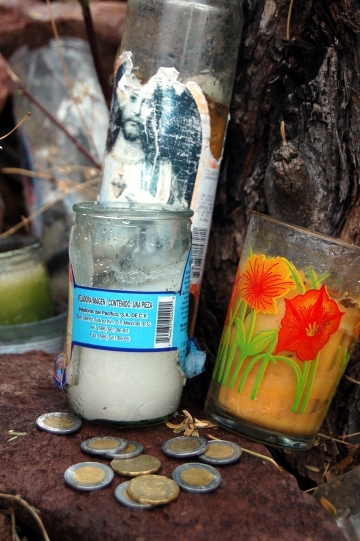
shrine

At the time of this writing there are 128 confirmed deaths since October 2009 (one nearly every 24 hours over a given year) on the Arizona border. There are likely far more, but as these migrants are undocumented, coming not only from Mexico but from all reaches of Central and northern South America, and the vast desert able to hide bodies for years, or forever, the true count will never be known. The border is 2000 miles long, from Texas to California, and the total number of deaths each year estimated to be in the thousands.

Of Helicopters & Handcuffs
We reached the northern side of the saddle and stopped to drink and eat in the shade of a tree. But from the southern side of the saddle, we heard a helicopter, likely the border patrol in pursuit.

A few minutes later, each of us found purchase on the high rock ledges which lined the giant valley bowl, maybe a quarter mile from the helicopter which hovered too low. It swooped down to nearly touch the tree tops, rising, spinning, and moving completely around a large, high island in the middle of the valley.

Having been pursued by a police helicopter when I was younger (another story for another time), I can personally attest to the fear they instill, machines highly effective at scattering those caught in the wake beneath. The border patrol often uses the helicopters to cause groups of migrants to break-up, their chance for survival greatly reduced if no longer traveling as a group.

We were far enough into the desert to believe this was a reconnaissance mission only, or perhaps a training exercise as we were unable to locate any individuals on the ground and the area covered by the helicopter seemingly too vast to be focused on individuals.

And yet just moments after the pilot directed his airborne vehicle over our heads, the saddle behind us, and to the north, we saw four individuals emerge from a lower saddle on the west side of the valley island.

We waited, listened, and thought we heard Spanish spoken. We called out to announce that we had water, food, and medical aid if needed. We waited again. Only the person in front continued forward, the other three falling back, or at least that is what we discerned from out distant perch without binoculars or scope.

We opted to move down into the valley to determine if our assistance was needed. Fifteen minutes later, we caught a trail and crested only two rises which followed the deep ravine bottom before we came across two border patrol officers, one in front and the other behind fifteen migrants, each handcuffed to the person in front and behind, save the single woman who was without restraints.

We announced ourselves as humanitarian aid workers, desiring to provide food and water. The officer in front stated we were allowed to proceed, but needed to do quickly, while the officer in the rear questioned the former about his decision.

Given the restraints on the migrants’ wrists, we opened the bottles and bags, helping each to what they needed in the moment, placing the remaining water and food in their backpacks. The lead border patrol officer instructed them to thank us, as a school teacher would a group of children after visiting the local museum or fire house on a field trip. Each had already thanked us, as is most always the case when we meet travelers in this place.

I quickly interviewed the young lady. She said she was without pain or need for medical assistance. By her account, they had been in the desert already for five days, and yet were but two days from the border for someone who knew the route.

As always, it is difficult to determine who might have been the coyote, if there was one at all. Given their slow pace, it is possible they were already abandoned or without one from the beginning.

In just five minutes time we had emptied our packs, attended to each migrant, offered water to the border patrol officers (who politely declined), and they continued to the saddle from which we had come.

This is the point at which I always break down. Perhaps with more experience I will become accustomed to the heightened emotions which are inherent in these interactions. I hope not, to be honest, for I do not desire to become cold to this heated place. The dirt on my face was changed to mud when the procession was moved along the trail back to waiting dog-catcher trucks and eventually, the Wackenhut buses. We kept our distance, not wanting to apply undue pressure to an already tense situation. Past the saddle, we believe the officers and migrants headed west while we continued north, back to our truck.

How some sections of the trail were traversed by people handcuffed front to back is beyond me, for I needed at least one hand on the ground in a number of places to steady myself over steep, loose sections.

It was just past noon, the sun gaining its highest, hottest position in the Arivaca sky. We didn’t talk much during our retreat nor the drive back. We had done what we could. Little more to say.

bottles

No More Deaths
At camp, those of us down for the weekend packed our things in preparation to head home; those just arriving received final training by one of the No More Deaths’ founders who in his mid-seventies shows no sign of slowing. Crates of water bottles loaded into the backs of trucks, food and medical supplies into backpacks, the afternoon sun again beat down on the desert trails.

It is unlikely that today, tomorrow, or this year will be the end, a time where there are no more deaths. Until then, migrants will continue to seek a better life, the border patrol will continue to give chase, politicians who have never been to the borderlands nor spoken with an undocumented worker (nor likely a border patrol officer either) will continue to debate the cost to the American people while volunteers place water on the trails.

By |2017-04-10T11:17:44-04:00June 15th, 2010|Out of America|2 Comments

I am …

“I. You.”
I experience myself as only I am able. I know myself in ways I will never know you. Therefore, “I” is a solid circle, as it is the whole experience of me.

I You

We may laugh, cry, fight, or make love, but ultimately, I will never fully know the experience of being you. My experience of you, for as rich as it may be, will always be how I experience you through my senses of sight, sound, touch, taste, and that intangible we call relationship. My experience of you will always be but a shell of who you really are. Therefore, “you” is an open circle, a shell around your core.

“To be.”
The richness of this human existence may be expressed best as the ebb and flow of our emotions, our perceptions, our comings and goings into the various realms and depths of self-awareness. Being human is never a stagnant thing, nor is being human a variable ever decreasing or increasing, for we hourly, daily, annually rise and fall to our creative potentials and our reptilian cores. Therefore, “to be” is an uncertainty, a relative unknown, a wave.

To be

“I am …”
We spend our entire lives describing our experience of being human to one another. We do this through verbal conversation, through our body language too. We express our experience of this relatively short time through the subtleties of endorphins released when courting a mate or running a race, and the bold release of sadness, anger, pain, and fear.’

I want. I need. I can or I cannot. I will or I will not. And when we attempt to control others, You will or You will not. Sometimes we stop long enough to reach out and ask, What do you need?

But ultimately, if we remove all the layers of where we are in the moment, the volatility, the passion, the wants and the needs, we are left with a very elemental central theme that likely perseveres throughout our entire life.

Everything we want, need, can or cannot do, even those things we demand from or give to others is a reflection of who we are. Therefore, central to iConji are the two most important characters, “I am” followed by the uncertainty of what we will do next, “…”

When you use iConji, stop long enough to consider who you are. You may send the character for ‘beer’ and a clock and a question mark with attached Notes for the time and place, but even in that simple request that your friend meet you for a drink in the evening at your favorite pub, you have in that moment said, “I am …” or in iConji:

I To be ellipsis

By |2017-04-10T11:17:44-04:00May 15th, 2010|The Written|0 Comments

Tap Dancing at Whole Foods on Earth Day

Whole Foods is, according to a hilarious (and all too true) daily calendar “Stuff White People Like“, the ultimate epiphany of olive bar congregation, hand lotion sampling, and coffee, bread, wine and cheese tasting for those who want everyone else to know they are doing the right thing.

To have stumbled into Whole Foods on Earth Day should be, according to the 365 tear-off pieces of paper, a cosmic orgasm of organic ecstasy to save Planet Earth, one echinacea infused, rose hip and lavender bottle of carrot juice at a time.

Quite frankly, I found it a bit overwhelming and would have run away were it not for the incredible variety of free samples of chocolates, breads, cheeses, and pastries. I nearly abandoned my plans for dinner, realizing that just two or three rounds, from end-cap to end-cap would likely suffice for a complete, 3-course meal.

At the table for Zinger brand trail bars, I enjoyed a few samples which reminded me of Bit-O-Honey candy when I was a kid, the rich flavor of honey so much preferred over any variety of processed sugar.

But on the right most paper lined dish was an assortment of red blobs, the diameter of a quarter and roughly half the height at the peak of their shiny, waxy dome. If the woman serving the samples had not explained that they were a new kind of “power shot”, I would have assumed someone failed to recover a highly displaced Christmas tree ornament box, its contents spilled neatly on this end-cap at Whole Foods.

At her request for me to try a sample, I shook my head stating it just didn’t look like something to be consumed, at least not without good reason.

Just then, a sharply dressed and quite fit woman I presume to be in late sixties or early seventies stepped up, grabbed one of the red drops and popped it her mouth. I looked at her, and then back to the woman behind the table and said, “If she starts tap dancing, I’ll eat one too.”

As though we had rehearsed the routine for weeks, she started to tap dance. I nearly fell over. She looked at me and said with a confident grin, “I used to tap dance, you know.”

I clapped my hands and said, “Hah! I knew it!” and then turning to the woman behind the table, “Guess I better try one now.”

And that is how I was witness to tap dancing at Whole Foods on Earth Day.

By |2017-04-10T11:17:44-04:00April 23rd, 2010|At Home in the Rockies|0 Comments

Without a Box

The Fall Guy
Earlier this year I met “Ed” who had setup an interview for my friend “D” with a particular City of Phoenix official. Barrel chested, chisel cut and strong, especially for his sixty+ age, Ed was like no one I had ever met.

Conversation with Ed from parking meter to the upper floors of the City government building revolved almost entirely around his work in Hollywood as the stunt double for one, very famous actor.

Ed did not fail to remind me nor D how much of a favor he was doing for her by making this introduction. Anyone else, he explained, would wait weeks to gain the attention let alone a meeting of this particular person. Ed pointed to the security cameras, the guards, the locked doors–all of which we passed with relative ease due to the people he knows and the trust they have in him.

I took all of this in stride, intrigued by this strong bodied and strong willed man who was keen to make clear his position with or without solicitation. Even if a bit overwhelming, I enjoyed the hour for Ed was also complimentary, in a fatherly manner, when it came to his emphasis that D would succeed if she focused and continued to move her life in a chosen direction.

At the end of the interview, Ed escorted the two of us back to my car, a little more than two blocks North of the City building.

The Hang Man
In the interest of his time in Hollywood, I invited him to attend the public screening of this year’s first Almost Famous Film Festival event. He glanced at the license plate on my car and incorrectly assumed the event was held in Colorado, quick to state “I won’t go there.”

I asked, “To Colorado? Why?” thinking he had an outstanding speeding ticket or perhaps an ex-wife who would hunt him down if she so much as smelled him within a thousand mile of her home. I could see that, given a strong predilection for stating his opinion.

But instead, Ed replied, “It’s about upholding my ethics.” Ed paused to look at the tips of his fingers and chew a blade of something which had found its way to his mouth. He looked at the sky and then back to me and D. “Too many goddamn liberals in Colorada. I told myself I will never set foot in that State again, not as long as Colorada is overrun with them kinds of people.”

I didn’t know if I should laugh or turn and run, but I was pleased to have cut my hair a few years earlier. I silently hoped he hadn’t noticed the foreign origin of my car.

He took a deep breath, leaned against the back of his white Ford pickup truck, head back and eyes narrowed into a tight focus, elbow propped on the closed tailgate, “You know what I got in the back of this truck?”

Oh shit. In broad daylight I was noticeably nervous that he had something in the back of his truck I didn’t want to see. Neither I nor D responded, which was in retrospect the best possible reaction.

“A rope.” He paused again, for effect I am certain. “A rope for hang’n. You see, in the old days, I would’a used it for hanging just about anyone if they crossed me, if you know what I mean.”

Ed glanced at D who is of African ethnicity, and my amusement was fully replaced with a very uncomfortable feeling. I considered the implications of what he had said with a sense of horror and at the same time belief that his story likely carried a Hollywood flair, perhaps a slight confusion for the movies in which he had acted and his real life.

“But I learned a thing or two and I have changed my ways. I don’t think like that any more. But I’ll still use it, ’cause there are plenty of folk that still need a hang’n. If you do something wrong, and I catch ya, I’m gonna use it, understand?”

This was not exactly the sort of thing I was used to hearing on the streets of Phoenix. Then again, I could not think of a better place in which to receive a live, serious Eastwood monologue outside of Dodge.

“You see, I ain’t afraid to do what’s right, to stand my ground and fight for what I believe in. I ain’t gonna go to Colorado no more ’cause it lost its way. On the principal of who I am, and I gotta stand by my principals, I won’t go there.”

“And just the same, I’ll hang a man for crossing me or anyone I care about and protect. I care about her mother

[pointing to D] and I will protect both of them with my life.”

Neither D nor I knew exactly what to say. I shifted my weight from one foot to the other and back again, looked at the top of my shoes and the backs of my hands as my fingers sought solace in just keeping busy.

I returned to the original subject saying, “Well, fortunately for you, the film festival is held here in Phoenix, if you remain interested. You are more than welcome to attend.”

He stated he just might do that, but maintained an out with “I am a busy man. We’ll see what I can do.”

We shook hands, said goodbye, and then D and I returned to the front seats of my car.

Building a Box
In that exchange, my mind was filled with momentary images of Hollywood westerns which both glorified and demonized hangings. I looked at this man, took a deep breath, and instead of arguing in an attempt to open his narrow view of the world–I placed him in a box.

The box I envisioned was not of my own fabrication, rather, of his design. Ed lived in a carefully constructed, thick walled box in which his world view was perfectly clear. He new his purpose, his rules of engagement, and the boundaries which encompassed those he cared for and protected, even if the means were … harsh.

It was at first difficult for me to not judge him, to keep from recoiling, throwing up my own defenses. But when I allowed myself to see this box within which he lived, it gave me the ability to instead see the practicality, even the value in the principals which he employed.

Ed has ethics. He has morals. He stands by them to the end. That understanding is what I chose to take with me as I departed from the otherwise obscure venture into yesteryear in downtown Phoenix, Arizona 2010.

Without a Box
Since this time, I have used the construction of a visual box in several occasions to help me react less and to respond more. These boxes are not my attempt to define people against my own insecurity nor for my personal safety, for we all live in boxes of various sizes, thicknesses, and opacity. Rather, it is a means of placing myself in their box with hope to see the world as they may see it. It is a simple, visual tool to help me, for if I lighten the burden of brick and mortar, discover a door, window, even a small ventilation shaft, I may improve my understanding and ultimately, our mutual communication.

Sometimes I see thick walls of concrete, stone, or brick. Sometimes I see wood, paper, or glass. But what has been the most challenging is when I meet someone whose box is wide open, the sides laid flat or the top removed. When I meet someone who lives seemingly without a box, I find that I recoil in fear from the realization that my own set of walls remain thick and impenetrable by comparison.

I remain afraid to let go of my own rules, my own reasons why I can or cannot engage. I too feel the safety of my box, and challenge those who appear to have none as readily as those who do, for if I find evidence of their boundaries, their apparent perfection will falter and I in comparison will not be so far from the truth.

To live life without a box is perhaps the greatest challenge of all, for it means moving through this world without self-declared affiliation to the left or right, Democratic or Republican parties, Christian, Jewish, Muslim, or Hindu faiths. To remove the walls and corners is to simply say “I am …” and leave it at that. No further explanation is required when one chooses to trust that whomever stands before you will gain what they need to know about you by the very nature of your transparency.

By |2017-04-10T11:17:45-04:00April 23rd, 2010|At Home in the Rockies|0 Comments
Go to Top