Kai Staats: writing

Solar Powered Hot Tub

Northern Colorado Business Report
“Solar Powered Hot Tub”
By Kai Staats
12 August 2011

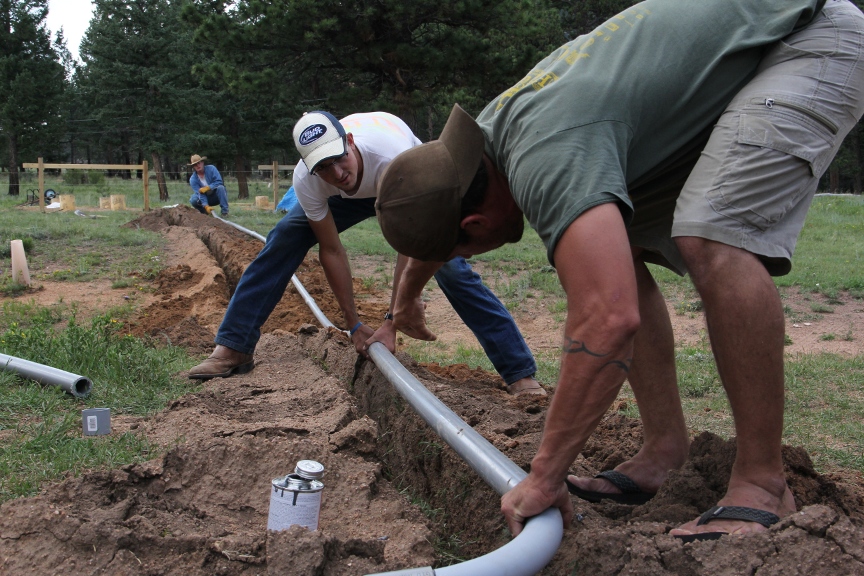
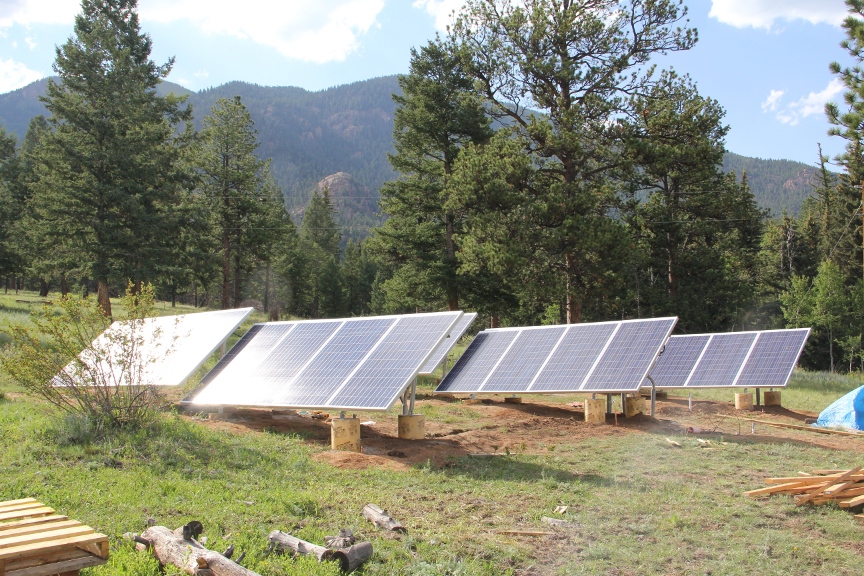
This summer I collaborated with three friends on the design and installation of a grid-tied, battery backed 5.6KW, 24 panel photovoltaic array on a 260 acre ranch near Bailey, Colorado. Despite the challenges of a relatively large-scale renewable energy project, it was an incredible pleasure beginning to end, given the stunning beauty of the location and contagious energy of the tireless individuals who were as eager to dig a seventy five foot trench as they were to learn hands-on about electrical wiring.

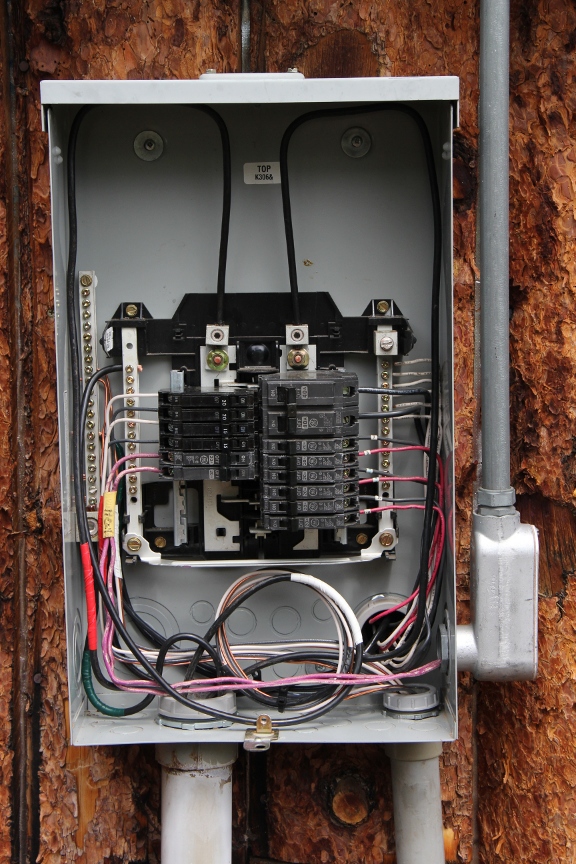
Twenty four, four foot deep holes filled with concrete provide the foundation to six aluminum frames which hold four panels each. We rewired three electrical boxes, migrating mission critical circuits (ie: lights, outlets, water pump, refrigerator) to the panel which is now isolated from the grid and powered by the battery-backed inverter. Best of all, there is ample power for the hot tub.

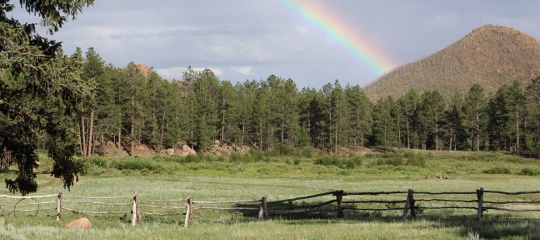
At 8,000 feet the ranch is surrounded by ten thousand foot peaks, undulating hilltops and ravines which harbor horses, deer, coyotes, bear, and buffalo. Any sense of guilt at having enjoyed such a job site is completely washed away when I consider that the power required to heat the hot tub is more than offset by the new solar PV array.

The introduction of a passive solar water heater would certainly be more efficient than converting sunlight to electricity which in turn heats the water, but as with most adoptions of technology, change is best taken one step at a time. This is true not only on the small scale of one ranch in the middle of thousands in Colorado, but also for the worldwide effort to transition to renewable energy.

Too often I hear the argument that we will never be able to rely entirely upon renewable energy sources, that the efficiency of solar panels and wind turbines is simply not high enough to produce the power required.
This skepticism is parallel to the naysayers of so many human achievements—and a failure to recognize the relatively brief history of research and the commercial application to renewable energy. As with all evolving technologies, renewable energy will not achieve full market play until market demand and the resulting mass production forces a higher level of efficiency. In this case “grid parity,” or the ability to produce energy for the same or lower cost than traditional methods such as coal, nuclear, or gas. The good news is that we have achieved this in certain markets, and are moving to find grid parity in a greater diversity of regions.

The history of photovoltaic energy production goes back to 1883 where Charles Fritts created a solar cell which converted just one percent of sunlight into electricity. In the late 1960s Elliot Berman and an Exxon research team increased the power-to-cost ratio by five fold in just two years. Fast forward and solar cells are manufactured today for roughly $1 per watt, compared to $250 in 1954. A two hundred and fifty times reduction in the cost of manufacturing in roughly sixty years without a market nearly as substantial as the housing, automobile, or even bicycle industries.

So what is holding solar power back?

I will not dive into the politics of renewable energy, for that alone could fill a few columns. At a lightly technical level there are some hurdles which have only recently been surmounted. The entry at wikipedia.org/wiki/Solar_cell provides an in-depth journey through the history and technology of the photovoltaic principal. The basic concept, however, is this: humans see what we call the visible portion of the spectrum while silicon-based solar cells are able to convert only a portion of that light energy into electricity. While the visible spectrum represents a good bit of the energy produced by the sun, this does not constitute the full energy available for conversion to electricity.

We are missing the tremendous potential for conversion of infrared and ultraviolet light energy. Relatively recent research into combinations of elements to expand the sensitivity of the solar cell has increased the efficiency of energy conversion.

In our own backyard, the National Renewable Energy Lab is researching cells with upwards of 40% efficiency, more than forty times greater than the original solar cell just 150 years ago. While southern California and Hawaii have achieved grid parity using traditional silicon based solar cells at efficiencies at or below 20%, the near-future potential for doubling this efficiency lies in the ability to reduce cost of production, the result being that multi-spectral systems are available to you, me, and those who have solar powered hot tubs in the mountains of Colorado at a market friendly price.

Until that time, I am pleased to sit back after a hard day’s work and know that the warm water which gives me comfort was generated, even if indirectly, by energy from the sun. I believe the near-future holds an exciting, rapid evolution for renewable energy production, soon becoming something greater than an alternative, rather, simply the way it is done.

By |2017-10-21T16:48:59-04:00August 12th, 2011|Humans & Technology, NCBR|0 Comments

To See Again

I am able to see again, to observe and engage the world around me in a way that compels me to write. It’s been a while, more than six months, maybe a year since I felt this way. It’s good to be in this place again.

By |2011-08-09T15:35:03-04:00August 9th, 2011|The Written|1 Comment

The Good Sam’s Utopia

Transient Homes
Certainly, Good Sam’s was not my first pick, but at thirty seven dollars for one night it was half the cost of the next accommodation in this beach side, New Hampshire town of Seabrook, one mile from the intersection of I395 and I95 and on the Atlantic Coast.

I was granted the very last tent spot 47A which has no official parking spot, but does sport the highest spot in the campground at some ten or twelve feet from the roadbed, a picnic bench, fire pit, and a view down and into the court yard of the half dozen adjacent RVs, none of which is more than thirty feet distance.

The smell of camp fires mixed with bug spray, cleaning supplies from the nearest bathhouse, outdoor cooking, and diesel from a large truck which just passed by. Across the road and a few meters down, a father crept beneath the window of the RV in which his kids were playing cards, popped up to slap the glass and yelled in his best monster voice. The kids screamed and then laughed in quick succession. The same interaction likely plays out night after night and neither grows wary, at least not until the children grow to be teenagers and dread the very presence of their father as much as the mandatory, summer family camping trip.

In the toilet and shower facility I quickly discovered that the men’s and women’s units were separated by a wall but shared an open ceiling space, all conversations moving without resistance into the adjacent facility. Two girls, perhaps in their late teens dared each other to pee in the shower, I gathered, without taking a shower at all.

When I finished brushing my teeth and left to walk back to my rental car, I recognized the voices of the girls who exited their side of the bathhouse at the same time.

One said to the other, “Where are we”?

“I don’t know. You live here, and you don’t know?”

“No. I’m lost.” She then turned to me, “You know where we are?”

Given that we were in a campground whose density of patrons matched that of Japanese tube hotels, and roadways the narrow streets of old Barcelona, I played along, “No. No clue. I was hoping you knew,” as I approached my car and reached into my pocket to grasp the key remote. A few more steps, and I pressed the unlock button. The lights flashed and the horn chirped.

“Is that your car?”

“Yup.

“Oh, so you DO know where you are.”

“No, but I do know the location of my car.” She didn’t catch the subtle challenge in that response and said only, “Oh!”

I stopped to open the back and they continued. I lost track of them quickly as the road was dark, lit only by the camp fires, porch lights, and rope lighting of the RVs.

Escape from Ourselves
I sat on the bumper and looked around. The Good Sam’s campground took on a new form in my mind. I was less offended by the obvious eye sore and more interested in the social experiment at play.

For the prior three nights I had been staying in cabins whose tenants were amateur astronomers, assembled for the intent purpose of sharing their passion for observing, for exploring the night sky. They maintained the utmost respect for each other by using only red lit headlamps, car dome lights, flash lights, pen lights, and perimeter lights on their scope legs and bodies.

Here, I originally found the stimuli overwhelming as loud voices contended with car doors slamming, kids screaming, fire crackers, televisions, radios, and the laughter of drunken adults who freely expressed all they had withheld since their last escape to the great outdoors.

With the words of the second girl, “You live here” I realized the unique qualities of this place in that it was congregation of semi-permanent residents with transient campers, like me. In a subtle way, everyone in this place agreed to a certain level of compliance to an unwritten set of rules which enabled the place to function without major confrontation.

The residents understood that their neighbors may come and go, staying one, two or a half dozen night before moving on. Those who passed through understood this was home to some people, and therefore deserved a level of respect for property and space.

I walked the entire perimeter and all interior roads twice, once to explore and then again to capture some time lapse photographs, the shadows of the night giving way to streaks of illumination as burning wood yields dancing flames. This is what I experienced.

A couple sat to the side of a fire, an open bottle of wine and two glasses reflecting the light. They said little, mostly staring into the flames. Several fires burnt unattended, the flames dropping between my first and second pass. A father played cards with his daughter at a picnic bench, their faces illuminated by the blue glow of a lantern reflecting from the inside of a suspended tarp. A dozen teenagers sat ’round a large fire on the edge of the campground, one boy played guitar and sang, his audience completely engrossed. A half dozen adults spoke aloud from stackable plastic lawn chairs, a block party unfolding.The side of their RV was adorned with string lights up and across the awning supports and around the bumper. Some RVs showcased plastic deer, white picket fences, water fountains, and an American flag. A preteen boy raced by on his BMX bike, apparently able to see well into the midnight spectrum where the rest of us walked with caution. A man in his sixties leaned over a picnic bench, his glasses low on his nose as he attempted to read the instructions of a manual printed in too small a font. The battery powered lantern to his side cast a cold, nearly white light upon his face, the bridge of his nose the divide between the light and dark portions of the rising, crescent moon.

Everyone came to this place to get away from home, with the understanding they would be living a simpler life for the duration. One bowl, one plate, one spoon. A small cook stove with few pans. Simple foods, and for most, no television, laptop, or cell phone. This is a retreat from the very things we work our entire lives to acquire, only to be overwhelmed by them in return. These people, myself included, are happier living this way. And yet, they will soon return to the complexity of ownership of more things, things which were not forced upon them but acquired of their own accord.

Ironic, it seems, that we must escape the very life we have created for ourselves. What keeps us from just living this simple life every day? Why are we afraid to stop acquiring, to say “Enough already! I don’t need any more.” There seems to be a process which takes us from tent to camper to RV, from Coleman fuel camp stove to four-burner propane kitchenettes. Is this the process which also takes college students from Raman noodles and masonry block book shelves to IKIA and eventually a custom built home which is challenging, if not impossible to afford?

I cannot help but laugh when I walk by the RVs whose small yards harbor miniature flower gardens, a sense of order and beauty surrounded on all sides by the chaos of an over crowded, noisy, dusty campground. They have established their island in this flotilla of drifters and weekend bums.

The Good Sam’s Utopia
I grew up with Star Trek which presented a vision of neat, clean, highly organized society filled with people who were content for their station in life. Everyone was important, everyone was needed, well educated, and capable. In contrast, Arthur C. Clarke’s “Rendezvous with Rama” books present an accurate portrayal of human society unfolding in a confined, isolated space. How many years would it take for highly trained military personel and researchers to resort to their human tendency of wanting more, to take more at the cost of their neighbor? How many generations would it take for humans to carve out camps which battle each other for resources? How soon would God intervene, showing her face in the diversity of fragmented expressions which somehow oppose each other, despite their common body and figure head?

But somehow, if I were to envision utopia, I am not certain it would be all that different than this–given a few hundred people in a completely new setting, the first to colonize the Moon or Mars, a campground is more likely an example of how humanity will touch the face of the next world. Synthetic reminders of a home far away, time made to play musical instruments at the end of a day, children free to ride their low gravity bicycles from the living quarters to the community bathhouse as long as they come right back and don’t bother the others, a loose sense of community and a respect for personal space.

Perhaps, if we are lucky, the first off-world colonies will not follow our own history played out again and again as the Rama saga depicts, rather, a Good Sam’s campground will provide the model for a perfect, human utopia.

© Kai Staats 2011

By |2017-04-10T11:17:42-04:00August 6th, 2011|From the Road, Looking up!|0 Comments

Andromeda’s Claim

When the Clouds Cover the Stars
When the clouds cover the stars, the astronomers come indoors. The guitars are removed from their cases and laptop lids are closed. We gathered to share the songs which have been sung for five decades, since the revolution that temporarily gave comfort to those who were different from the rest. It was a time to be accepted. Here too everyone is accepted, no matter how awkward, no matter how socially odd in the real world. Here, everyone has a talent, a gift, a shared passion to teach and to learn.

Wendee and two others transition to a semi-private discussion of the politics of government, cuts in education, and how amateur astronomy remains a bridge for children, from raw passion for learning to applied sciences when the school systems fail again and again. Federal mandates curb creativity and threaten the individuality and creativity of otherwise capable teachers.

Steve, Bob, and Brad sit in the same order at the same table at each meal, and this night as well. Each is a bit cantankerous, sarcastic, and yet more generous with their time in three days and nights than some parents are in a life time with their children. They relish the opportunity to help someone, like me, snap my very first photograph of a distant planet, nebulae, or cluster of stars.

I pull up a backward facing chair and lean onto the table to their front, elbows and shoulder braced for what I know will be a fight.

I say, “So, tomorrow, I would like to interview the three of you, at the same time.”

Brad is quick to respond, “Yeah? When would that be?”

Bob adds, “I am not certain we are worthy of an interview.”

Steve stares at me for a while before saying, “I’m not available. Very busy, you know.”

Brad quips, “Yeah, you gotta talk to Steve’s agent.”

Bob again, “So why do you think we’re worth interviewing?”

Without hesitation I respond to all three, “No, not really. Individually you are boring, not worth my time. But together you’re entertaining. I need comic relief in my documentary.” We all break character and laugh. I conclude, “Allow me to rephrase: I am going to interview the three of you so all you have to do is pick the time. No option. Got it?”

Steve comes back, smiling, “Hey! He is catching on pretty quick. He’s gonna be one of us pretty soon!” They all laughed and agreed to 1:00 pm the next day.

Stories Unfold
My interviews have gone well. Good content, great stories. David tells of his phone call with a professional astronomer who confirmed his discovery of Shoemaker-Levy 9, the famous comet that crashed into the atmosphere of Jupiter. I am captivated, as though it was happening all over again.

I recall many years ago when David came to speak to the Phoenix Astronomical Society for which I served as President at that time. He had made his discovery just a few days prior to our club meeting at which David was speaking. He entered the room and there was silence. David cleared his throat, looked around the room, cleared his throat again and said, “As you may have guessed, there is going to be a change of subject for my presentation for the evening.”

David wears a light blue T-shirt which reads, “Don’t blame me! I voted for Pluto!” The value of this otherwise comical tribute to Clyde Tombaugh is given full weight when one considers that David wrote a biography of Clyde’s life in the ’90s, a copy of which remains on my bookshelf.

A New Adventure Every Night
It’s 12:30 am and a half dozen remain in the dining hall, watching the live Doplar radar and Star Trek out-takes on YouTube, hoping for a break in the clouds. Staying up till 1:00 am is consider the bare minimum, three to four the norm. Sleep ’till 10:15 the next morning and eat breakfast at 10:30.

Every night is an adventure, an exploration of some one hundred billion stars, nebulae, gaseous birthing chambers for the next generation of solar engines, pulsars, super novae, and black holes. Even with an eight inch diameter telescope, one that can be carried underarm, a ten minute exposure illuminates a half dozen other galaxies with spiral arms, hot, glowing centers, tilted and thrown about in what appears to be, from our point of view, a chaotic array of tossed white dishes in a black, spotted basin.

The mind has no choice but to open when one looks through a telescope. It is nearly impossible to walk away from a night of observing and return unaffected to that other world of political battles, economic downturns, looting, warfare, and starvation. The contrast is tremendous. I am compelled to ask of the congressmen who squabble over the appropriation of dollars, of religious leaders who proclaim holy wars to cleanse the world of unbelievers, and of military generals who order their soldiers to use rape as a weapon against the opposing tribe, even if knowingly naive, “Look up! Have you ever seen something so beautiful?”

When viewing an impressive photo of the Andromeda galaxy, the closest neighbor to our own, I considered that our human race could perhaps have enjoyed a very different history if only we could see the outstretched arms and rich, dynamic body of another galaxy with our naked eye. It is, after all, six times larger than the moon in the night sky.

Andromeda’s Claim
The sun, moon, and planets are our celestial partners, tightly coupled on the same, nearly level playing field. They move and interact with us directly. We have over time attributed the planets with the power of gods, suggesting that their color and motion in the sky is that of emotion expressed at how we manage our lives. But to consider that the lives and deaths of creatures whose very bodies are but an infinitesimal fraction of the mass of the soil on which they walk, somehow please or displease a power so great that it created hundreds of millions of planets in each of a hundred billion galaxies seems dreadfully egocentric and selfishly unaware.

If we could see the Andromeda galaxy overhead, perhaps we would recognize that we were never alone, and did not need to invent gods to micromanage our affairs. Perhaps we would have understood long ago that the heavens are unaware of what we say, with whom we share our bed, or whether we live clothed or bare. We are an incredible aggregation of self-organized matter, a moment of entropy in reverse. We are the heavy stuff of long ago dead stars, not the finger puppet of something greater or something less.

Six billion humans, each the center of his or her own universe … or a universe which likely harbors far more than six billion planets capable of life, each unique to all the rest.

If we could see the Andromeda galaxy overhead, perhaps then we could recognize the fallacy of believing that our lives are worth destroying in order to gain what we do not already have, when in fact we are simple travelers on an interstellar ship, spinning at 1600 kilometers per hour, orbiting our local star at more than one hundred times this velocity, racing toward the star Vega at 70,000 kilometers per hour.

With resources limited and running low, the only way we will ever arrive to where it is we want to go is to give of ourselves without concern for what remains to call our own. If only we could see the Andromeda galaxy overhead, perhaps its light would remind us that we are not alone.

© Kai Staats 2011

By |2017-04-10T11:17:43-04:00August 3rd, 2011|From the Road, Looking up!|0 Comments

To Hold the Sun

Kai Staats - Buffalo Ranch Solar PV Install

Kai Staats - Buffalo Ranch Solar PV Install Kai Staats - Buffalo Ranch Solar PV Install Kai Staats - Buffalo Ranch Solar PV Install Kai Staats - Buffalo Ranch Solar PV Install

Kai Staats - Buffalo Ranch Solar PV Install

The owner of Buffalo Peak Ranch, Leigh McGill, desired to have a battery backup for the cabin and barn. Lightning strikes and falling trees (since the Hayman fire some ten years ago) frequently cut power for hours, even days at at time. While we could have installed a simpler grid-tied, battery backed or even auto-generator system, it was determined that to generate our own power from the Sun was a preferred solution.

We worked with The Solar Biz, an established, New Mexico based, family-owned distributor of all things solar to design and procure the system, my company Over the Sun, LLC the reseller and installer.

Kai Staats - Buffalo Ranch Solar PV Install

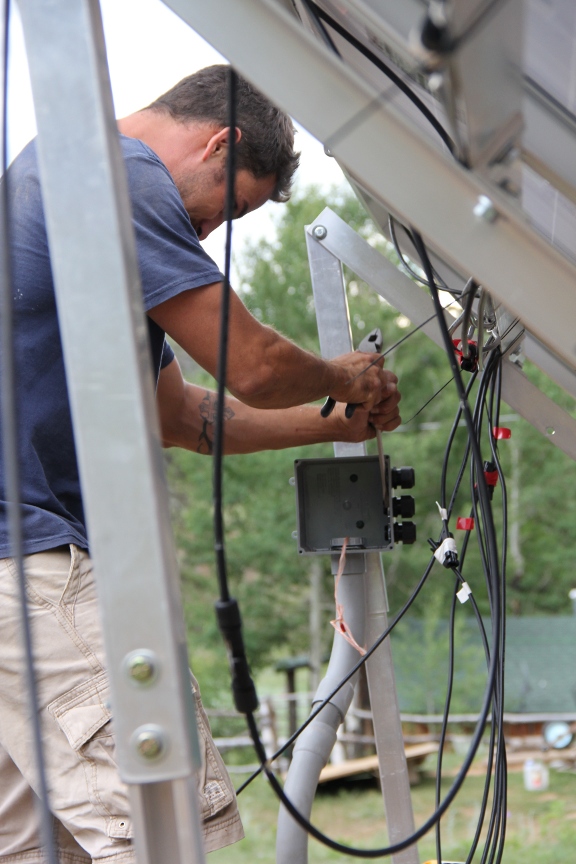
As many projects do unfold, it was more work than anticipated. We set concrete forms to support the PV panel runs, a good 32 or 36 inches below grade to avoid frost-heave. The racks required some modification, but nothing a hack saw and drill could not remedy, and in the end the panels sit side by side, perfectly aligned.

Our four man team was comprised of Trevor (ranch hand), Clint (son of the owner), Chris (renewable energy engineer out of Fort Collins, my co-worker and friend), and me. We worked well together, logging long hours for a few weeks in total.

The deep trench was started with a ditch-witch, but in the end, much of it came down to a pickax and shovel (and Clint’s strong back). The pipe was laid in place and then the heavy, thick cables lubricated and pushed/pulled through, chasing a braided, nylon string which was inserted into each piece pipe, one by one. I forget the exact length, but moving more than one hundred feet of cable is not a simple task. Each bend in the pipe, each joint offered more of a challenge as it neared the end.

Kai Staats - Buffalo Ranch Solar PV Install

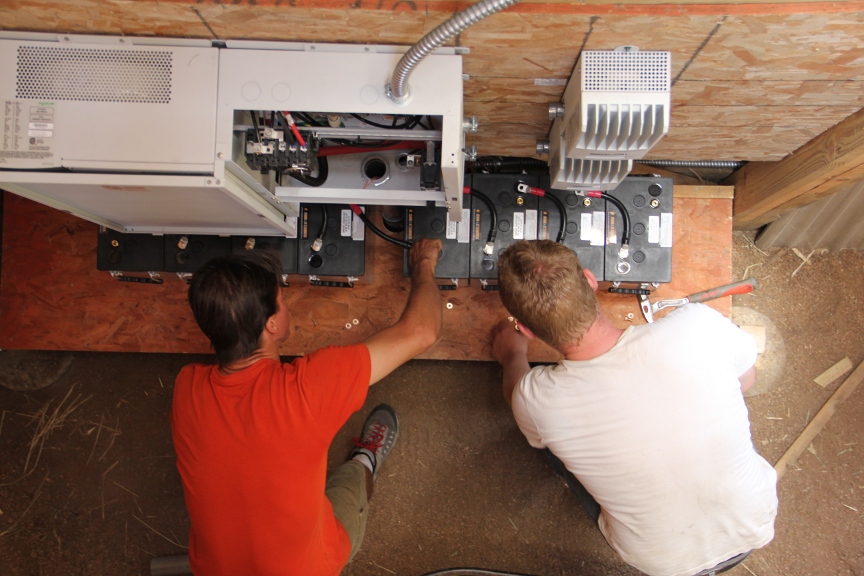
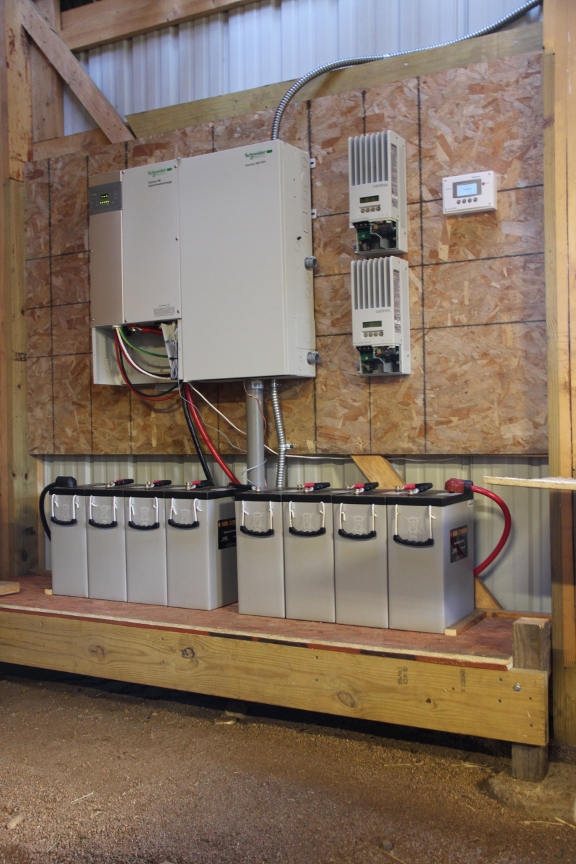
I built a utility wall from which the Xantrex inverter and charge controllers hang. The eight 6V batteries (48V array) rest on a sturdy shelf beneath. Ample power to run the electric oven, fridge, microwave, and heaters in the fall and spring. This was my second Xantrex wiring effort (the first being my house in Loveland) and while familiar, it remained a bit tricky. But in the end, having rewired both electrical panels on the house in order to isolate mission-critical circuits for backup power, it works perfectly.

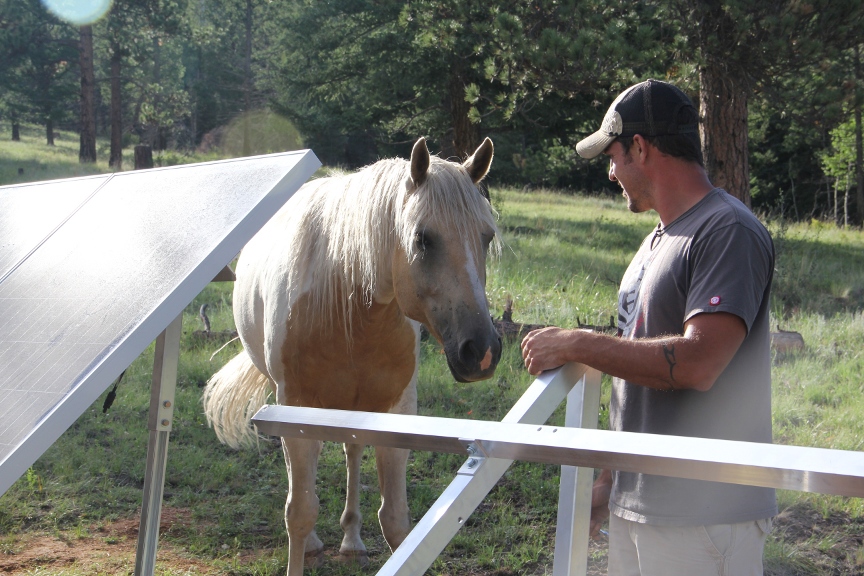
I cannot think of a place in which I’d rather work. At more than 7000 feet elevation, there are elk, coyotes, fox, deer, bear, horses and domestic buffalo. It is a place in which I feel truly calm. It is one of my favorite places in the world.

With 24 220W panels, the system generates a theoretical maximum 5200W. It produces more when in direct, early afternoon sun. But generally, we see between 4-5k with less than 10% total system loss (D/C from the panels to the charge controllers, batteries, inverter). It’s a good, functional solution that will generate more power, over the year, than is consumed meaning eventually, it will pay for itself in addition to its obvious functionality.

Even the hot tub is solar powered. That makes me feel good.

By |2017-04-10T11:17:43-04:00July 31st, 2011|At Home in the Rockies|0 Comments

A Consumer’s Guide: Part 4

Northern Colorado Business Report
“A consumer’s guide to adoption of technology, part 4”
By Kai Staats
30 June 2011

This is the fourth and final entry in a guide to the adoption of technology into one’s personal life. This is not the typical guide that offers a comparison of the speed of wifi networks or the quality of LCD screens. Rather, this is a guide for you, a window into your own consumer behavior when considering the purchase and addition of new technology into your daily life for leisure or for work.

In the previous column we explored questions four, five and six of ten questions concerning the adoption of technology: Does it help me to better understand or improve myself? Does it help me to better understand or to help others? Does it improve my communication with others?

Since beginning this series on “A Consumer’s Guide to Technology” in April, my questioning my own consumer behavior has been further shaped by my travels and encounters which gave me opportunity to be unplugged while further connected through face-to-face conversations and the sharing of stories. During these times I was more at ease as I my mind stopped juggling the potential of a phone call, text message, or email. Instead, I was present with whomever was the focus of my attention.

I am now sitting on the living room floor of my family’s farm in rural Iowa where there is neither cell phone reception nor Internet access. Echoes of five generations of stories told here reverberate throughout the house, perfect timing to address the final four of the ten questions:

7. How did I perform this function prior to owning this device/gadget?
8. Does it improve upon a former means of operation?
9. What is the worst thing that would happen if I do not make this purchase?
10. If I wait three weeks, will I still have a need or desire to make this purchase?

My grandfather, Raymond Kruse, was a farmer, inventor, and environmental activist in this heartland community. He was an avid reader, staying current with trends in scientific research, discoveries, and consumer products. As is the case with many who lived through the Great Depression, my grandfather was conservative with his money, careful to research and purchase only the highest quality products, his intent to maintain each for use as long as possible.

I am fortunate to be the recipient of his legacy, inheriting a means of moving through the world in which material objects are not in and of themselves a goal, rather a gift to our already abundant life not to be taken for granted. Therefore when I ask myself How did I perform this function without this device? I see my grandfather’s face and hear his voice, “Kai-boy, don’t you already have one of those? Seems like the one you got is working just fine.”

Before I could answer, “Yes, but this one is faster, and has more …” I knew he had me beat. As a child, it was challenging to have my desire for instant gratification curbed, but as I grew to recognize his wisdom I learned to ask myself, Does it improve upon a former means of doing so? What is the worst thing that would happen if I don’t purchase it?

As the ultimate litmus test, I ask myself what my parents routinely asked me when I desperately pleaded that they buy the latest LEGO set, “If I wait three weeks, will I still have a need or desire to purchase it?” Often the answer to the last question satisfies the prior three in this series, my appetite for the latest, greatest technical device temporarily, if not permanently quelled.

You may ask, “Why does any of this matter?” While the full answer would likely demand a venture into the deeply ingrained psychology of consumption, I offer in response a well executed short film available on YouTube called “The Story of Electronics” which touches upon much of what I have called to attention, and expands the conversation to include the environmental impact of poor design.

One only needs to read the news to know that technology is rapidly changing the world. But the focus of this series has been on the adoption of technology into one’s personal life, I will summarize this four-part series as I began, with a quote from Langdon Miller, “The Whale and the Reactor,” 1986, “Through technological creation and many other ways as well, we make a world for each other to live in, much more than we have acknowledged in the past, we must admit our responsibility for what we are making.”

Responsibility begins with designers and ends with us, the consumers, a responsibility to the world around us, yes, but also to ourselves. It is my hope that ten questions I have asked will in some way stay with you, adopted and adapted to your benefit.

By |2017-10-21T16:47:20-04:00July 4th, 2011|Humans & Technology, NCBR|0 Comments

A Consumer’s Guide: Part 3

Northern Colorado Business Report
“A consumer’s guide to adoption of technology, part 3”
By Kai Staats
3 June 2011

This is the third in a series in what is unfolding as a guide to the adoption of technology into one’s personal life. This is not the typical guide which compares the speed of wifi networks or the quality of LCD screens. Rather, this is a guide for you, a window to your own consumer behavior when considering new technology.

In the previous column we explored three of ten questions concerning the adoption of technology and how we, as the consumer and owner are affected by our purchase and use decisions: Does it save time? Does it provide a foundation for education, entertainment, or improved safety? How do I feel when I use this product?

Having just returned from three weeks travel and volunteer work in northern Peru, I find the next three questions invigorating:

4. Does it help me to better understand or improve myself?
5. Does it help me to better understand or to help others?
6. Does it improve my communication with others?

Because I am not fluent in Spanish, I sometimes struggled to convey to those with whom I worked more than a basic concept of the projects with which I was engaged: electrical wiring, solar PV array design, and the architectural design of an open air sanctuary and meditation center.

Sarah and I intentionally traveled without electronics save a camera and old cell phone for emergency calls. Where a 3D sketch program or electronic translator could have assisted me, when communicating with the electrician and construction engineer I was reminded of the simplicity and ease of using pen and paper, even a stick for drawing in the sand.

Not long after our return to the States, I found myself in Best Buy, my mind pondering the next three questions concerning technology products:

Does it help me to better understand or improve myself? Very few consumer electronic products satisfy this question, except possibly a digital camera and computer. Through a camera, we can see the world in a new way and express ourselves artistically. Through the use of a computer, we can expand our knowledge.

Does it help me to better understand or help others? [This question has been slightly modified from the original, as published at NCBR.] When used with discretion, televisions and computers both provide a window to a greater world, a means of virtual travel to other places and opportunity to learn about people who are different than ourselves and those around us. In this respect, yes, our understanding of one another may be improved, if that is how we use these devices. To help? It is my experience that computers do play a significant role in organizing and managing projects, in sharing information.

Does it improve my communication with others? Does a mobile phone or laptop allow us to coordinate events, stay in touch, and move through our world with relative ease? Sometimes, yes. But both have a way of causing us to be distracted when we would benefit from being focused.

I often find a state of relief, nearly bliss when I leave my phone at home or in the car for I am free of the potential of an interruption and the people I am with benefit from my full attention. I experienced this several times during our journey, both with Sarah and with those whom we met along the way—educators from Holland, climbers from Colorado, and the staff of a church and clinic in Piura.

We engaged until the embers of the fire were too low to keep us warm, until the tea in our cups ran dry, and until the conversations were simply … done. It is in my experience that only a lack of technology does enable this kind of human interaction, when face-to-face encounters unfold.

The most memorable of our journey in Peru was in a stone cabin located in a high, green valley of the Cordillera Negra. At 14,200 feet elevation nine rock climbers wore multiple layers to find warmth against the sleet outside. The fog pressing against the windows was countered only by the single kerosene lantern and shimmer of the wood burning stove.

Not for one moment did I desire a cell phone, laptop, or television. The conversations carried us into the night for no digital device could fully capture or enhance the aroma of home cooked meals over a gas stove, the mixing of four languages spoken in whispers, and the sharing of that space by people who before that day had never met. We shared what humans have experienced for tens of thousands of years—our stories.

I offer that when next you find yourself reaching for your smart phone to record the moment for Facebook, stop and consider whether you will experience that time more vividly from behind the camera, or by being fully engaged in the moment, you yourself the best recording and playback medium.

By |2017-10-21T16:45:22-04:00June 3rd, 2011|Humans & Technology, NCBR|0 Comments

A Consumer’s Guide: Part 2

Northern Colorado Business Report
“A consumer’s guide to adoption of technology, part 2”
By Kai Staats
6 May 2011

This is the second of a multi-part series in what I hope will unfold as a guide to the adoption of technology into one’s personal life. This is not the typical guide which compares the speed of wifi networks or the quality of LCD screens. Rather, this is a guide for you, the consumer, as a window into your own behavior when considering the technology you wish to adopt.

As mentioned in the prior column, Henry Dreyfuss in “Designing for People” (1955) offered five points by which products could be designed and developed: 1) Utility and Safety, 2) Maintenance, 3) Cost, 4) Sales and Appeal, and 5) Appearance.

What Dreyfuss may not have known is that Appeal would fifty years later gain a momentum so strong that consumers find themselves compelled to replace perfectly functional products every 18-24 months due to the allure of Utility and Appearance. Maintenance becomes irrelevant as nearly all consumer electronics are disposable, designed to be neither repaired nor upgraded.

What concerns me most is not the speed at which we purchase goods, but how we are affected by the use of these products. I have prepared 10 questions to get the gears turning:

  1. Does it save time?
  2. Does it provide a foundation for education, entertainment, or improved safety?
  3. How do I feel when I use this product? (or does it cause me to reduce or increase my stress?)
  4. Does it help me to better understand or improve myself?
  5. Does it help me to better understand or help others to improve themselves?
  6. Does it improve my communication with others?
  7. How did I perform this function without this device?
  8. Does it improve upon a former means of doing so?
  9. What is the worst thing that would happen if I don’t purchase it?
  10. If I wait three weeks, will I still have a need or desire to purchase it?

Despite the fact that all phone models are moving toward smart phone capabilities, let’s look at the upgrade from an older model to a smart phone as an example of how to apply the first three questions.

Does it save time? Hard to say. One could argue that you can do more in less time with so many functions at your fingertips, but as I offered last fall in “The Myth of Free Time,” we tend to just fill that space with doing more things. There are seldom, if ever, inventions which truly save time. In part because they only add complexity to our lives; in part because we just fill that void with doing more. If smart phones actually saved time, people would be using them less, not more.

Education? Entertainment? Safety? Yes. Yes. And maybe. A smart phone can provide a weather update for mountain travel, but you are likely to use it while driving which is both dangerous and increasingly illegal. Again, the potential is there, but the consumer gets in the mix and the value-ad is undermined by human behavior.

Number 3 is complex. This is one that we talk about in the form of complaint, but seem to be helpless to do anything about. Let’s ask the same question applied to other devices, and see how we respond. “How does my car make me feel?” Safe, comfortable, content, even at home, if it is in good condition and runs well. Frustrated, angry, scared, even embarrassed if it is in need of repair and often fails to perform its basic functions.

You may not believe you have a relationship with your microwave oven, but when it warms a cup of coffee or fills the kitchen with the aroma of a hot bowl of soup, chances are you have a smile on your face when the oven door opens wide. But if the buttons on your oven are temperamental, or the insides nasty due to lack of cleaning, then perhaps you cringe at the very thought of the noontime meal.

Concerning your mobile phone: Does it feel good in your hand, or is it awkward to hold? Do you find it to be intuitive and seemingly designed just for you? Or do you get lost in the interface, often wondering why your friend’s number is missing, again!? Does it always work, no matter where you go? Or does it lock-up, hang-up, and get beat-up (as you slam it against the wall)? Do you carry it with pride? Or does your body tense every time it rings because you have not, after six months, determined how to change the ring tone?

Let’s return to How does the upgrade to a smart phone benefit you? Will you immediately use text messaging, email, news feeds, calendar, camera, and video conferencing? Or will you determine that simply because these functions are available, you may choose not to use them? Most important, do you feel compelled to check email just one more time, because it is right there, in the palm of your hand? Do you often interrupt face-to-face conversations to answer a quick email? Or are you comforted and relaxed knowing that your entire digital world is within reach, at all times?

I recommend paying more attention to how you feel, in the moment, when using your phone than whether or not it has a larger memory capacity or higher resolution camera. Remember, Responsibility begins with designers and ends with consumers. Be responsible to you.

By |2017-10-21T16:40:33-04:00May 11th, 2011|Humans & Technology, NCBR|0 Comments

Three Breaths

One breath and the mind begins to clear.

Two breaths and the heart releases fear.

Three breaths and my arms pull you near.

Hand on my chest, the comfort of your breast,
breathe with me, and hold me forever.

By |2011-04-17T15:56:30-04:00April 17th, 2011|The Written|0 Comments

A Consumer’s Guide to Adoption of Technology

Northern Colorado Business Report
“A consumer’s guide to adoption of technology”
By Kai Staats
8 April 2011

As I walked out of the Miramont North gym this afternoon, I felt the warmth of the sun against the cool, crisp spring air. As I approached my car, however, the roar of gasoline powered hedge trimmers and leaf blowers filled the air. The foul stench of poorly combusted two-stroke engine pollution was unavoidable.

I was overwhelmed by the contrast, having just left the relative calm of yoga class and rock climbing to witness the rapid, noxious reduction of the budding greenery. It just didn’t feel right, that the tools and methods used in an attempt to create beauty were themselves not beautiful.

When I arrived home and prepared to write this column, I struggled between two topics: the sorry state of downloaded digital movies versus hi-definition home theater appliances, or a larger, more engaging, even risky introduction to the concept of appropriate application of technology and how it affects our functional intelligence as individuals and as a species.

The former would have been too simple to compose, easily summarized as The quality of Netflix sucks. Better to rent Blu-ray Disc.

The latter, however, is a return to my Sr. year Industrial Design thesis “Confused Vanity and the Mad Dog TV” written eighteen years ago. The three chapters “Down the Tube,” “Forced Obsolescence,” and “The Power Blower Wars” take the reader into a mindset beyond form follows function, calling upon my experience as a design student and consumer, and that of several profound, world-renowned designers and technology writers.
In review of my thesis (which was great fun to read again) I was pleased to rediscover a completely relevant five-point formula for product design written by Henry Dreyfuss in “Designing for People” (1955):

  1. Utility and Safety
  2. Maintenance
  3. Cost
  4. Sales and Appeal
  5. Appearance

In the same vein, Buckminster Fuller concluded, “You have to make up your mind either to make sense or to make money, if you want to be a designer.” (Operation Manual for Spaceship Earth, 1969) How many products on the market today follow this type of formula? Of equal importance, how many of us as consumers challenge the true value of a new product before we make our purchase?

I will for the next several columns engage you in a conversation around appropriate technology, consumer products comprised of software or hardware, and how they affect us as consumers. In particular, I will explore the categories of entertainment, communication, and transportation, leaving medical, military, and safety to another time and space.

For as much as I am an advocate of advances in technology when and where they assist us in finding greater personal health and satisfaction, understanding the world around us, and moving ourselves and our things from place to place, I am increasingly wary of technology which diminishes our individual creativity, self-awareness, ability to make decisions for ourselves, and functional, real-world intelligence.

I am concerned that Google’s Gmail search keeps us from invoking the cognitive function of organizing and managing the emails we create and receive, instead encouraging a mental clutter which spills over into our virtual and physical life. I believe GPS units keep us from visualizing our world in three dimensions, causing us instead to become reliant on technology and less capable of conducting the very basic act of navigating from point A to B. I am concerned that new model cars which automatically conduct parallel parking on our behalf are in fact reducing our motor skills and ability to problem solve in real-time. If we cannot organize, navigate, nor move through our world without assistance from computers, then what exactly are we able to do on our own?
I ask, “How many of our modern technology-based products are denying us the very functions our brain offers instead of encouraging dynamic improvement of our intelligence?”

While researchers discovered a half dozen years ago that the human brain does in fact grow new cells throughout our lives, SPECT imaging conducted by Dr. Daniel Amen (Change Your Brain, Change Your Life, 1999) has demonstrated time and again that exercising the brain improves cognitive abilities, even slowing or reversing the onset of mental disorders and disease, does it not stand to reason that not using our brain also reduces our cognitive capacity?

Calling upon the research I conducted at Arizona State, I find it refreshing to read again Langdon Miller’s words, “Through technological creation and many other ways as well, we make a world for each other to live in, much more than we have acknowledged in the past, we must admit our responsibility for what we are making.” (The Whale and the Reactor, 1986)

Responsibility begins with designers and ends with consumers.

In the coming months I will guide you, the intelligent consumer, through a thought process that may alter the way you look at the multitude of products you consider for purchase, even those which you already own.

By |2021-03-29T15:30:06-04:00April 9th, 2011|Humans & Technology, NCBR|0 Comments
Go to Top